
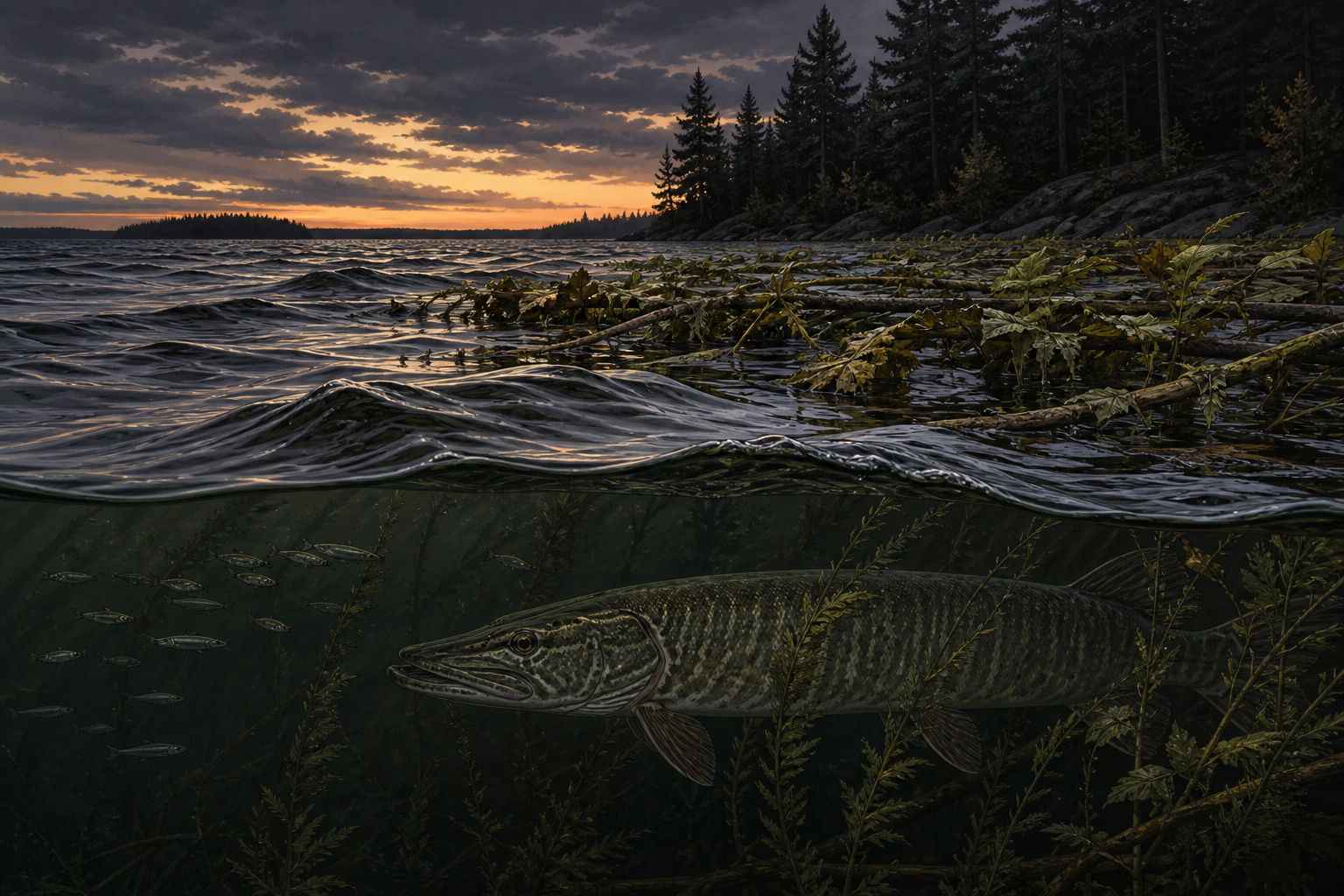
A windy shoreline is more than a direction
A northwest wind does not make every southeast shoreline good. What matters is what that wind meets when it arrives. A broad, featureless sand flat may receive plenty of wave action and still offer very little to hold a musky. A cabbage edge, rocky point, saddle, or sharp break on that same shoreline gives moving water something useful to work against.
That is the central idea: wind can make an already-good piece of habitat more active. It may push warm surface water, plankton, and small forage toward one side of the lake, but a musky still needs a place to travel, pause, and ambush. The best starting spot is where wind exposure overlaps a clear structural transition.
What to look for before making the first cast
On Big Fork Lake, begin by looking at the southeast-facing side of a point, inside turn, or weedline. Do not stop at the first patch of green vegetation you see. Idle far enough away to understand where the healthy weeds end, where the bottom begins to fall, and whether perch, suckers, or panfish are actually using the area.
The most valuable detail is often an irregularity: a notch in the weeds, one tongue of rock reaching farther than the rest, or a short section where the edge drops faster. Those places give a following fish a reason to change direction. They also give you a repeatable target instead of asking you to fan-cast an entire windy shoreline.
How to fish the loaded edge
Hold the boat outside the break and cast across the transition at an angle. The lure should travel from cover into open water, not simply run parallel over one depth from start to finish. A bucktail is useful when you need to cover the edge and learn where fish or forage are positioned. A glide bait becomes more useful once you find a precise turn, pocket, or rock contact that deserves slower attention.
Let the wind help the lure without surrendering boat control to it. Make short, controlled passes, then reset. Keep the bait clean through the highest-percentage section and accelerate slightly as it clears the cover. At the boat, finish with a wide turn. Muskies often use the final direction change as one more chance to commit.
Give the spot a fair test—not the entire evening
Fish the best part of the edge from two useful angles. If the wind is strong enough to make control sloppy, move slightly deeper and cast shorter. If the water is clear, lengthen the cast and keep the boat farther off the break. In stained water, a tighter line and a bait with more vibration can help you maintain contact with the structure.
A follow, a baitfish school, or one clean mark near the edge is a reason to refine the pass. Empty water is a reason to move. The goal is not to prove that the windy side must be right; it is to quickly learn whether wind, structure, and forage have actually come together there.
When the windward idea stops making sense
Leave the edge when the evidence points somewhere else. If forage is consistently suspended over the basin, if the weeds are dying, if the wind has only just begun, or if the boat cannot be handled safely, the loaded shoreline loses value. A rapid temperature change or poor oxygen below the thermocline can also compress the useful depth band.
The practical takeaway is simple: use the wind to choose where to look first, then let the lake tell you whether to stay. Wind is a multiplier, not a guarantee. The angler who notices the first contradiction usually gets to the next productive pattern sooner.