
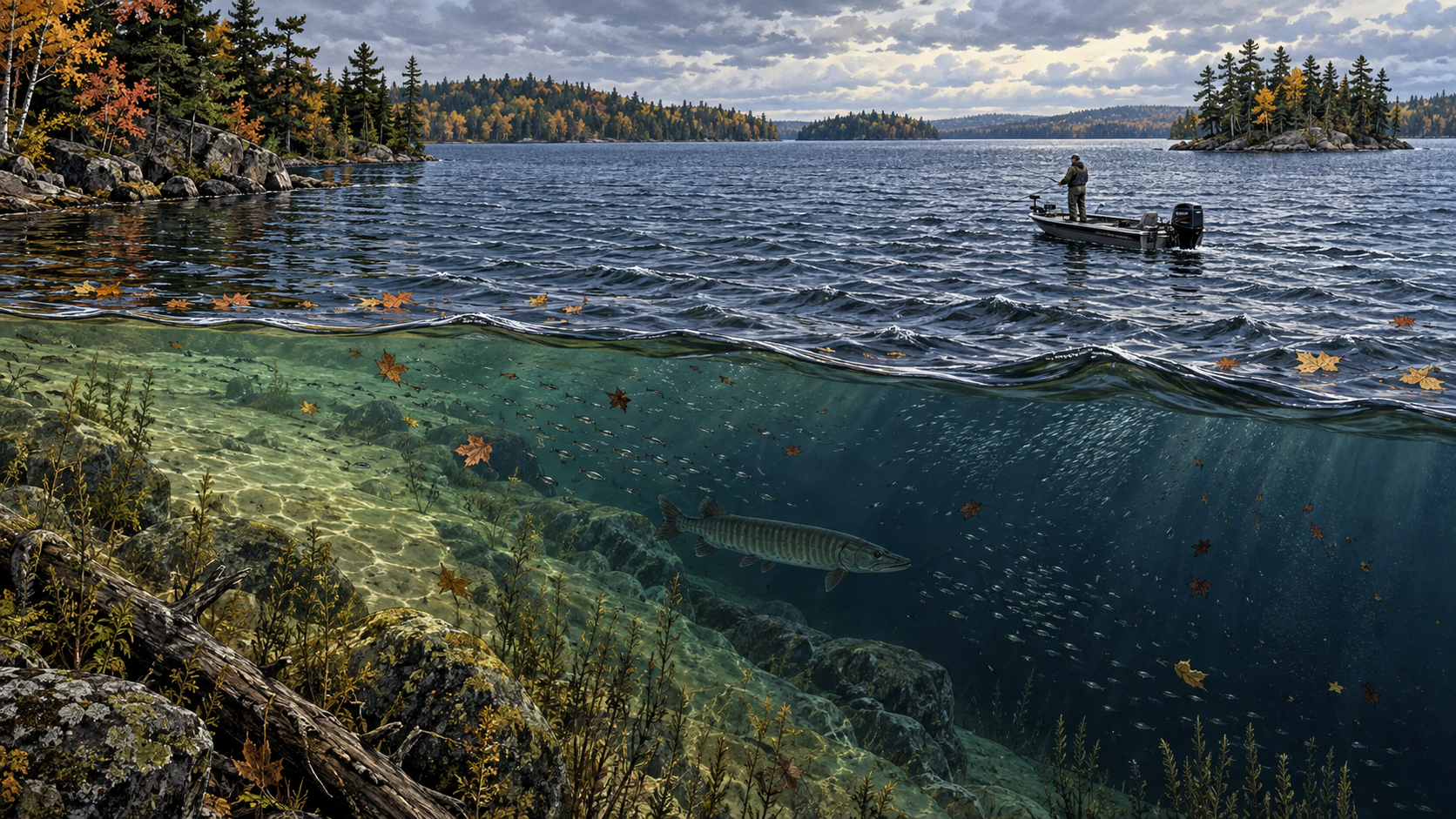
Turnover is not a date on the calendar
Fall turnover is often discussed as if a lake flips from summer to autumn overnight. The physical process is slower and less tidy. A lake that held warm water over a colder bottom layer begins losing heat at the surface. Cooling water becomes denser and sinks, which pushes the actively mixed layer deeper.
Wind keeps adding mechanical energy. As the temperature difference between upper and lower water shrinks, the thermocline weakens. A lake reaches whole-water-column turnover when temperatures become nearly uniform and wind can circulate the full depth.
That sequence has no universal start date, duration, or magic temperature. Depth, size, shape, shelter from wind, and recent weather all affect how an individual lake mixes.
What actually changes
Summer stratification separates more than temperatures. A stable thermocline can limit the exchange of oxygen between surface and deep water. When fall cooling and wind erode that barrier, deeper water can be replenished with oxygen and material from different depths can be redistributed.
The United States Geological Survey notes that water temperature affects biological activity and water chemistry, and that cooler water can hold more dissolved oxygen than warmer water. Those are broad physical relationships. They do not specify where a musky will sit on a particular lake during a particular hour.
The useful fishing implication is that the range of physically usable water may change. That is not the same as saying every depth becomes equally valuable.
Every lake runs a different clock
Shallow lakes may mix repeatedly because wind can influence much of the water column. Deeper protected lakes can hold distinct layers longer. Some lakes mix completely in spring and fall, while others resist complete mixing because of basin shape, dissolved substances, or persistent chemical density differences.
A 2024 study of four dilute lakes in Minnesota's Itasca region illustrates the point. Three were prone to mixing during isothermal spring and fall periods, while Deming Lake did not fully mix during the observations. The disappearance of a strong temperature difference was not, by itself, proof of complete circulation in every basin.
That evidence makes the phrase the lake turned over too vague for a useful record. Name the lake, the basin, the profile, the date, and the evidence used.
Do not confuse mixing with random fish
When a thermocline weakens, anglers often respond by abandoning every earlier depth pattern. That may widen the search, but it can also erase useful evidence. Weed condition, rock transitions, current, forage, light, and recent contacts still give the fish reasons to use one part of the lake rather than another.
A better model is expanding access, not instant chaos. Water that was previously separated by temperature or oxygen may become more usable, but the food web and physical habitat do not become uniform at the same moment.
Keep one productive reference area in the plan. Then add a deeper or more exposed comparison area. If the new water produces forage and contacts while the reference fades, the expanded search has earned its place.
Measure the column, not just the surface
A surface-temperature reading can document the water touching the transducer. It cannot prove that the same temperature extends to the bottom. To test for a changing profile, collect comparable readings at several depths in the same basin and repeat the transect over time.
A calibrated temperature probe provides direct measurements. Sonar may show a thermocline or forage depth, but an absent line on a display is not proof of complete mixing. Dissolved oxygen should be recorded only when a suitable, calibrated meter is available. Otherwise mark it unknown.
Use the same locations, approximate times, and depth intervals on repeat visits. Consistency turns a handful of readings into a trend instead of a collection of anecdotes.
Muskellunge still make individual choices
A year-long telemetry study in Shabbona Lake, Illinois, followed 36 muskellunge, including 17 with temperature-sensing tags. Fish moved substantial distances, used thermal refuge, and showed strong individual variation. Larger fish tended to occupy cooler water than smaller fish as surface temperature changed.
The study came from one small impoundment and was not designed as a fall-turnover experiment. Its value here is caution. A lake-wide temperature trend does not force every musky into the same response, and body size can be associated with different thermal choices.
Treat temperature as one layer of the location problem. Forage, habitat, fish history, and individual behavior remain live alternatives.
Run the profile-collapse test
Choose one deep basin and two repeatable fishing zones: a familiar structural area and a deeper or more exposed comparison area. On each trip, record surface, middle, and near-bottom temperature at a fixed station, using the same method. Add wind direction and speed class, recent air-temperature trend, water clarity, forage depth, vegetation condition, lure depth, effort, and every contact depth.
Fish both zones with the same presentation class and comparable effort. Rotate which zone is fished first so the test does not automatically reward the first light window or the least-disturbed pass. Record blank effort as carefully as follows and strikes.
The theory gains support if shrinking temperature differences repeatedly coincide with a wider range of forage and musky contact depths. It loses support if contact depth remains stable, if forage location predicts the fish more cleanly, or if the apparent pattern disappears when effort and pass order are controlled.
A better blank-day diagnosis
A blank day during fall mixing can have many explanations. Fish may be present but unwilling to strike. Forage may have shifted. Wind may have changed the productive side of the lake. A presentation may be running above or below the active depth. The lake may be partly mixed, fully mixed, or not mixing in the assumed way.
None of the sources used here establishes a universal turnover bite shutdown or a universal post-turnover location. The muskellunge telemetry work documents thermal behavior and variation, not a guaranteed autumn pattern. The lake studies describe physical mixing, not catch rates.
Use turnover as a measurable process, not a verdict. Profile the water, keep habitat and forage in the picture, and make the lake earn every change in your search.