
The lure box is lit for the angler
A lure color earns its name in air. Black is black under the cabin light. White is white under the tackle-shop fluorescents. Firetiger remains firetiger in a photograph. The label feels permanent because the angler keeps seeing the object against the same easy background.
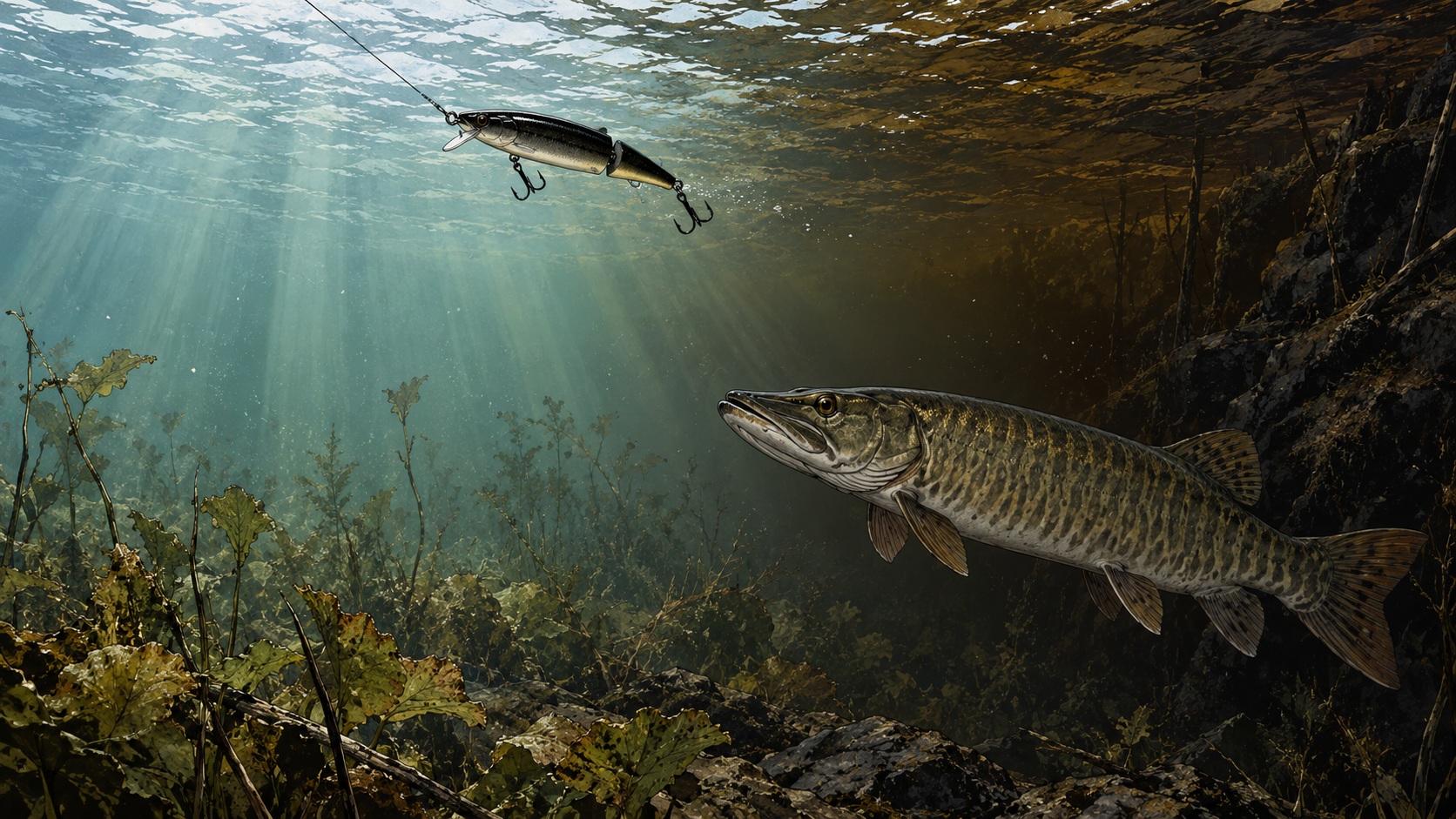
The cast takes that certainty away. A musky may see the lure from below against a bright surface, sideways against cabbage, down a dark rock face, or through brown water that scatters and absorbs the available light. Distance, depth, cloud cover, waves, suspended material, and viewing angle all change the signal before the fish decides what it is.
That makes the useful color question relational: not which paint is best, but which version of this lure separates from the background along the route where a fish is likely to see it.
A musky has to find the target first
A 2001 controlled feeding study videotaped subadult muskellunge, 15 to 25 centimeters long, as they hunted live fathead minnows. Researchers compared intact fish with animals whose visual or lateral-line input had been reduced. The feeding sequence separated into a slow stalk and an explosive lunge.
Vision was central to the first acquisition of prey. Both vision and the lateral line helped determine the rapid strike, and the lateral line appeared especially important near final capture. Blinded muskies did not perform the normal stalk but could still lunge at prey that came close enough.
The experiment does not rank lure colors. It used small hatchery fish, live minnows, and a test arena. It does establish a practical sequence: the visible target matters early, while motion and water displacement continue to matter as distance closes. A perfectly conspicuous lure can still travel through the wrong lane, and an effective pressure signal can still go unnoticed if the fish never acquires the target.
Water rewrites the signal
Turbidity does more than make water generically dirty. Suspended material scatters and absorbs light, lowers the amount available for vision, changes the spectrum that reaches an object, and blurs its boundary. Different sources of turbidity can change the visual scene in different ways. Algal material can shift available light toward green wavelengths, while mineral sediment produces effects that depend on its composition.
Contrast therefore belongs to the whole scene. A dark lure viewed upward can form a hard silhouette against the surface even when its painted details disappear. The same lure moving laterally along a dark weed wall may merge with its background. A light side or a flashing blade may separate during one part of the retrieve and vanish during another.
This is not a claim that muskies perform human color comparisons underwater. Brightness contrast, color contrast, edge, motion, size, and background arrive together. The angler can control the lure, but the water controls much of the image.
A pike eye supplies a useful warning, not a musky formula
Researchers comparing fish from a clear greenish lake and a dark brown lake in Finland found that northern pike possessed middle-wavelength-sensitive and long-wavelength-sensitive cone pigments. Their autumn rod absorption spectra peaked near 533 nanometers. Pike from the dark brown lake had eyes configured for greater sensitivity at the expense of acuity, while the study found no within-species difference in the pike photoreceptor complement or pigment spectra between the two lakes.
Northern pike are close esocid relatives, not muskellunge. The result cannot identify a best musky color, and it does not show that wild adult muskies see exactly as those pike did. Its value is more disciplined: a predator's visual performance is a tradeoff shaped by both the eye and the light environment. A paint chart viewed by a human on deck is not a fish-eye model.
One real fishery changed color winners with water
On Lake Erie, researchers worked with 19 charter captains and anglers during the 2017 and 2018 seasons. Participants submitted catch information plus standardized photographs of the fish, lure, and water. Of 176 submissions, 66 met every analysis criterion.
Successful lures contained more white in clear, low-turbidity water, more yellow in sedimentary turbidity, and more black in algal turbidity. The authors interpreted the pattern as evidence that both brightness and color contrast may matter in different visual environments.
The boundary is as important as the result. These were walleyes, not muskies. The data described landed fish but could not calculate catch per unit effort for each color because unsuccessful lure time was not recorded. Lures carried multiple colors, and depth, shape, texture, scent, angler choice, and location could travel with the apparent color effect. The study proves no universal palette. It shows that a color result can depend on the kind of water surrounding it.
Build a contrast ladder, not a rainbow
A clean field test begins with three lures that do the same job. Match family, length, running depth, buoyancy, hardware, and controllable retrieve speed as closely as the tackle box allows. Let one be light-dominant, one dark-dominant, and one broken by a strong light-dark boundary or flash. This is a contrast ladder, not a ranking of favorite paint names.
Define the viewing lane before the first cast. A shallow lure crossing open water may be seen mostly from below. A bait parallel to cabbage may spend more of the retrieve against vegetation. A deep lure climbing over a break can alternate between bottom, open water, and surface backgrounds. The likely background is a hypothesis, not a fact, so record the cast angle and route.
Fish the same route with matched passes and rotate the order among outings. Keep depth and speed steady enough that color is the main intended change. Record follows, direction changes, accelerations, strikes, catches, blank effort, and the exact lure. A low-contact fishery needs every credible response because catches alone may leave the experiment empty for too long.
Make the favorite lose honestly
The contrast-ladder theory gains confidence if one contrast class repeatedly produces earlier acquisition, longer follows, or more strikes on comparable routes and if the result returns under similar light and water conditions. It becomes more useful when the winning class changes predictably with viewing background rather than staying attached to one permanent color.
It loses confidence if the effect disappears when pass order is rotated, if different anglers cannot hold the same speed and depth, or if running depth, profile, vibration, and boat path explain the contacts better. It also weakens if the supposedly high-contrast lure is not measured or photographed in the actual water and is only assumed to stand out.
Water clarity can change across one lake, light can move during a single pass, and a musky can refuse for reasons no camera or notebook can see. The purpose is not to turn color into a new law. It is to stop calling a paint job successful before asking what background made it visible.
The color belongs to the whole cast
Keep confidence in the lure that you control well. Familiarity improves placement, cadence, and boatside finish, and those advantages can outweigh a theoretical color edge. But separate confidence from explanation. If a dark bait works, note whether it was a silhouette. If white works, record the water color, depth, sky, and background. If nothing responds, keep the blank passes with the successful ones.
A lure never enters the lake as a paint chip. It enters as a moving object inside a changing field of light. The angler chooses the color. The water chooses what that color becomes.