
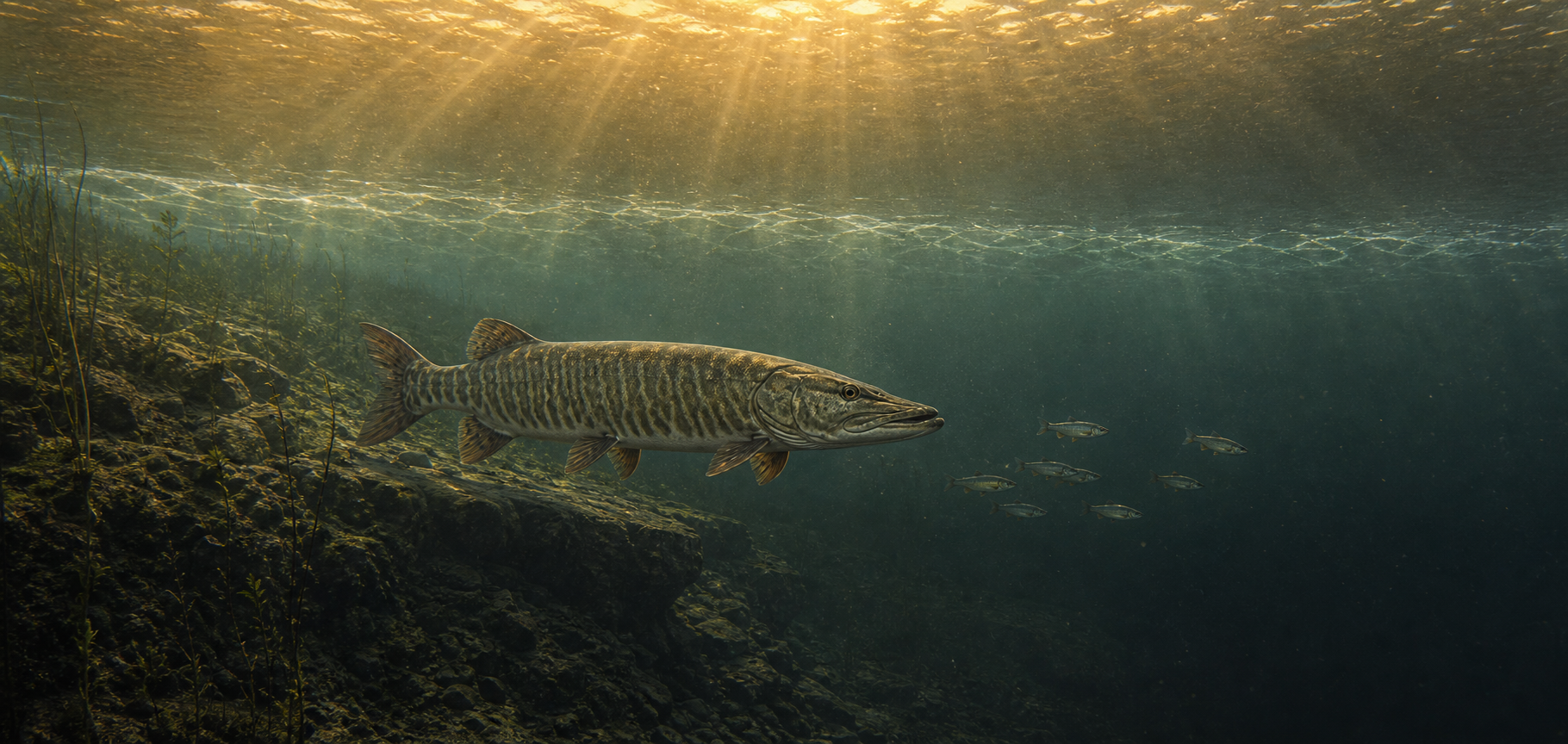
Deep water is not automatically usable water
A lake map may show forty feet beneath the boat, but that does not mean a musky can comfortably use all forty feet in midsummer. As the lake stratifies, warm water stays above colder deep water and a thermocline forms between them. In some lakes, oxygen below that boundary becomes limited as summer continues.
Muskies, their prey, and the habitat they use must overlap in a layer with suitable temperature and oxygen. A beautiful deep point below that layer can look perfect on a contour map and still be poor fishing water. The useful question is not “How deep is the lake?” It is “How much of that depth is alive and available today?”
Find the lower edge of the living zone
Electronics can often show a thermocline as a faint, consistent band, especially after sensitivity is adjusted. A temperature-and-oxygen profile is better when one is available, but anglers can also learn from repeated fish and forage marks. If nearly every mark ends at the same depth, that boundary deserves attention.
Treat that depth as a ceiling over the deeper water, not a target to fish beneath. If usable water ends around eighteen feet, a lure running at twenty-four feet is not “getting down to the fish.” It may be spending most of the retrieve below the layer both predator and prey are using.
Look for structure that intersects the band
Once the usable depth is clear, look horizontally. A point that tops out above the thermocline, a weed edge ending near it, or a suspended forage school riding just above it can concentrate activity. On Spirit Lake, clear-water points and basin edges become more interesting when they pass through the same band where forage is consistently visible.
Keep the boat outside the feature and cast so the lure spends most of its time just above the lower boundary. Predators can rise to a lure they can see. Running the bait slightly high is usually more forgiving than dropping it into oxygen-poor water beneath the fish.
How to fish the squeeze
Use a bait whose running depth you understand. Weighted rubber and controlled crankbaits are useful when the band is deep; a bucktail may be better when fish are holding higher. Count the lure down consistently, note when it contacts weeds or disappears beneath visible forage, and adjust weight or rod angle one step at a time.
Make several passes at different angles, but keep the vertical lane consistent. If a fish follows, note the lure depth before changing color or size. The first useful adjustment is often a few feet higher or lower, not an entirely different presentation.
Turnover changes the whole picture
As surface water cools and the lake mixes, the clean summer layers break down. The old thermocline may weaken or disappear, oxygen can redistribute, and forage may scatter. A productive August depth rule can become irrelevant surprisingly quickly.
When marks appear throughout the water column and temperatures become more uniform, widen the search instead of clinging to the former boundary. Return to structure, current, wind, and visible forage as the main clues. In warm conditions, handle every musky efficiently, minimize time out of the water, and follow local guidance; a good pattern is never worth compromising the fish.
The practical takeaway
Before choosing a lure or shoreline, identify the slice of water the fish can realistically use. Then find where food and structure cross that slice. This turns a vague summer question—“Should I fish deep?”—into a much more useful one: “Where does the living water meet something a musky can hunt?”