
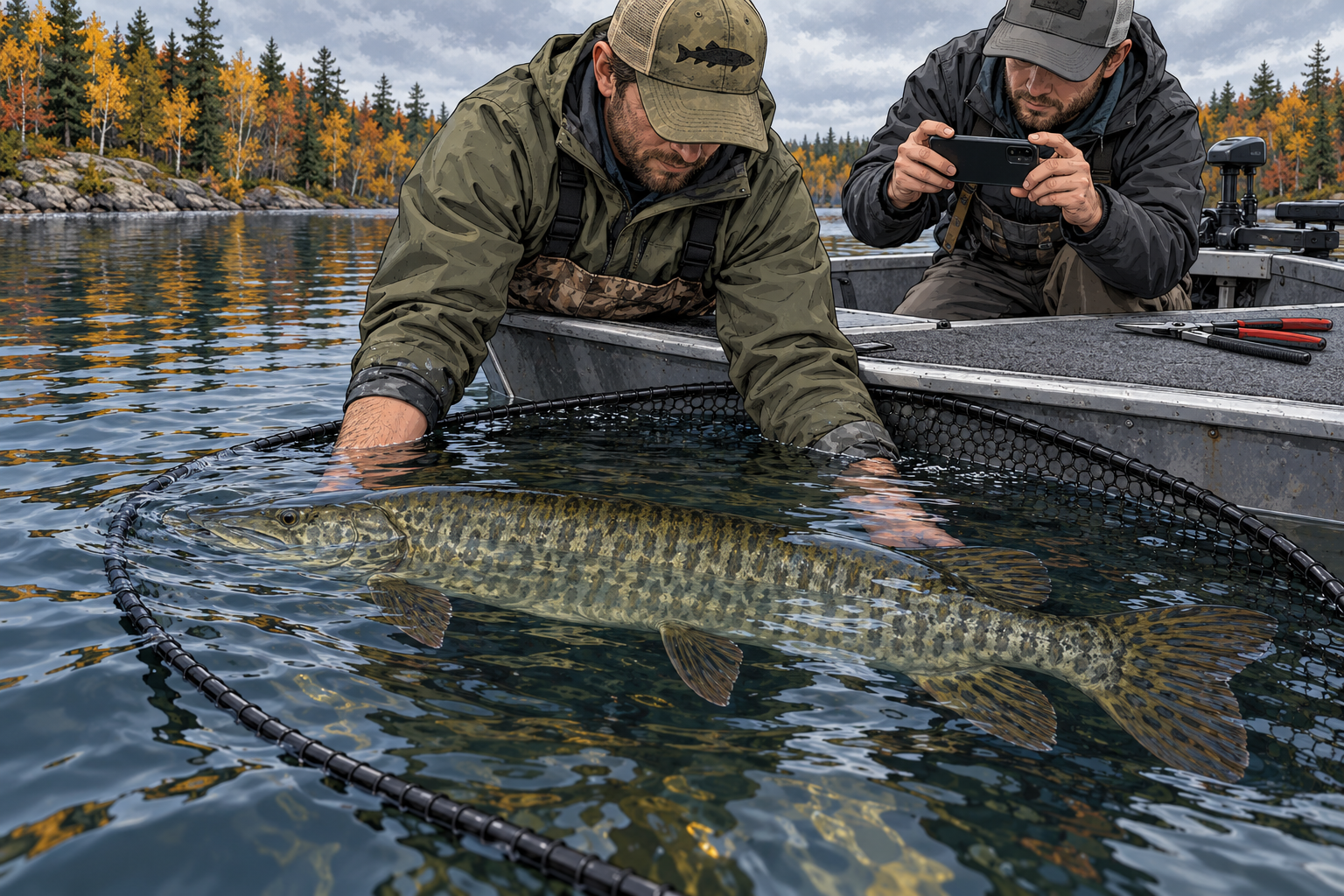
A record fish creates an identification question
Wisconsin's live-release record table now lists a 49.25-inch tiger muskellunge from Yellow Lake in Burnett County, caught September 5, 2026. It is an exceptional fish and a useful reminder that the word tiger carries a biological claim. The name does not mean a musky with especially bold bars. It means a hybrid of northern pike and muskellunge.
The public record page gives the species, measured length, catch date, water, and county. It does not publish the identification photographs or the traits used to verify the fish. That is not a defect in the record. It is the boundary of what the public table documents, and it keeps this article from pretending to re-identify a fish it has not examined.
The broader lesson begins there. A striking pattern can start an identification. It should not finish one.
Pattern is the fastest clue and the weakest verdict
A northern pike usually presents light horizontal spots on a darker body. A pure muskellunge may be spotted, barred, or nearly unmarked, with dark marks on a lighter background. A tiger musky commonly carries dark irregular bars or spots that look intermediate and can be visually dramatic.
Those descriptions are useful because pattern is visible before the net is wet. They are not foolproof. Pure muskellunge patterns vary, young fish can look different from adults, lighting can reverse apparent contrast, water can mute markings, and photographs can exaggerate or erase bars. A damaged fin can also make another feature harder to read.
Identification gets stronger when several traits that fail in different ways point to the same answer. That is why official keys move beyond color.
Read the tail, jaw, and cheek together
Wisconsin DNR's identification sheet gives the tiger musky five to seven sensory pores on each side of the underside of the lower jaw, rounded tail lobes, and scales on the upper half of the cheek. It lists pure muskellunge with six to nine pores, pointed tail lobes, and upper-half cheek scaling. Northern pike carry five or fewer pores, rounded tail lobes, and scales across the entire cheek.
No single one of those characters should be asked to do all the work. The tiger's pore range overlaps both parents. Its upper-half cheek scaling resembles a musky, while its rounded tail resembles a pike. That intermediate combination is exactly why a multi-feature key is more useful than a stripe count.
Iowa DNR offers a similar field sequence: pattern first, then jaw pores, tail shape, and cheek scaling. It also warns that tail damage can obscure the outline. The best identification is a convergence, not a magic mark.
Do not turn identification into another handling event
A good record does not require a long inspection. Before fishing, decide who controls the fish and who makes the photographs. If a quick image is already appropriate, capture one clear side view that includes the entire tail. A second frame of the lower jaw and cheek can help only if it is safe, immediate, and does not add a new lift or force the fish into an awkward position.
Store the waterbody, date, measured length, measurement method, and both sides of the jaw-pore count if they were actually visible. Record tail damage instead of guessing the original shape. Mark cheek scaling unknown if glare, water, or image angle hides it. A missing field is better than a confident invention.
If legal status, a record claim, or a management report depends on the answer, send the original images to the responsible fisheries agency. Social-media agreement is not agency verification, and a compressed photograph may not preserve the features a biologist needs.
The word sterile needs a footnote
Official summaries do not all describe tiger-musky fertility the same way. Minnesota DNR calls the tiger musky a sterile hybrid. The U.S. Geological Survey's nonindigenous species profile says males are sterile while females are often fertile and capable of backcrossing, citing older fisheries literature. Ontario's freshwater fish database gives the same sex-specific qualification.
That conflict should not be hidden behind a smoother sentence. It may reflect different hatchery crosses, management shorthand, older source material, or the difficulty of describing rare reproductive exceptions in a public field guide. None of these pages establishes the reproductive capacity of a fish in an angler's net.
The cautious field record is therefore simple: hybrid identity does not prove origin, sex, fertility, or successful natural reproduction. Those fields remain unknown unless stocking records, reproductive evidence, or genetic analysis supports them.
A hybrid can arrive by more than one route
Tiger muskellunge have been produced intentionally in hatcheries, but natural hybridization is also documented where northern pike and muskellunge occur together. The U.S. Geological Survey describes both routes. A tiger caught in a particular lake is not automatically proof of a current stocking program, and one hybrid is not proof that a self-sustaining hybrid population exists.
Location is still valuable evidence. An agency stocking database, survey report, or verified species list can make one interpretation more plausible. But the fish's range cannot replace its anatomy, and anatomy alone cannot reconstruct its family history.
This distinction matters when records are reused. A photograph labeled tiger musky can enter catch reports, distribution maps, stocking discussions, or record books. Preserving the identification method keeps one uncertain label from becoming several false facts.
Test the four-feature audit
The four-feature audit records flank pattern, tail shape, jaw pores on both sides, and cheek-scale coverage. Give every field an observed, obscured, damaged, or not-recorded state. Add waterbody, date, length method, original-image availability, and whether a qualified biologist confirmed the identification.
The theory gains support if expert review or genetic results agree more often with complete four-feature records than with color-only labels. It loses support if the extra traits do not improve accuracy, if field photographs cannot capture them reliably, or if the process lengthens handling and harms fish care.
A practical test needs the misses. Keep cases that experts reject, cases left unknown, and photographs too poor to score. A method that records only its clean successes will make itself look better than it is.
Let the evidence earn the name
The memorable fish is the easiest one to label too quickly. Bold bars invite the word tiger, and the word feels complete. A stronger record slows the conclusion without slowing the release.
Use the pattern as an invitation. Use the tail, pores, cheek, location, and photographs as evidence. Use a biologist when the consequence matters. If the features do not agree, leave the name open. The stripes are part of the fish. They are not the whole identification.