
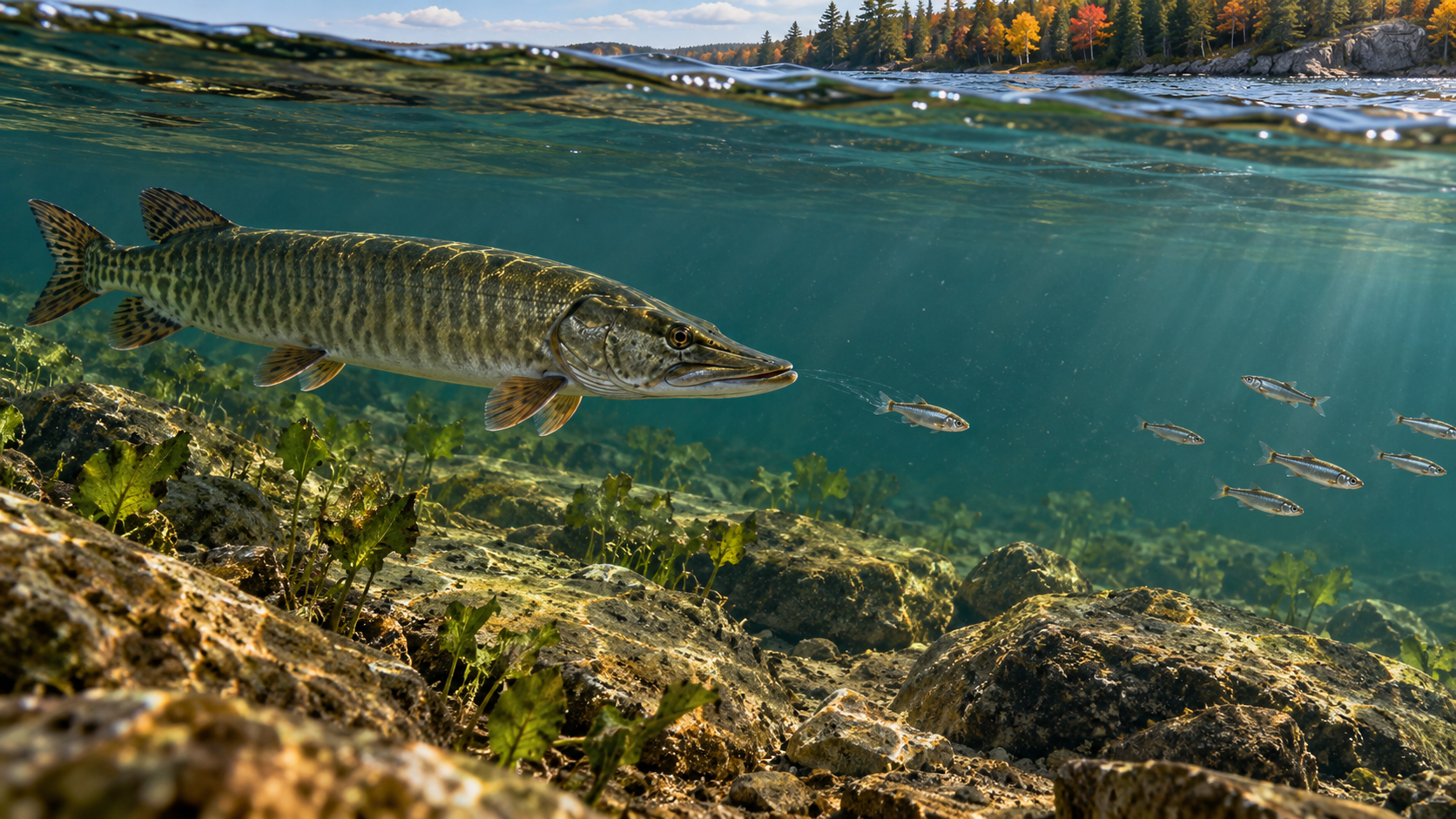
A strike is not one decision
A musky that appears behind a lure has already completed several jobs. It detected something worth attending to, oriented its body, closed distance, and decided whether to launch. Anglers often compress that sequence into one word, follow, then explain the result with one cause: color, vibration, speed, mood, pressure, or luck.
Controlled feeding work shows why that explanation is usually too small. Researchers filmed subadult muskellunge taking live fathead minnows and divided the attack into two visible phases. The fish first made a slow, directed stalk with limited body movement. It then released an explosive C- or S-shaped lunge at the prey.
That division matters because the fish did not use its senses equally from beginning to end. The evidence supports a changing hierarchy, with one sensory stream doing more work during initial acquisition and another becoming increasingly useful as the final gap closed.
Vision starts the conversation
The muskellunge experiment compared intact fish with animals whose lateral-line input had been suppressed, fish that had been blinded, and fish with one-sided sensory loss. The intact group produced 166 recorded strikes. Their mean first orientation to the minnow occurred at 25.5 centimeters, and their mean strike initiation occurred at 13.5 centimeters.
Suppressing the lateral line did not remove the initial stalk. Those fish first oriented at a mean distance of 22.8 centimeters, a result the researchers reported as not significantly different from the intact group. Blinded fish behaved differently. They did not show the usual orientation and stalk. They remained relatively still until a minnow came close, then lunged from a mean distance of 3.2 centimeters.
Those numbers belong to a laboratory arena, natural daylight, subadult fish, and prey averaging about 5 centimeters long. They are not casting distances, lure-detection limits, or a universal formula for clear and stained lakes. What transfers is the sequence: in this experiment, sight organized the first detection and approach.
The lateral line helps solve the last gap
The lateral line is a mechanosensory system distributed along the head and body. It detects local water motion and pressure gradients. That makes it different from vision, not a replacement version of vision.
When lateral-line input was suppressed, muskellunge closed to smaller distances and angles before launching than intact fish did. The authors concluded that vision and lateral-line input both helped determine the distance and direction of the rapid strike, and that lateral-line information may be especially important during the final capture phase.
Blinded muskellunge could still catch minnows at very close range, which shows how useful the lateral line can be once prey is near the head. Fish deprived of both vision and lateral-line input did not feed during the observations. Together, the treatments support complementary senses with changing jobs, not one magic system that explains every attack.
The lateral line is not long-range radar
Fishing language often turns the lateral line into an all-seeing detector that finds any hard-thumping lure from far away. The controlled musky evidence does not support that simple picture. Blind fish in the experiment did not perform the normal stalk and struck only when prey entered a small close-range window.
That does not establish a fixed field range for a bucktail, rubber bait, crankbait, or live sucker. A lure can create different flow than a minnow, and water depth, current, vegetation, waves, fish size, motivation, and background turbulence all change the signal. The study also did not test darkness, stained Northwoods water, boat noise, or artificial lures.
The safer working model is local and sequential. Motion, silhouette, flash, and contrast help a fish acquire a target when it can see. Water displacement then provides another stream of close-range information that can help the fish judge where and when to strike.
Dirty water shortens the first conversation
A separate experiment with northern pike, a related esocid rather than muskellunge, tested visual ranges from 25 to 200 centimeters in water altered with algae, clay, or dissolved brown material. As visual range fell, pike reaction distance also fell. The effect was stronger in clay and algae treatments than in brown water.
Strike distance did not change with visual range or optical treatment. However, pike struck from shorter distances when prey were confined behind glass and supplied visual cues alone than when prey swam freely and could provide multiple cues. That result fits a phase-based interpretation: visibility strongly changed first reaction, while the final strike drew on more than sight alone.
The pike study cannot be assigned directly to adult muskellunge or used to rank lure colors. It does strengthen the caution against treating visibility and strike execution as the same problem. A fish may have trouble finding a lure at range yet still track it effectively once the gap becomes small.
Build the presentation for two jobs
The first job is acquisition. Give the lure a path that can be seen against its background, enough time in the useful depth band, and motion that separates it from clutter. Contrast is relational: the same bait can be conspicuous against open water and disappear against bright surface glare, weeds, or a broken rock background.
The second job is close-range continuity. Once a fish follows, the lure should remain a coherent moving target. A speed change, turn, pause, or acceleration can trigger a strike, but each change also rewrites the path the fish is predicting. The useful move is one the fish can follow through space, not random motion added because the fish is near.
This model does not demand loud lures in dirty water and quiet lures in clear water. Every moving lure produces water motion, and blades, tails, lips, bodies, hooks, and line all contribute. It asks a more precise question: which feature helped the fish acquire the lure, and which feature helped it finish?
Run the two-signal field test
Choose two lure families that can be fished through the same depth and speed window but differ meaningfully in visible contrast and vibration class. Across repeated trips, rotate four presentation categories: higher contrast with stronger vibration, higher contrast with subtler vibration, lower contrast with stronger vibration, and lower contrast with subtler vibration. Perfect isolation is impossible, so record the actual lure, hardware, cadence, and path instead of trusting the category name.
Track the stages separately. Record first sight of fish, approximate follow distance, whether the fish gained or lost ground, closest approach, strike, contact, and capture. Add water clarity, sky, sun angle, background type, depth, vegetation, wind, boat noise, lure speed, direction change, and pass order. Blank passes belong in the record.
The cue-continuity theory gains support if contrast class changes follow or acquisition rate while vibration and path class change close-range conversion after a follow begins. It loses support if the same variable predicts every stage, if fish respond only to one lure family, or if location, speed, light, prey, or individual fish explain the results more cleanly.
A miss is not a sensory diagnosis
Even the controlled experiment resisted a simple success story. Lateral-line-suppressed fish captured prey at a numerically higher rate than intact fish, but the difference was not statistically significant. The authors suggested that these fish may have compensated by moving closer and straighter before striking.
That is useful disconfirming evidence. Losing part of one sensory stream did not automatically create obvious failure. Behavior changed, and the fish adjusted. A wild musky that misses a lure may have misjudged the target, changed its decision, met an evasive path, encountered fouled hooks, or simply failed during a difficult high-speed event.
Do not diagnose a miss as too little vibration, too much color, or a broken figure eight from one encounter. Separate acquisition, approach, and final contact in the log. The stage that repeatedly fails is the stage that deserves a controlled change.
Let each sense keep its job
Musky presentation improves when the fish is treated as a moving decision maker rather than a sensor with fins. The lure first has to enter a detectable scene. Then it has to remain trackable while distance, angle, and speed collapse into a strike window.
The laboratory work gives no universal lure recipe. It gives something better: a structure for observation. Vision can lead the opening phase. The lateral line can become more important near the end. Water clarity can change acquisition without changing every part of the attack in the same way.
A follow is therefore not one failure. It is evidence that the opening job worked. The next useful question is exactly where the sequence stopped.