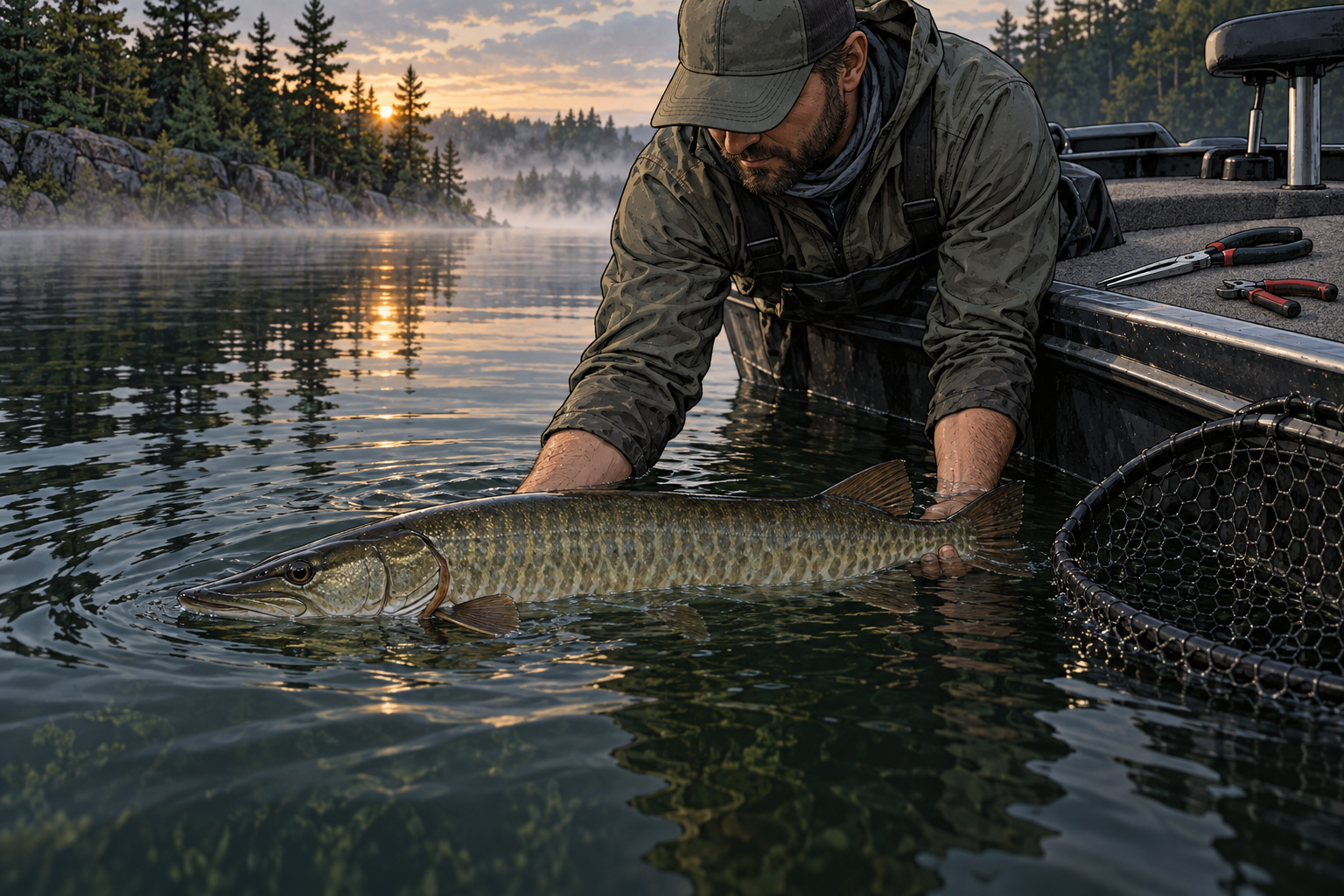
The fish swam away. The story was not over.
A clean kick away from the boat feels like the end of a successful release. New research suggests it is only the last moment the angler gets to see.
In a 2026 field study, researchers angled muskies in eastern Ontario, attached temporary biologging packages, and followed their swimming activity, depth, and water-temperature use for ten hours after release. The fish were assigned to one of three air-exposure groups: no exposure, 73 to 94 seconds, or 120 to 160 seconds.
The longest-exposure fish swam more during the first five hours after release than fish kept in the water. Their activity moved back toward the other groups later in the monitoring period. No mortality occurred during those ten hours, and the researchers did not find clear treatment differences in the depth or water temperature the fish used.
The tag recorded work we could not see
The biologging package measured acceleration, which researchers used as a proxy for swimming activity and energy expenditure. It also recorded depth and water temperature. That turned the hours after release into evidence instead of a guess based on whether the fish left the angler's hand upright.
The study could not determine exactly why the longest-exposure fish moved more. The authors discuss several possible explanations, including escape behavior, searching for recovery habitat, and increased movement associated with physiological recovery. Those explanations remain interpretations, not directly observed causes.
The durable point is narrower: a fish can survive the visible release and still behave differently for hours. Catch-and-release quality therefore cannot be judged only by the final kick.
Sixty seconds is a ceiling, not a photo allowance
The study authors recommend keeping air exposure below 60 seconds. That number should not be treated as a target or a guaranteed safe allowance. It is a precautionary recommendation from a small field study in which the medium group actually experienced 73 to 94 seconds of exposure and did not differ significantly from the no-exposure group in the measured swimming response.
The high group contained only three fish, the full analysis contained 13, and monitoring ended after ten hours. The work shows a meaningful behavioral cost at 120 to 160 seconds. It does not prove that 59 seconds is harmless, that 61 seconds is damaging in every case, or that delayed mortality could not occur after the tags stopped recording.
The better reading is simple: less air is better, and the timer should never be filled merely because some time appears available.
Build the release before you build the cast
A musky release becomes slow when the boat has to invent the process after the fish is already in the net. Pliers are buried. Hook cutters are closed in a compartment. The measuring board is under tackle. The camera is locked. Every small delay becomes part of the fish's handling event.
Before the first cast, open the large knotless net, place long pliers and hook cutters where either angler can reach them, clear a wet measuring surface, and set the camera for one quick image. Decide who controls the fish, who handles the hooks, and who takes the photograph. If fishing alone, simplify further.
Minnesota DNR advises landing fish quickly, keeping them in the water while unhooking when possible, wetting hands, supporting the body horizontally, and never lifting a fish vertically. Those steps become far easier when the boat is ready before the strike.
The net is a workspace, not a waiting room
A large rubberized net lets the fish remain in the water while the angler regains control and removes hooks. It does not make unlimited net time harmless. A 2023 muskellunge mortality experiment found net time to be a better mortality predictor than fight time within the conditions the researchers observed, although the study design and temperature range limit how broadly that result should be applied.
Keep the fish submerged, but keep the job moving. Stabilize the net, control loose hooks, use long pliers when removal is immediate, and cut a stubborn hook instead of winning a small argument with hardware. A replacement hook is cheaper than another minute of handling.
The practical sequence is water, control, hooks, measurement, one prepared photograph if conditions allow, and release. Anything that does not help one of those steps can wait.
Warm water removes margin
The Ontario air-exposure study captured fish in water from 19 to 27 degrees Celsius, or about 66 to 81 degrees Fahrenheit. The longest-exposure group was also caught in warmer water than the other groups, although the analysis accounted for surface temperature and did not find it independently explained the measured swimming activity.
Separate 2023 research found increasing catch-and-release mortality risk for muskellunge at water temperatures above 25 degrees Celsius, about 77 degrees Fahrenheit, and identified temperature and net time as important predictors in its experimental setting. Those results do not create one universal shutdown number for every lake or river. They do show why air exposure, net time, water temperature, dissolved oxygen, hooking injury, and individual fish condition must be treated as overlapping risks.
When the water is warm, the right decision may be to remove the photograph, shorten the session, change the target species, or stop musky fishing. The fish cannot negotiate for more recovery margin. The angler has to leave it.
Count what happens after the net closes
Musky Moon's working test is to log the release with the same seriousness as the catch. Record fight time, net time, total seconds fully out of water, the number of separate air exposures, hook location, whether cutters were used, surface temperature, fish length, and the fish's condition when it left.
The theory is that anglers who count those seconds will steadily remove wasted motion from their releases. It gains confidence if air exposure and net time decline across comparable catches without more dropped fish, hook injuries, or unsafe handling. It loses confidence if the timer distracts the crew, produces rushed mistakes, or fails to improve the sequence.
The goal is not to turn a musky into a stopwatch exercise. It is to replace the phrase 'that was pretty quick' with a record honest enough to improve the next release.
What this research cannot promise
Thirteen fish cannot represent every size, population, lake, river, water temperature, hooking injury, or angler. The fish came from multiple eastern Ontario waters within one ecoregion and similar shallow, vegetated habitat. Air-exposure groups also differed in net time and capture temperature, and the temporary tags themselves were part of the handling event.
No fish died during ten hours of monitoring, but the study was not long enough to rule out later mortality. It also did not compare specific photo routines, measuring boards, revival techniques, or novice and expert crews under identical conditions.
That uncertainty does not weaken the practical message. It sharpens it. A careful angler cannot know exactly how much stress a particular fish can absorb, so the release should be designed around the things the angler can control before the lure ever touches water.