
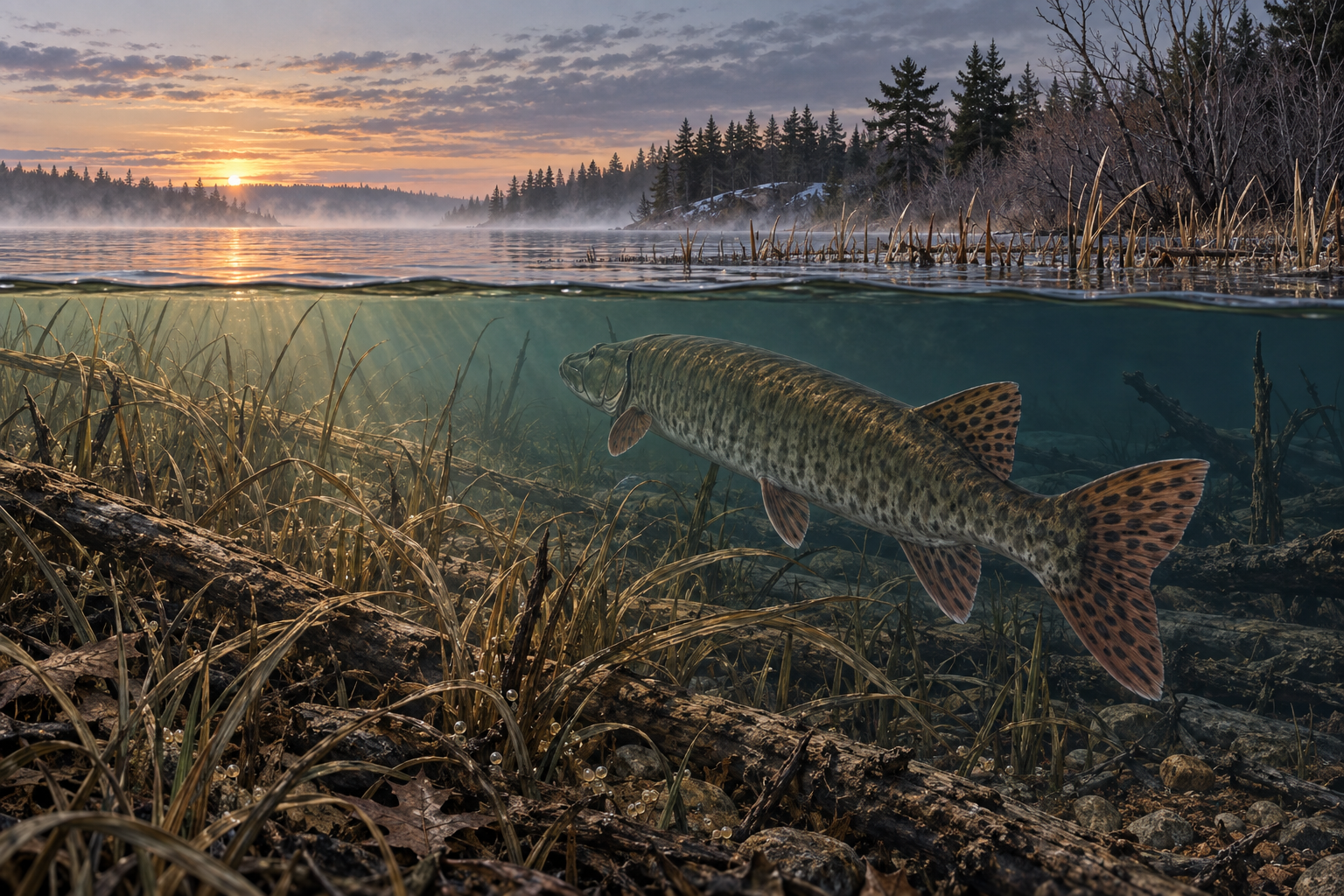
An adult fishery can hide a missing generation
A musky on the screen, in the net, or beside the boat proves that an adult fish is present. It does not prove that the lake is replacing that fish. Long-lived adults and stocking can sustain a fishery even when few naturally produced young survive their first season.
That distinction matters because adult habitat is not the whole life cycle. A fish that spends much of the year on weed edges, rock, or suspended forage may depend on a narrow spring band of shallow water to reproduce. The ecological bottleneck can occupy far less space than the adult fishery.
The useful question is not simply whether muskies spawn. It is whether eggs are deposited in places where they can survive, hatch, reach nursery habitat, and enter the population as a recognizable year class.
The spawning floor does the work
A Wisconsin study published in 1998 compared two self-sustaining musky lakes with two waters supported by stocking. Spawning sites were typically marshy areas in less than one meter of water. The researchers focused on conditions at the substrate-water interface, where broadcast eggs settle and early development occurs.
The study found low dissolved oxygen in spawning areas of the stocked lakes, while the self-sustaining lakes contained a wider range of oxygen conditions and some high-oxygen microhabitats. Fallen logs, stumps, and other wood were associated with a possible survival benefit. Egg survival over natural substrate was only 0 to 1.3 percent, even in the self-sustaining waters.
The largest loss appeared to occur after eggs were deposited but before fry reached nursery habitat several weeks after hatching. A visible spawning event, therefore, is not the same as successful recruitment.
Green Bay found eggs, then almost no larvae
A study published in December 2025 followed 60 radio- and acoustic-tagged adult muskellunge in Green Bay from 2017 through 2019. Researchers located spawning areas, measured habitat, searched for eggs and larvae, and used side-scan sonar to estimate habitat available for egg deposition in the Fox and Menominee rivers.
They collected musky eggs at 58 locations. They collected only two larvae, both from one location. Bottom slope, depth, distance from shore, gravel, organic matter, and dissolved oxygen were among the variables that best predicted egg presence. The researchers found little habitat associated with egg deposition in the two tributaries, although about half of the tagged fish appeared to spawn outside those tributaries.
The study does not say that every egg outside a collection net failed, or that its results transfer directly to an inland Northwoods lake. It shows how sharply the evidence can narrow between adults, spawning locations, eggs, and surviving larvae.
A shoreline feature is not automatically nursery habitat
From the boat, a shallow bay may look ideal because it contains reeds, dark bottom, flooded brush, or downed wood. Those features are clues, not proof. Oxygen at the egg layer, water-level stability, bottom slope, substrate, organic matter, temperature, flow, predation, and access to later nursery habitat can change the outcome.
The 1998 Wisconsin work cautioned that disruptive fixes can fail. The authors noted that dredging, bottom sealing, and adding sand or gravel can be costly, ecologically disruptive, and mismatched to where muskies naturally spawn. They identified protection of spawning areas, retention of woody debris, and appropriate water-level management as more relevant considerations for managers.
Anglers should not attempt their own habitat alterations. Shoreline work, wood placement, vegetation removal, and water-level decisions belong to landowners, agencies, tribal authorities, and qualified habitat professionals operating under current permits and waterbody-specific plans.
September can still reveal the spring nursery
Late summer and early fall offer a low-disturbance chance to document the physical setting that spring water covered. Photographs from public water can record the position of wood, sedge edges, exposed substrate, erosion, culverts, and the elevation of the current shoreline. Historical gauge records or manager reports can show whether spring water rose, held, pulsed, or fell.
Those observations cannot identify a spawning site by themselves. They become useful when paired with agency telemetry, egg or larval sampling, young-of-year surveys, natural-reproduction classifications, and stocking history. If those records are unavailable, the recruitment status is unknown, not poor by default.
The practical benefit is a better conservation question. Instead of asking why a bay that looks good does not produce fish, ask which stage has evidence: adult use, spawning, egg deposition, hatching, nursery occupancy, young-of-year survival, or later recruitment.
Build a nursery ledger, not a spawning rumor
For a set of waters, build one record for each year. Store spring water-level timing, large daily fluctuations where documented, shallow habitat condition, woody cover, substrate notes, measured dissolved oxygen source and depth, spawning observations from authorized studies, egg or larval detections, young-of-year survey results, stocking, and later cohort evidence.
Keep adult catch records separate. Adult contacts describe the fishery available to anglers. The nursery ledger describes whether and where the population may be replacing itself. Link the two only after accounting for stocking and the lag between hatching and entry into adult surveys.
The theory gains confidence if years with stable access to suitable shallow habitat and stronger early-life evidence later produce detectable cohorts. It loses confidence if recruitment remains unrelated, if stocking explains the cohorts, or if prey, predation, genetics, disease, sampling error, or habitat outside the recorded area provides the better explanation.
What can break the bottom-first model
The 1998 study examined four Wisconsin lakes, and the 2025 study examined a large Green Bay system. Neither establishes a universal oxygen threshold, substrate recipe, or water-level rule for every musky population. Their methods also differ, so the numerical results should not be merged into a single prediction.
A 2023 study in the lower Wolastoq-Saint John River documented eggs, sac-fry, and juvenile muskellunge in a regulated river system. That evidence shows that successful reproduction can occur under conditions unlike a shallow inland lake and warns against treating one habitat picture as the only workable path.
Stocked fisheries can provide valuable angling without strong natural recruitment. Conversely, natural reproduction can be present at low levels that ordinary observation misses. The durable conclusion is narrower: count life stages separately, protect verified habitat, and do not mistake adult presence for proof that the next generation is secure.