
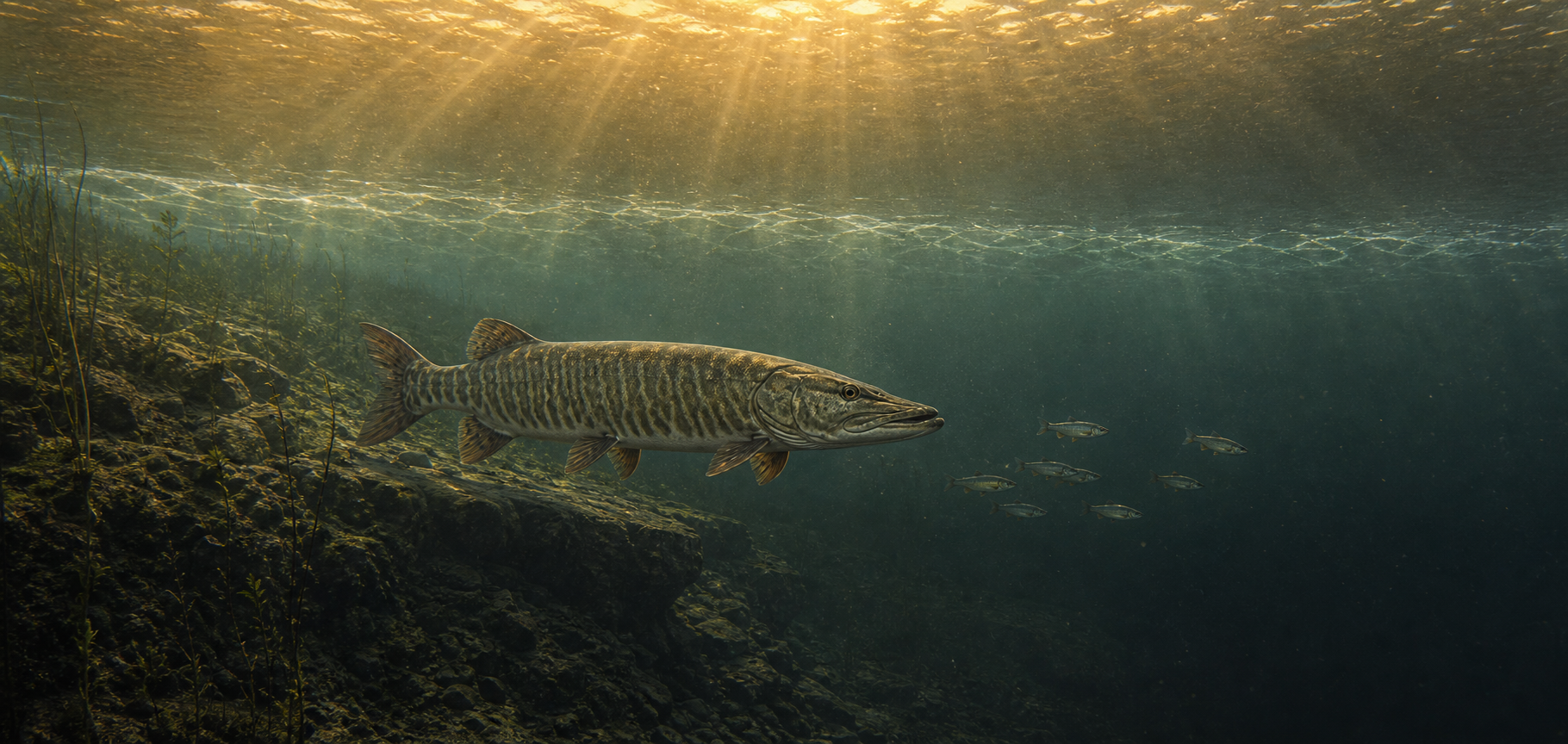
A date cannot tell you which lake you are on
The familiar musky calendar is tidy. Spring fish are shallow. Summer fish live on weeds. Fall fish move deep and eat large meals. It is easy to remember, easy to repeat, and incomplete enough to waste a day.
Tracking studies make the problem obvious. In the nontidal Potomac River, tagged muskies moved most during spring, then reduced their movement through summer, fall, and winter. In the much larger St. Clair-Detroit River System, movement rates were highest in fall and lowest in winter. Neither result cancels the other. The systems are different, so the seasons create different opportunities and constraints.
That is the useful starting point. A month names the time of year. It does not tell you whether a lake is stratified, whether a river has warmed past a fish's comfort, whether the cabbage is still alive, or whether the prey has left the shoreline. The water writes the working calendar.
Spring is a route before it is a pattern
Wisconsin DNR places musky spawning from roughly mid-April through mid-May, generally in shallow water, with activity often associated with vegetation or scattered woody material. The agency also reports that adult spawners can return to the same spawning ground in consecutive years. A recent Green Bay study found moderate spawning-site fidelity, while also showing that spawning habitat could not be reduced to one bottom type or one tributary.
For an angler, the important shape is not simply 'shallow.' It is the route connecting a wintering or staging area to suitable spawning water and then back toward feeding habitat. A protected bay, wetland edge, tributary, channel, first break, or adjacent basin can each be a piece of that route. Which pieces matter depends on the fishery.
This is not permission to ignore seasons, protected areas, or local regulations. Spring timing varies with water temperature, and legal fishing dates vary by jurisdiction. The biological lesson is narrower: when fish are moving for reproduction, the connection between habitats can matter as much as either habitat by itself.
Post-spawn is dispersal, not a shoreline guarantee
After spawning, the temptation is to fish the nearest warming bay and call it an early-summer pattern. That can work. It can also confuse a convenient spot with the reason a fish is there.
A better search begins with exits. Follow the first meaningful break, emerging vegetation, rock transition, channel edge, or current seam away from spawning water. Then ask what the fish can find along that route: warming cover, recoverable depth, or prey that has made the same seasonal move.
Some fish may remain shallow. Others may move quickly into the main system. Sex, body size, forage, water clarity, angling pressure, and the structure of the waterbody can all change the pace. The useful pattern is not 'all muskies leave the bay.' It is that post-spawn fish have reasons to redistribute, and those reasons leave routes an angler can test.
Summer has a hidden wall
Warm weather makes anglers think deeper. But depth by itself is not habitat. In a stratified lake, deeper water may be cooler while losing dissolved oxygen. In a shallow mixed lake, there may be no deep thermal refuge at all. A contour map cannot show either condition.
The Minnesota DNR's long-range musky plan describes this squeeze clearly: warm, oxygenated water can deepen while oxygen is consumed below it, narrowing the band of water that is both cool enough and oxygenated enough for cool-water fish and their prey. In the nontidal Potomac, tagged muskies used thermal refuges during stressful summer conditions and movement largely stopped. The study predicted that refuge use became common around a daily average of 24°C and exceeded 90% of tagged fish at 26°C. Those thresholds belong to that river and should not be exported as universal rules.
A Tennessee reservoir study adds another warning against magic numbers. When tagged muskies could choose among a broad range of well-oxygenated temperatures, their realized thermal niche averaged 22.3°C, but selection also varied with fish size and the unusual thermal conditions of that reservoir. Temperature is information. Temperature without oxygen, system type, and trend is only part of the answer.
Some muskies leave the shoreline without leaving the food
Wisconsin DNR describes two legitimate musky worlds. Fish can use vegetation, rock bars, ledges, shoals, and other cover. In some waters they also suspend over deep water with open-water prey such as cisco, yellow perch, or crappie.
That makes forage position one of the most important seasonal readings on the lake. A weed edge can look perfect while the food has moved fifty yards off it. A blank basin can look featureless while prey is compressed into a usable band of temperature and oxygen.
The practical move is to stop treating the shoreline as the edge of the fishery. If repeated passes over good cover produce no follows, scan the first open-water corridor, the basin side of the break, and any depth where suspended prey is consistently present. The target is not empty water. It is the interface where prey and livable water overlap.
Fall is redistribution, not a magic switch
Cooling water can reopen habitat that summer heat or low oxygen made less useful. Dying vegetation can remove cover from one area while remaining green growth concentrates life somewhere else. Turnover can change the vertical structure of a lake. Pelagic prey can shift, and connected-water fish can move across boundaries an angler treats as permanent.
That is why fall can be productive without requiring every musky to occupy the same late-season spot. On a shallow flowage, the important change may be current and remaining weeds. On a cisco lake, it may be prey depth and basin access. On a connected river system, it may be a seasonal travel corridor. The lure matters after the location problem has been framed correctly.
Bigger baits, slower retrieves, and deep breaks are possibilities, not the definition of fall. A cooling trend should cause a new set of questions, not an automatic migration to the deepest waypoint in the boat.
Five questions before the first cast
First: is the water warming, stable, or cooling? A three-day trend is often more useful than one surface reading at the landing.
Second: where is the usable temperature-and-oxygen band? If you do not have an oxygen profile, treat deep-water assumptions as untested.
Third: which cover is alive and functioning? Green weeds, wood, rock, shade, current, and open water do different jobs at different times.
Fourth: where is the forage now? Look for repeatable schools, not one exciting sonar mark.
Fifth: what route connects the best feeding habitat to safety, spawning water, current, or another basin? If you can answer those questions, the month becomes context instead of a command.
Build a local calendar that can be wrong
For one season, record the water-temperature trend, temperature at contact depth, dissolved oxygen when available, weed condition, forage depth, current, exact structure, distance to connected water, and every follow, strike, and catch. Mark what changed before the contact instead of labeling the day only as 'June' or 'fall.'
The hypothesis gains confidence if contacts repeatedly shift after measurable transitions: a warming threshold, loss of deep oxygen, weed dieback, turnover, a forage move, or a change in current. It loses confidence if calendar dates predict contacts just as well, if the supposed environmental transitions do not precede location changes, or if individual fish remain loyal to small areas despite large changes in the system.
No seasonal framework can tell you where every musky is. Telemetry samples a limited number of tagged fish. Studies from rivers, Great Lakes connections, and southern reservoirs cannot be copied directly onto a Northwoods lake. Individual muskies break population-level patterns. That uncertainty is not a flaw in the calendar. It is the reason to write your own in water.