
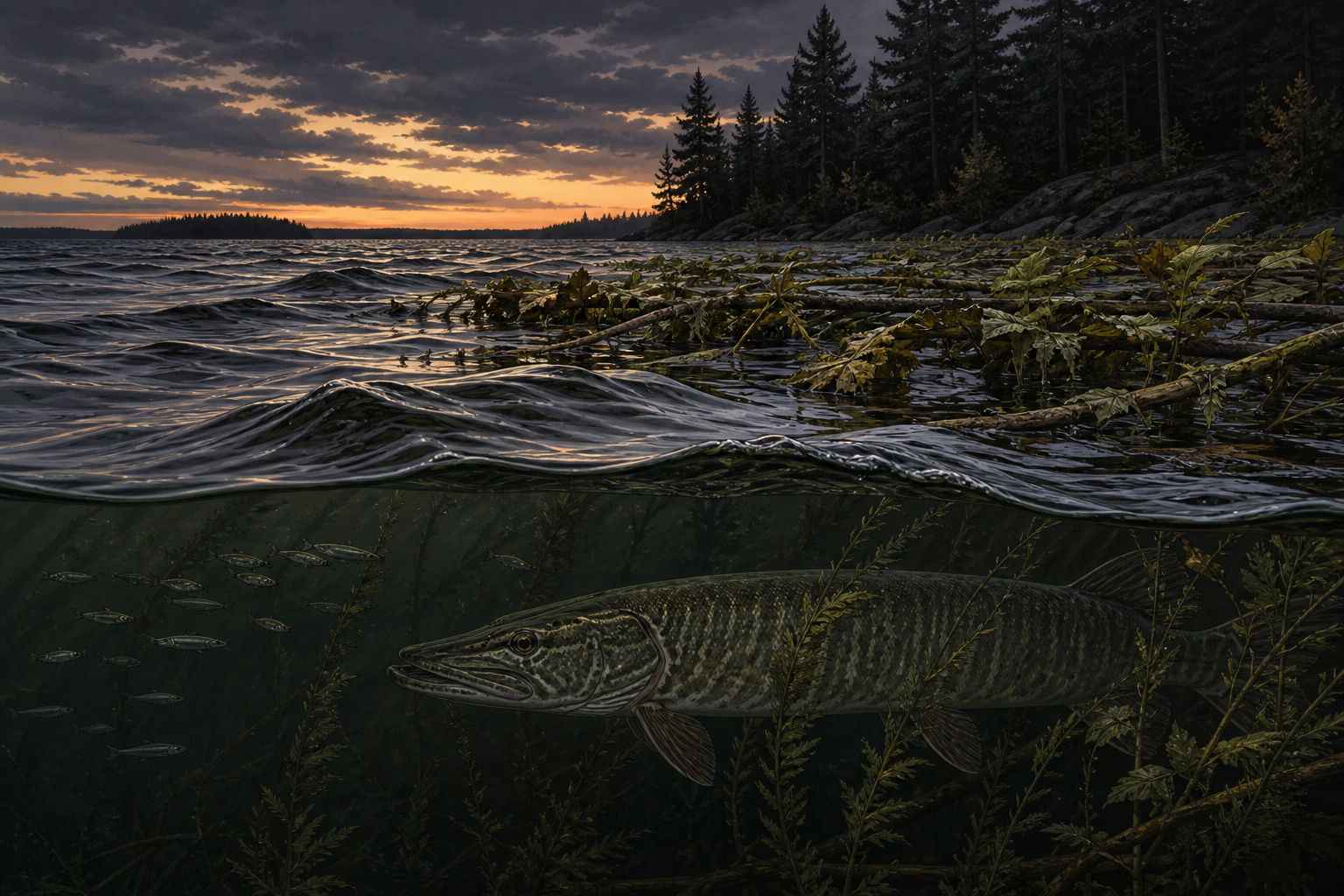
The cast is still alive beside the boat
Most casts end twice. The first ending happens in the angler's head when the lure reaches the boat. The second happens in the water, where a musky may still be tracking from below, behind, or outside the angler's easiest line of sight.
Longtime guides Joe Bucher and Steven Paul both describe the figure eight as a continuous extension of the retrieve. Their practical advice converges on the same fundamentals: prepare before the lure arrives, carry it into a broad turn, keep the movement controlled, and avoid a cramped last-second maneuver. Those are source-reported field methods. They do not prove that every following fish can be converted or that one geometry works for every lure.
What the fish brings to the final approach
A laboratory study of subadult muskellunge feeding on fathead minnows recorded a slow stalk followed by an explosive C- or S-shaped lunge. Vision helped the fish acquire prey, while both vision and the lateral-line system contributed to starting the strike. The researchers found that the lateral line may become particularly important during the last part of capture.
That does not make the study a figure-eight experiment. It used subadult fish in a controlled arena, not adult muskies following full-size lures around a boat. Its value is narrower and more useful: close-range predation is not just a visual chase. Direction, vibration, distance, and the final opportunity to intercept all matter to the fish.
Build the first turn before the lure gets there
The first turn is the part most likely to be ruined by surprise. If the rod is still high, the lure is climbing, or the angler has run out of line and space, the bait changes behavior at the exact moment a close follower needs continuity.
Set the boat-side plan early. In the final stretch of the retrieve, bring the rod into a position that keeps the lure at its working depth and leaves room for a long first sweep. Watch behind and beneath the lure, but do not wait to see a fish before making a useful turn. The movement should look intentional even when nothing visible followed the cast.
Make room for a predator, not just the lure
A lure can survive a tiny circle that a large fish cannot negotiate cleanly. That is why experienced guides favor long, rounded turns using the reach of the rod. The practical goal is not to draw a perfect numeral eight. It is to create two connected lanes with enough depth and radius for the lure to keep working and the fish to stay oriented behind it.
Depth is part of that turning room. Letting the bait rise abruptly can change its speed, vibration, and silhouette all at once. A deeper first turn often preserves the retrieve's original lane, but this remains a field inference. Boat shape, water clarity, lure buoyancy, leader length, weeds, and the fish's position can all change the useful path.
Speed changes should be decisions
Panic produces two common endings: stopping the lure or ripping it away without enough turning room. A better baseline is to carry the retrieve's cadence into the first turn, then alter one variable deliberately. A controlled acceleration on the outside lane may keep separation from a closing fish. A deeper, steadier pass may be better for a fish hanging low and wide.
The point is not that faster always wins. It is that a speed change becomes informative only when the path remains controlled. If direction, depth, speed, and lure action all change at once, the angler learns almost nothing from the fish's response.
Practice when no fish is watching
Steven Paul's guide emphasizes practicing boatside lure control without a following fish. That is the cheapest high-value repetition in musky fishing. Run every lure beside the boat and learn how it behaves on a short line: how much it rises in a turn, how slowly it can move without dying, how much leader can enter the guides safely, and where the hooks travel relative to the hull.
The answer will not be identical across bucktails, rubber, crankbaits, jerkbaits, and topwater. A universal figure-eight rule can therefore be less useful than a small library of lure-specific endings. The retrieve earns the follow. The practiced ending gives that follow a clean final decision.
The two-variable boatside test
Musky Moon's working experiment is simple. Establish one baseline for a specific lure: a deep, wide path at steady speed. When a comparable fish follows, test only one change, such as a measured acceleration on the outside turn or a slightly deeper first corner. Keep the rest of the path as consistent as possible.
Record whether the fish was visible before the turn, its depth and distance from the lure, the direction it entered, the segment where it accelerated or faded, the number of turns, and whether it struck. The theory gains confidence if the same lure and fish posture repeatedly respond to the same controlled adjustment. It loses confidence if responses remain random, if the baseline performs equally well, or if the pattern disappears across anglers and waters.
What this advice cannot promise
No source used here provides a universal boatside strike percentage, a perfect turn radius, or a speed that applies across all muskies and tackle. The sensory study does not validate guide technique, and guide experience does not replace a controlled experiment. A fish may disengage because of lure choice, visibility, boat position, prior angling pressure, mood, or a variable the angler never saw.
This method also fits casting from a boat better than trolling, shore fishing, heavy surface cover, or any situation where a broad turn is unsafe. Its strongest claim is modest: preparation preserves options. Finish every cast with room, control, and one change you can explain. Then let the fish, including the refusals, teach you what belongs in the next turn.