
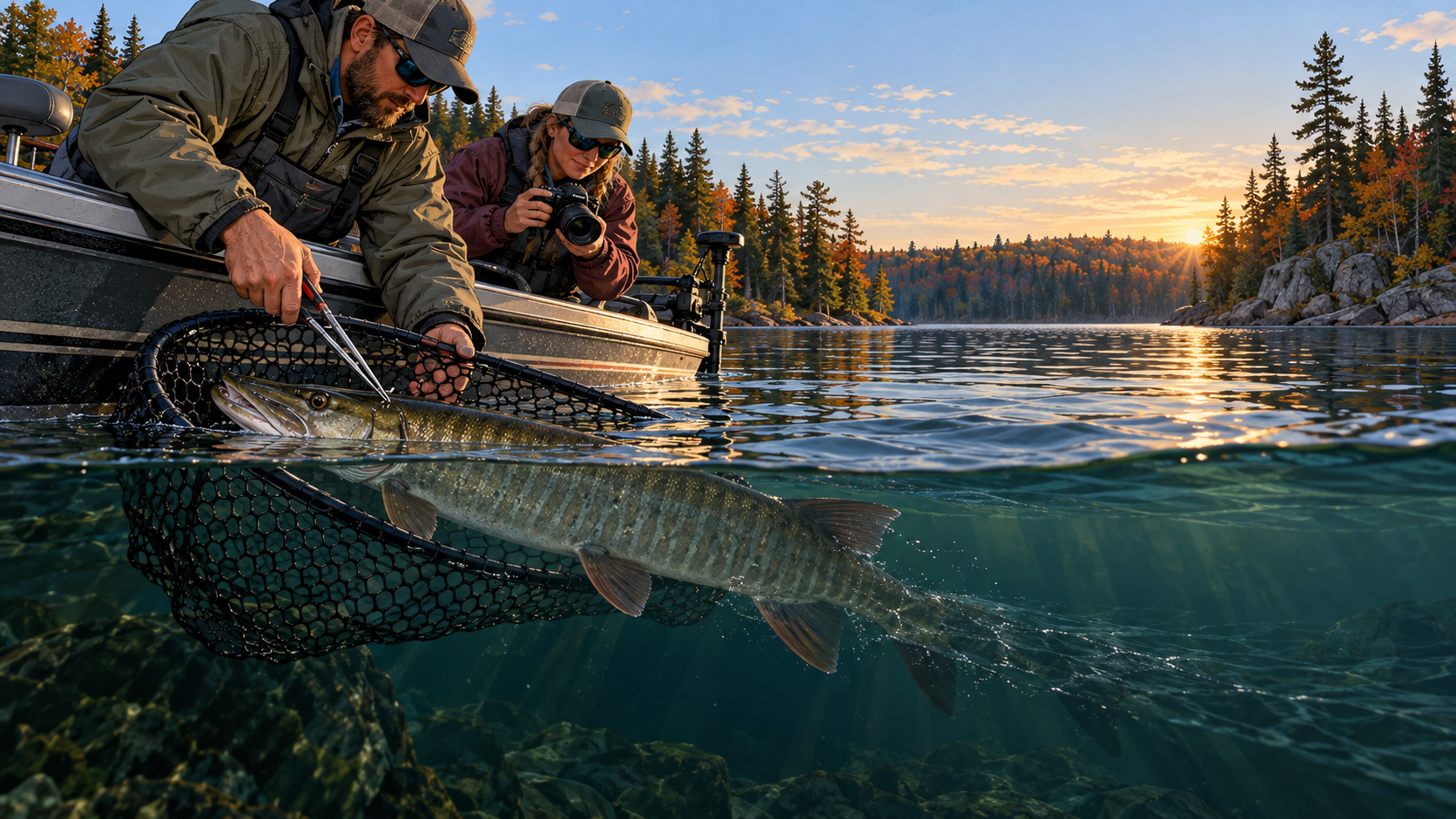
The release ends for us before it ends for the fish
The most reassuring moment in musky fishing is the first hard kick away from the boat. The fish is upright, responsive, and moving under its own power. That is meaningful evidence. It is not a view inside the next several hours.
A new field study makes that hidden period easier to see. Researchers angled 13 muskellunge in eastern Ontario waters, attached temporary pop-off biologging packages, and recorded swimming activity, depth, and the water temperatures used by each fish for ten hours after release. The fish were captured in water ranging from 19 to 27 degrees Celsius, or 66.2 to 80.6 degrees Fahrenheit.
No fish died during the ten-hour monitoring period. Yet the fish did not all behave the same after leaving the anglers' hands. Air exposure changed what happened beyond the visible release scene.
Two minutes in air changed five hours in water
The study divided fish into three air-exposure ranges: no air exposure, a middle treatment of 60 to 94 seconds, and a high treatment of 120 to 160 seconds. Fish in the longest exposure group showed elevated swimming activity during the first five hours after release compared with fish that were never lifted into air.
The groups did not differ significantly in the depths or water temperatures they used. The clearest signal was activity. The authors proposed that extra swimming may help circulate blood and clear anaerobic by-products created by the fight and time out of water, while also warning that the additional movement represents energy the fish must spend during recovery.
The published highlights report that elevated activity returned to control levels within six hours. In the full discussion, the authors noted that all treatment groups appeared behaviorally equivalent at roughly nine hours. Those statements describe different comparisons inside a small ten-hour record. Neither should be turned into a universal countdown for every musky.
Sixty seconds is a ceiling, not a photo budget
The researchers concluded that anglers should aim to keep air exposure below 60 seconds. Wisconsin DNR guidance independently tells anglers to keep muskellunge in the water whenever possible, remove or cut hooks while the fish remains horizontal in the water, and make any photograph quick.
The wrong way to use that advice is to treat 59 seconds as harmless inventory that ought to be spent. The study did not compare every second from zero through one minute, and its middle group began at 60 seconds. Its practical direction is to minimize exposure, not to fill an allowance.
Think in lifts rather than in one long pose. Complete the hook work and measurement in the water. If a photograph matters, have the camera framed before the fish leaves the net. Lift once, support the fish horizontally, make the image, and return it immediately. A second attempt should have to justify another withdrawal from the fish's recovery account.
A strong departure does not measure the debt
The first kick answers a narrow question: can the fish maintain orientation and swim away now? It does not measure blood chemistry, energy use, delayed injury, disease risk, later feeding, or survival beyond the period an angler can watch.
That distinction is why release success should not be scored only as swam away. The biologgers found altered activity after the fish had already departed. An angler could not have diagnosed that difference from the surface, and should not pretend to know that a fast departure erased the fight, netting, hook removal, or air exposure that came before it.
This is not a reason to hold a fish until it becomes passive. Support it upright in the water while it regains strength, then let it choose the moment of departure. Do not repeatedly pull it backward through the water, chase it after release, or delay release in an attempt to observe a recovery that continues beyond the boat.
Good handling works, but heat changes the stakes
The new result does not overturn earlier work showing that specialized musky handling can be effective. A 2011 study compared normal handling that included air exposure with a gentler alternative that did not. It reported similar post-release behavior and no angling-related mortality among 30 radio-tagged fish across water temperatures from 17.5 to 26 degrees Celsius, or 63.5 to 78.8 degrees Fahrenheit.
A 2023 experimental-pond study found a much harsher warm-water picture. Researchers stocked 102 adult muskellunge, angled 50 of them between 19.6 and 32.6 degrees Celsius, and observed 30 percent mortality among angled fish versus 11.3 percent among controls. Five-day cumulative temperature and time in the net were positively related to mortality probability.
That pond study deliberately removed much of the escape route available in a stratified lake or cool inflow. The fish could not simply select a colder refuge, and control fish also died. Its mortality percentages should not be copied directly onto a Northwoods lake. The durable warning is that temperature history, refuge, and net time can change the cost of the same visible release routine.
Run the ready-boat test on the angler
The ethical field experiment is not to keep fish in air longer. It is to change the boat before the strike. For a baseline set of catches, record the handling sequence exactly as it naturally occurs. Then adopt a fixed ready-boat system: cutters and long pliers in one known position, measuring marks visible beside the net, camera awake with exposure set, and one person assigned to each job.
Start the net clock when the fish enters the mesh. Record every lift from water to air with a separate start and stop time, then total the exposures. Also record hook location, whether hooks were cut, number of photo attempts, release-support time, water temperature, and whether the final image was usable. Never add handling time to complete a record.
The ready-boat theory gains support if preparation lowers median net time, total air exposure, and the longest delays while preserving the usable-photo rate. It loses support if times do not improve, if the assigned roles create confusion, or if hook location and fish behavior explain the delays more clearly than preparation does.
Count the whole sequence, not just the hero shot
Air exposure is easy to underestimate because memory preserves the pose and drops the transitions. The clock includes the lift to the measuring board, the pause while a phone unlocks, the reset after a blurred image, and any time the fish remains above water while the crew decides what to do next.
Net time belongs beside that number. In the warm-water pond study, longer net time predicted mortality within the observed range. A deep rubber-mesh net is valuable because it can keep the fish supported in water, but it is not a waiting room. Hooks can restrict the mouth or gill covers, mesh can hold the fish near warm surface water, and repeated thrashing can add injury.
The clean sequence is short fight, controlled net, immediate hook decision, in-water measurement, one prepared photo if conditions and fish condition allow it, supported recovery, and voluntary departure. If the hook is dangerous, the fish is badly stressed, or the water is too warm for your conservation goal, the photograph is the easiest step to remove.
What the new study cannot prove
Thirteen fish are enough to reveal a useful behavioral signal, but not enough to define every musky, lake, season, temperature, fish size, hook injury, or handling crew. The longest treatment also lasted two to nearly three minutes, substantially longer than the recommended one-minute ceiling.
The monitoring ended at ten hours. No mortality occurred during that window, but delayed mortality beyond it was not ruled out. The biologging package was itself an added handling and tagging event. The authors also sampled several waterbodies within one eastern Ontario ecoregion rather than one controlled population.
Most important, elevated swimming is an observed behavior and the proposed clearance of anaerobic by-products is a physiological interpretation. The study did not measure every component of recovery or establish that a fish swimming normally at hour six had no remaining cost. The evidence supports shorter air exposure. It does not support claiming certainty from a single threshold or a single kick.
Make the unseen hours lighter
Catch-and-release conservation happens before the fish is released. Heavy enough tackle, a large net, cutters, pliers, a measuring plan, and a ready camera remove decisions from the most expensive minutes of the encounter.
The new biologging work gives those familiar habits a longer horizon. A fish can leave strongly and still spend hours expressing the cost of what happened at the boat. We cannot watch that entire recovery, but we can make it carry less.
Respect the first kick. Just do not mistake it for the finish line.