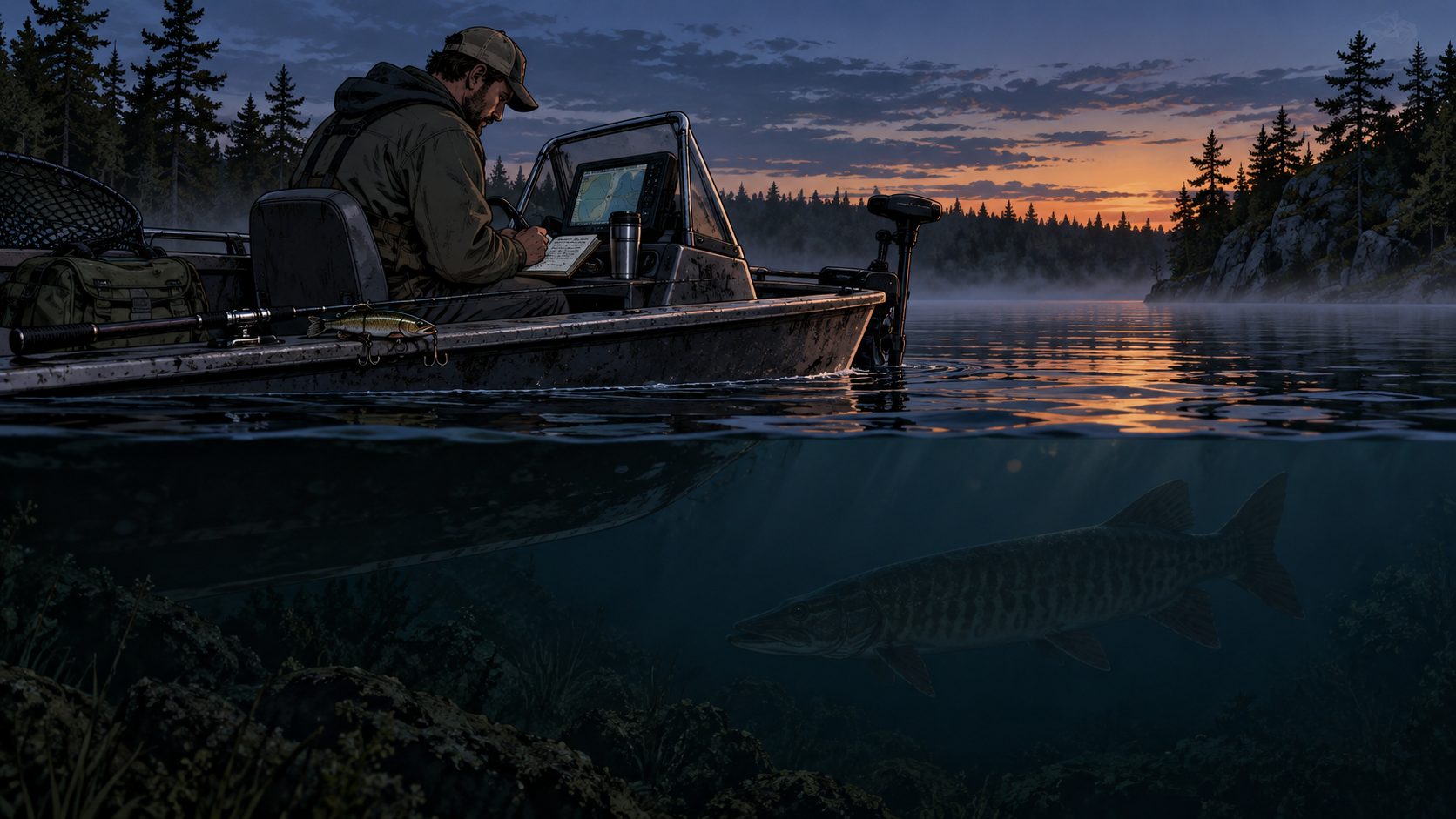
A catch log can tell the truth and still mislead you
The fish in the photograph was real. The lure, the point, the wind, and the time were real. But if those are the only things that enter the notebook, the record has already forgotten most of the day.
It has forgotten the three hours on similar points that produced nothing. It has forgotten the weed edge where two fish followed without striking. It has forgotten that the winning lure received six times more water than the lure beside it. A catch-only log preserves the ending while discarding the experiment.
Musky fishing makes that mistake especially tempting. Encounters are scarce enough that one fish can dominate the memory of an entire week. The answer is not to make the notebook more dramatic. It is to make the empty hours count.
The largest musky record began one fish at a time
Muskies, Inc. established the Lunge Log in 1970 as a standardized voluntary reporting system. An American Fisheries Society summary reported nearly 370,000 entries by March 2016, with as many as 28 fields attached to an entry. The organization now says the database holds details on more than 453,000 caught-and-released muskies.
That scale has made the record useful beyond a fishing contest. The 2017 summary describes the database as a resource for scientists and fisheries managers, and published researchers have used it to examine broad questions that no single angler could answer alone.
It also remains a voluntary record built around reported catches. That is a strength and a limitation. Hundreds of thousands of honest catch records can reveal important patterns, but they do not automatically tell us how many people fished, how long they fished, or how often comparable conditions produced no fish.
Zero is a result
Michigan DNR asks musky anglers to submit one survey for each fishing trip, whether the trip produced a catch or not. The survey collects angler effort, waterbody, methods, and catch information. Fisheries managers have used those reports to evaluate stocking, consider regulations, and learn about self-sustaining populations.
The no-catch report supplies the denominator. Five muskies sound impressive until we know whether they came from 20 hours or 2,000. Ten follows may describe a strong pattern, or merely a lure that was cast more often than everything else. Effort turns an event count into something that can be compared.
For a personal log, zero should not mean nothing happened. It should mean the angler completed a defined amount of effort under recorded conditions without a visible contact. That is useful evidence against a pattern, especially when the same result repeats.
Good records still carry bias
A long-running Lake of the Woods volunteer diary program demonstrated both the value and the danger of angler records. Diary and creel-survey results showed similar long-term trends, but success rates were consistently higher in the volunteer diaries. The people willing to keep a diary were not necessarily a perfect sample of everyone fishing the lake.
That does not make diaries useless. It means the comparison has to stay honest. A personal log is best at comparing one angler with that same angler using consistent rules. It becomes less reliable when skill, electronics, boat control, available time, or the waters being fished change without being acknowledged.
The fish are not identical test subjects either. A controlled 2023 muskellunge study found capture probability varied with size and measured behavior in young hatchery fish stocked into ponds. The study does not tell an adult angler which wild fish will bite. It does warn against treating every musky as equally catchable.
Record the decision before the result
Start each trip with one written prediction: the habitat, depth, presentation, and time window most likely to produce contact. Keep it short enough that it cannot become a story after the fact. For example: outside green weeds connected to twelve feet of water, moving bait, first two hours after sunrise.
Then record the work in comparable blocks. An hour is simple, but a defined route or a fixed number of passes can work when it fits the water better. For every block, save the lake or river, zone, minutes fished, lure family, running depth, retrieve class, structure, boat position, water temperature when measured, wind, light, and one outcome: no contact, follow, strike, hooked, or landed.
When the plan changes, write down why. A weather change, visible bait, a follow, dying weeds, boat traffic, or a deliberate test are different reasons. If the log only captures the new tactic after it works, it cannot distinguish a thoughtful adjustment from a lucky ending.
Large samples can find a pattern without proving its cause
A 2014 analysis used 341,959 North American musky catch records to test lunar timing. It found catch peaks around full and new moons and estimated a maximum average relative effect of about five percent. But the authors also found a lunar pattern in angler effort on Lake Vermilion and could not attribute the catch pattern to fish behavior alone.
That is the proper lesson for a fishing log. A correlation is an invitation to test, not permission to stop thinking. More fish on west winds may reflect fish activity, the shorelines you chose, better boat control, more hours fished, or the fact that you stayed longer because the day felt promising.
A useful notebook keeps possible explanations alive. It does not turn the first interesting column into a law of musky behavior.
The twenty-trip honest log
For the next twenty trips, make one prediction before launching and divide the fishing into consistent effort blocks. Record every block, including the blanks. After a contact, change no more than one major variable on the return pass: speed, depth, lure family, angle, or timing.
At the end of twenty trips, compare contacts per hour rather than total fish. Separate follows from strikes and landed fish. Ask which patterns produced repeated evidence, which merely received the most effort, and which succeeded once but failed on every comparable return.
The theory gains confidence if pre-trip predictions improve, contact rates repeat under similar conditions, and one-variable return passes outperform random changes. It loses confidence if the apparent patterns vanish when effort is included, if results depend on one unusual day, or if another angler using the same definitions cannot classify the records consistently.
What the notebook cannot control
Twenty trips remain a small sample. Seasonal movement can change the fishery before the test is complete. Angler skill may improve. A new lure may receive more concentration. Electronics may reveal fish that were previously invisible. A single active musky may be encountered more than once and counted as several independent contacts.
Voluntary records can also lose their worst days. If cold rain, short sessions, and blank water are the first entries abandoned, the notebook slowly edits the fishery into something easier than it was. The discipline is not in recording every trophy. It is in finishing every trip.
The goal is not a universal formula. It is a better next decision. When the empty hours stay in the record, a musky becomes more than proof that one cast worked. It becomes one result inside a pattern that can be challenged, repeated, and improved.