
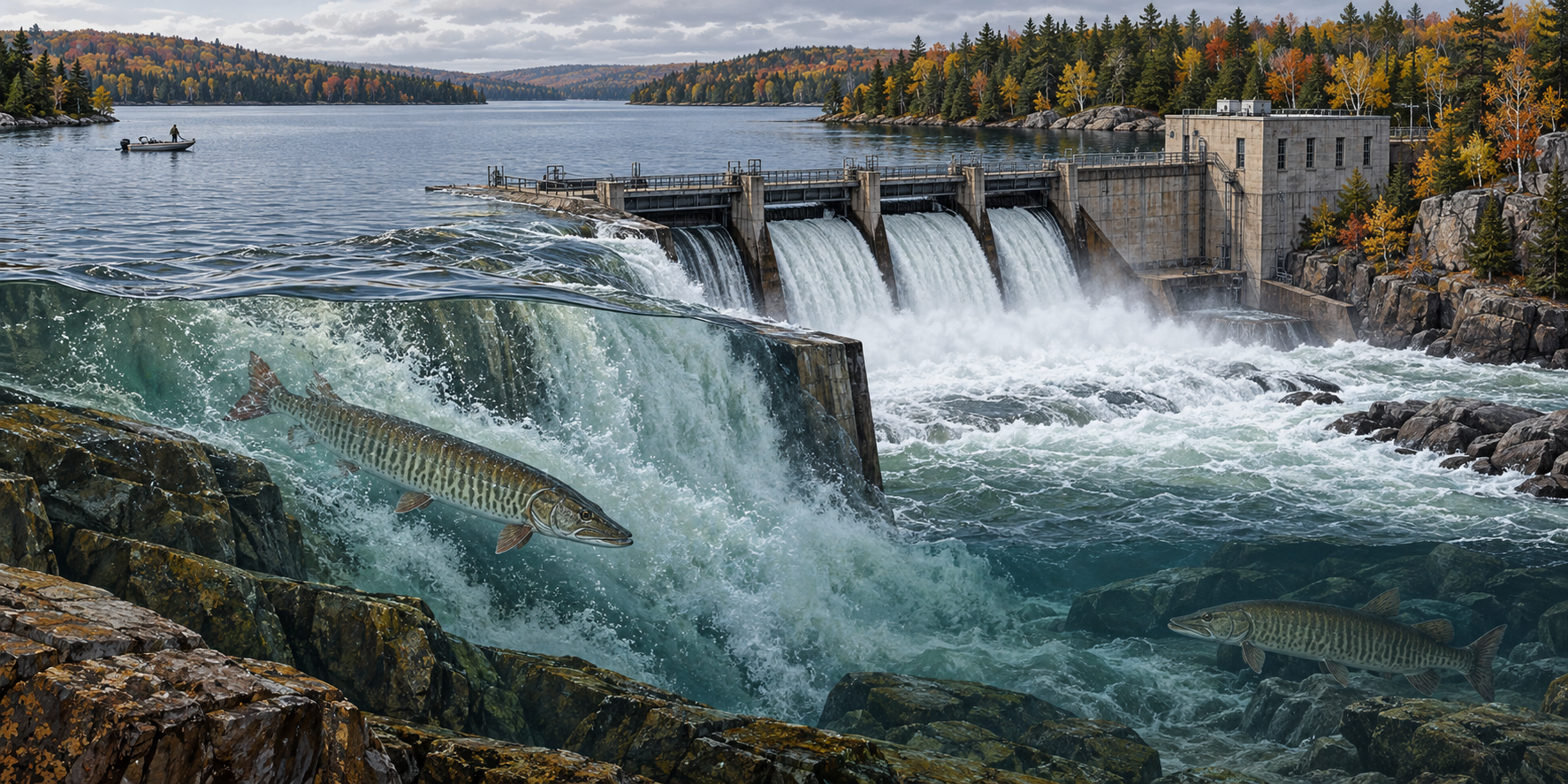
A concrete boundary can still leak fish
A reservoir map usually stops at the dam. The population does not always stop there. Water leaving through a spillway can carry muskellunge downstream, turning a fish counted, stocked, or caught in the reservoir into a fish that may never return upstream.
Fisheries biologists call that loss escapement. It is not the same as seasonal movement within a connected lake chain. Passage over or through an outlet can be effectively one-way, so the event can reduce the reservoir population even when the fish survives.
The practical consequence is larger than a rare travel story. In some systems, escapement can remove more adult muskellunge than natural mortality. In others, it can be close to zero. The dam design and the way water is released belong in the fishery description.
Two Iowa reservoirs produced opposite outcomes
Researchers implanted radio tags in 47 adult muskellunge from two central Iowa reservoirs, 17 in Big Creek Lake and 30 in Brushy Creek Lake, and tracked them from 2016 through May 2019. The study produced 1,301 fish locations and modeled both escapement and natural mortality.
Big Creek had a physical barrier on its spillway. No tagged muskellunge escaped there. Brushy Creek had no barrier during the study, and its estimated annual escapement ranged from 18 to 54 percent. Weekly escape probability reached 0.13, was greatest from May through August, and increased with the weekly maximum reservoir level.
Estimated annual natural mortality was 15 to 18 percent in the two systems. That comparison matters because it shows a reservoir can lose more adult fish through its outlet than through all measured natural causes. It does not mean those percentages transfer to another dam.
The long record says the structure matters
A later Ohio study widened the view. From 2013 through 2022, researchers tagged 51,052 juvenile muskellunge and 774 adults across four stocked reservoirs. The monitoring system recorded 3,428 detections representing 2,316 individual fish.
The number of known escapees ranged from zero to 481 among reservoirs. Eighty-five percent of documented escapement occurred from March through May, and 96 percent of known-age fish that escaped were at least age three. Estimated annual juvenile escape probability remained at or below 0.02, while mean adult probability ranged from zero to 0.34 among reservoirs.
Outlet design lined up with those differences. Escapement was lowest where offshore sluice-gate towers managed water levels and greatest where surface water left through shoreline structures such as crest gates or unregulated spillways. Where escapement occurred, higher annual escape probability was associated with lower fishing success.
Below the dam can become a second fishery
An escaped musky is lost to the reservoir, but it is not automatically lost from the broader angling system. A 2025 Ohio study used tag detections and mark-recapture models to examine escaped fish in the tailwaters of Alum Creek Lake and Clearfork Reservoir.
Researchers collected detections from 707 escaped muskellunge during 2016 through 2022. Estimated annual musky abundance across the studied tailwaters ranged from 35.8 to 165.4 fish, and average residence exceeded four months. Average survival differed sharply between locations, at 0.54 in the Clearfork tailwater and 0.26 in the Alum Creek tailwater.
Those fish did not make escapement harmless. A trophy fish below a dam no longer contributes to catch rates or future reproduction in the reservoir above. The finding does show that management may need to consider a reservoir and its tailwater together instead of treating every escape as immediate disappearance.
A barrier is engineering, not a magic screen
Keeping fish in a reservoir is not as simple as installing any set of bars. A 2026 controlled raceway experiment tested fingerling muskellunge against parallel-bar barriers under a water velocity of 0.1 meter per second. Ten fish were used per trial, with ten trials for each treatment.
A 25-millimeter spacing reduced fingerling muskellunge passage compared with no barrier. Wider 51- and 76-millimeter spacings did not. Smaller fingerlings were also more likely to pass than larger ones.
The experiment tested short trials in a covered raceway, not a full-size spillway during flood discharge. Debris loading, ice, maintenance, dam safety, native fish passage, and the size range of wild fish can all change the real decision. A barrier that retains muskellunge but compromises water control or other species is not an automatic solution.
Read reservoirs from both sides
For anglers, the first useful change is conceptual. A reservoir should not be judged only by stocking totals, surface acreage, and catches above the dam. Ask what kind of outlet it has, whether fish passage has been documented, how water levels are managed, and whether agency surveys or tag detections have found muskellunge below it.
After a high-discharge period, a tailwater may deserve attention when public access is legal and the area can be fished safely. That is a modeled search decision, not a prediction that a musky passed during the latest event. Current flow, barriers, water temperature, dissolved oxygen, forage, and downstream habitat can make the tailwater valuable, temporary, or unsuitable.
Above the dam, a falling catch rate does not prove escapement. Sampling changes, angling effort, prey, habitat, stocking survival, and natural mortality can produce the same appearance. The outlet becomes a serious explanation only when direct detections, downstream recoveries, or repeated system-level evidence supports it.
Build a spill ledger, not a flood story
Musky Moon's working theory is that each reservoir can develop a spill signature. The signature is the combination of season, water level, discharge, outlet type, fish age or size, and downstream habitat under which confirmed passage becomes more likely.
Start with official records. Store the reservoir name, date, gauge height or pool elevation, discharge, water-release structure in use, barrier status, precipitation, water temperature if measured, and any agency-confirmed tag detection or recovery. For angler observations, add the exact side of the dam, access point, effort, lure family, contact type, fish length if measured, tag number if present, and whether the observation was reported to the managing agency.
The theory gains support when confirmed escape events cluster around repeatable combinations of discharge and outlet operation, and when tailwater detections follow those events. It loses support when passage remains rare across large releases, when a barrier is verified effective, or when apparent changes are better explained by sampling and effort.
The most interesting water may be the least safe
Tailwaters combine current, turbulence, rapidly changing releases, cold-water shock, slippery banks, restricted zones, and submerged hazards. Posted exclusion areas and local regulations are not optional, and a visible fish is never a reason to approach a spillway, power plant, or dam face unsafely.
Check the dam operator's release information, agency fishing rules, access hours, and life-jacket requirements before fishing. Flow can change faster than the weather. If no authoritative operating or access information is available, treat the current conditions as unknown and keep away from the structure.
An escaped muskellunge may also cross jurisdictional or waterbody boundaries. Verify the season, size limit, harvest rule, and gear restrictions for the exact tailwater reach rather than carrying the reservoir rule downstream by assumption.
What these studies cannot settle
The Iowa estimates came from two reservoirs and 47 tagged adults. The Ohio results came from four stocked reservoirs with their own outlet designs and monitoring systems. Neither study supplies a universal escape rate for natural lakes, rivers, or Northwoods impoundments.
Passive tag antennas detect tagged fish that pass within their reading field, while radio telemetry depends on relocation effort and transmitter performance. Survival and abundance estimates are model outputs with uncertainty. Fish can also move beyond the monitored tailwater or occupy water where detection is poor.
Seasonal clustering does not prove that any individual flood moved a musky, and a tailwater catch does not identify when the fish escaped. The 2026 barrier experiment involved fingerlings in controlled flow, so its bar-spacing result should not be applied directly to adult fish or a working dam.
Put the outlet into the population model
A stocking truck can add fish, a size limit can protect fish, and careful release can keep fish alive. None of those tools can hold an adult in a reservoir whose outlet regularly moves it downstream.
The useful map therefore has two sides. Above the dam is the fishery managers intended to build. Below it may be a persistent secondary fishery, a short holding area, or water that cannot support the escapees for long. Which one exists has to be measured.
The dam is not the end of the musky map. It is a valve in the population, and the fishery makes more sense when that valve is counted.