
Darkness is a condition, not a command
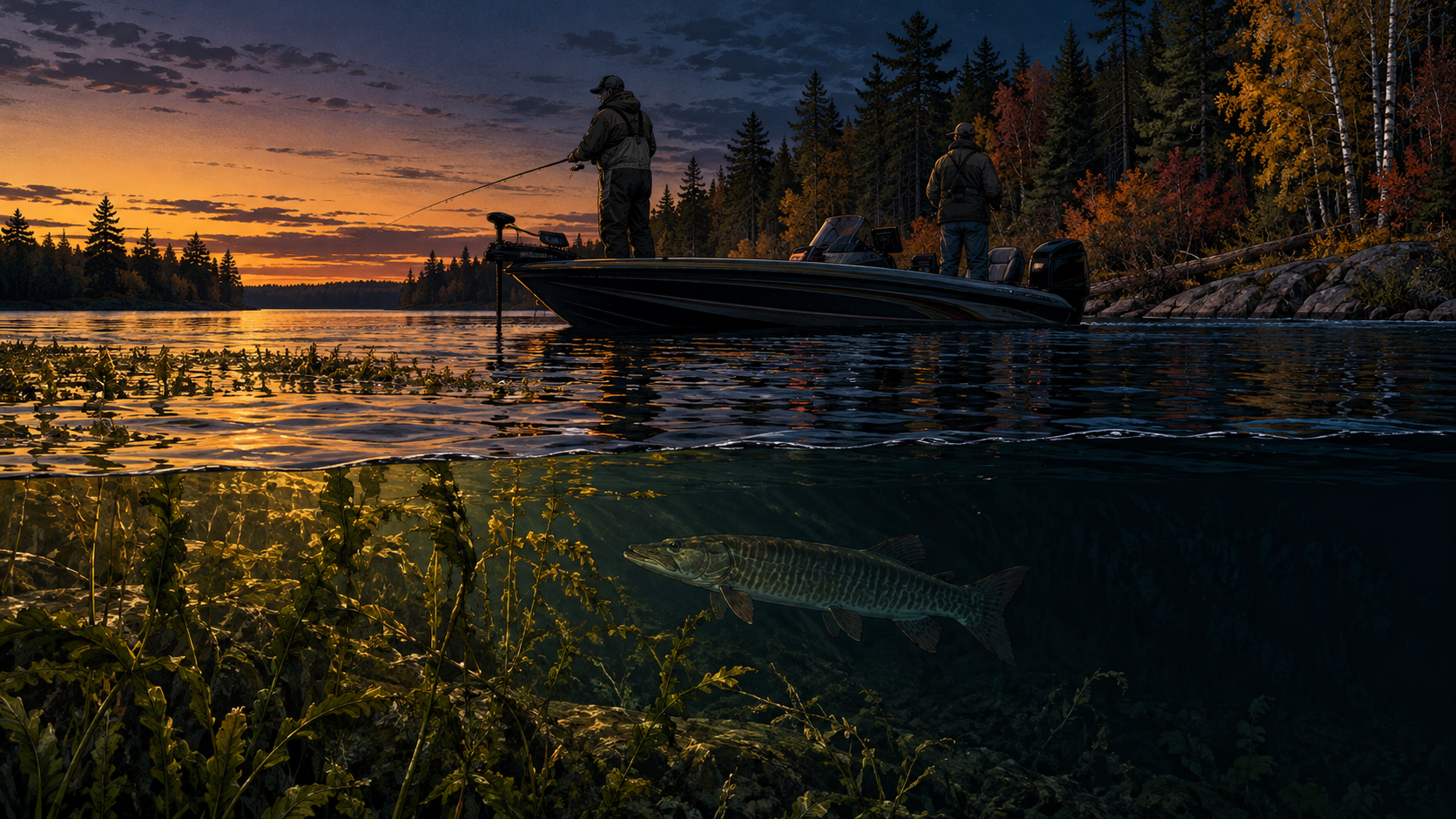
Night fishing carries a clean story: the light leaves, the lake quiets, and a musky switches on. The story is useful only if the fishery repeats it. Direct measurements of muskellunge behavior do not support one universal nighttime rule.
In an eight-kilometer reach of Ontario's Rideau River, researchers used acoustic transmitters with tri-axial acceleration sensors to follow summer activity from June 1 through August 20, 2010. Activity was lowest at dawn, increased through the day, peaked at dusk, and declined at night. Fish were inactive much of the time, and activity also declined above 25 degrees Celsius, or 77 degrees Fahrenheit.
That result makes dusk important in the studied river. It does not make every Northwoods sunset a guaranteed feeding window, and it does not prove that a quieter fish cannot be caught.
Another study saw night differently
A separate radio-telemetry study tracked stocked age-two muskellunge in Forbes Lake, a 225-hectare Illinois reservoir. The fish measured 399 to 610 millimeters in total length and came from three genetic stocks. Researchers detected no stock-level differences in hourly movement rate or home-range size.
Season mattered. Mean movement was greatest in spring at 42 meters per hour, lowest in summer at 16 meters per hour, and intermediate in autumn at 28 meters per hour. Within summer, however, movement was greater at night than during crepuscular periods.
The two studies do not cancel each other. They measured different fish in different systems with different instruments. One measured body acceleration in a river reach. The other estimated movement from radio locations in a reservoir and focused on juveniles. The apparent conflict is the lesson: diel behavior belongs to context.
Movement, activity, and vulnerability are not synonyms
A fish can move far without striking. It can hold nearly still and still be catchable. An accelerometer records body motion, radio telemetry estimates change in location, and an angler records an encounter filtered through lure choice, boat position, detection, and hook-up. Those are related observations, not interchangeable measurements.
Escanaba Lake records sharpen that distinction. From 2003 through 2015, researchers analyzed 2,771 targeted musky trips. The fishery did not permit night angling, so the data compare dawn, day, and dusk rather than a complete 24-hour cycle. Successful dusk trips were uncommon in the analyzed catch-rate data: only nine successful trips occurred at dusk.
Predicted catch rate among successful trips was higher at dusk than at dawn, but all modeled effects were very small and the dusk estimate had wide uncertainty. The study also found that solar radiation, angler choices, wind, temperature, lunar variables, prior capture exposure, and other factors could contribute to vulnerability. The clock never acted alone.
The useful unit is minutes from the light change
Day and night are coarse labels. A cast made 20 minutes before sunset, one made during the last visible glow, and one made two hours into darkness all receive different light, background contrast, prey behavior, and boat traffic. Storing them in one night bucket can hide the transition that matters.
Use sunset as a reference point, not a promise. Record the midpoint of each pass as minutes before or after sunset. Add cloud cover, moon illumination when visible, water clarity, surface temperature, wind, prey depth, and the habitat crossed. A light window becomes credible when contacts repeat at a similar offset under comparable conditions.
This framing also protects against selective memory. A single fish caught at 10:12 p.m. is an event. Ten equal-effort windows around sunset, including nine blanks, are evidence about a pattern.
Run three windows with one job
Choose one compact route that can be fished safely and consistently. Give it equal effort in three windows: late daylight, the civil-twilight transition, and the first full-dark hour. Keep lure family, running depth, retrieve class, boat path, and number of casts as stable as practical.
The lure still needs a job suited to visibility. A vibration-heavy bait, a slow directional bait, and a high-contrast silhouette may each be reasonable, but changing all three at every window destroys the comparison. Select one presentation family for the test and let light be the main variable.
Count follows, strikes, catches, uncertain sightings, and blank casts. Also record whether a fish appeared to track the lure farther, closer to the boat, or only at the turn. Darkness changes what the angler can detect, so a fall in visible follows may reflect observation as much as fish behavior.
Build a transition-signature ledger
Musky Moon's working theory is that each fishery can develop a light-transition signature, but only after season and habitat are allowed to modify it. One lake may produce a tight dusk pulse along weeds. Another may show steadier night contacts over open water. A third may offer no measurable low-light advantage at all.
Repeat the three-window route across at least several trips before promoting a pattern. Calculate contacts per 100 casts or contacts per hour for each window. Separate seasonal phase, because a summer river result and an October lake result do not describe the same biological setting.
The theory gains support if one window repeatedly produces a higher standardized contact rate and the advantage persists after route order is rotated. It loses support if contacts distribute evenly, if the first pass always wins regardless of light, or if temperature, wind, prey position, pressure, or presentation explains the difference more cleanly.
Night adds human variables too
Reduced boat traffic can change a spot even if the musky's internal activity does not change. Darkness can also change casting accuracy, lure speed, depth control, follow detection, net readiness, photography time, and safe boat handling. Any of those can raise or lower catch probability independently of fish movement.
Prepare the boat before light disappears. Keep the deck clear, navigation lights working, tools staged, headlamps reachable, and the net ready. Mark hazards in daylight and avoid using a night experiment to justify unsafe water or weather.
A night result is therefore a property of the entire encounter system: fish, prey, light, habitat, angler, equipment, and traffic. Calling it only a feeding window gives the clock too much credit.
What these studies cannot settle
Neither telemetry study establishes the best October fishing hour in Wisconsin. The Rideau work covered one summer and one river reach. The Forbes Lake work involved stocked juveniles, and its night result concerns movement rather than strikes. The Escanaba dataset excludes night fishing and includes only nine successful dusk trips in the positive catch-rate model.
Fish size, age, prey, water color, depth, temperature, weather, angling pressure, and individual behavior can alter a diel pattern. Telemetry samples tagged fish, receiver coverage, and the behaviors each instrument can detect. Angling records add human effort and choice.
The durable conclusion is modest: muskellunge behavior changes across the day, but the direction and fishing meaning of that change are not universal. Measure the transition your water gives you.
Let the lake write the clock
A favorite hour can be useful confidence. It becomes a pattern only after equal-effort comparisons survive blank nights, route rotation, and changing conditions.
Fish dusk because one direct study found a dusk activity peak. Test early night because another found greater summer movement there. Believe neither result as a local law until your own standardized ledger makes one repeat.
The clock does not turn musky behavior on. It gives you a clean axis on which to discover when, where, and under what conditions behavior changes.