
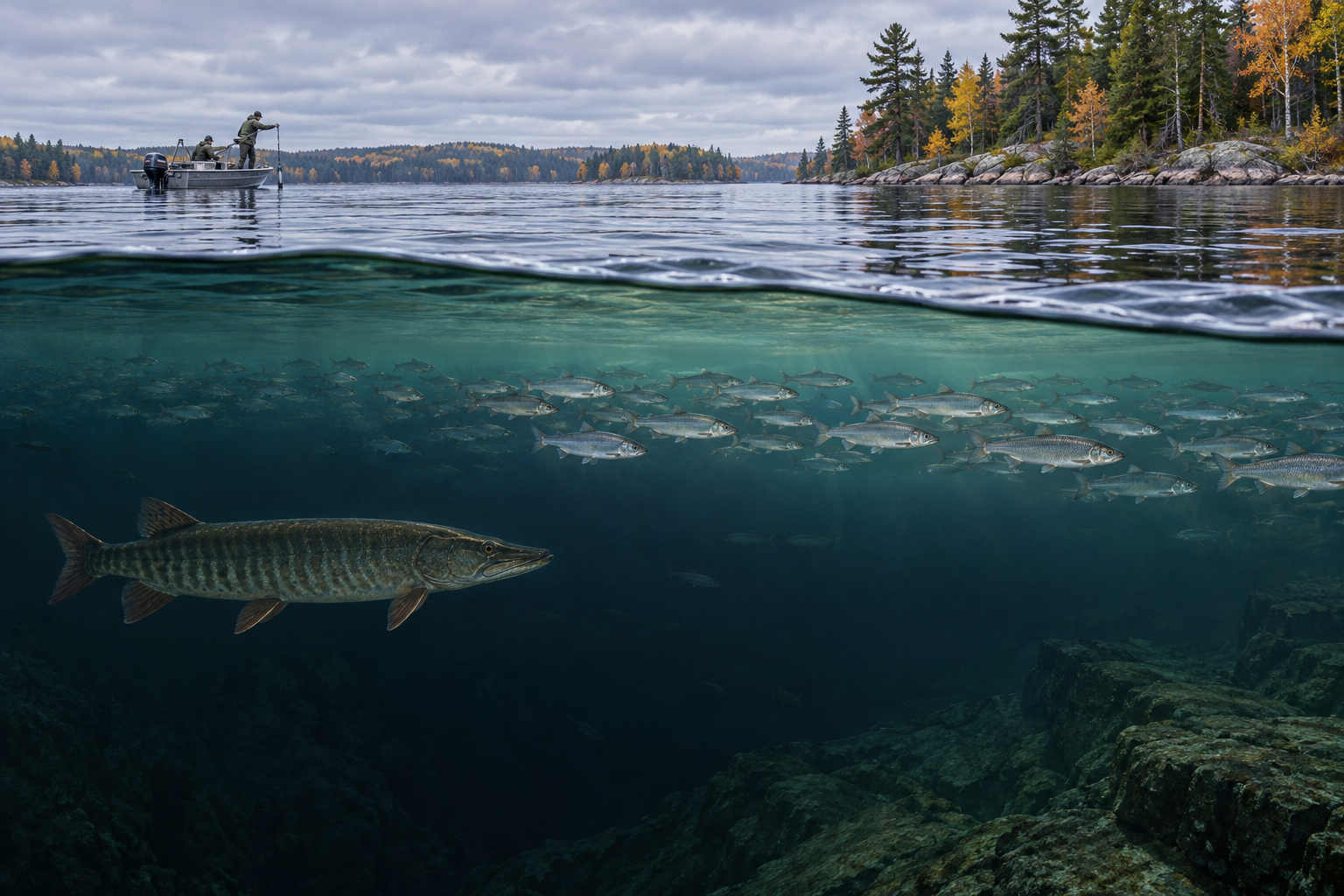
Cold water is only one side of the room
A deep lake can hold cold water that is poor habitat. Temperature usually falls with depth during summer stratification, but dissolved oxygen can fall too. Cisco need the overlap: water cool enough for a coldwater fish and oxygen high enough to support it.
A new open-access study made that overlap visible with 42 years of profiles from Big Muskellunge Lake in Vilas County. The researchers used 17 degrees Celsius, or 62.6 degrees Fahrenheit, as the warm boundary and 3 milligrams per liter of dissolved oxygen as the low-oxygen boundary for their cisco analysis. The distance between those boundaries was called vertical habitat thickness.
That measurement turns one vague idea, deep and cold, into two independently moving limits. The upper wall is heat. The lower wall is oxygen. Suitable water is the band between them.
The band can narrow to zero
Big Muskellunge Lake did not produce one stable summer layer. Suitable cisco habitat varied within seasons and among years, and it occasionally reached zero meters under the study thresholds. That does not mean every cisco died or that every fish used the same location. It means the measured water column contained no depth that simultaneously met both selected limits at that sampling point and time.
The long record also showed a later squeeze. Comparing 1981 through 2001 with 2002 through 2022, median September habitat thickness declined from 3.0 meters to 1.0 meter, a 67 percent reduction. The month of least available habitat shifted visually from August toward September, and low-habitat conditions extended later into the season.
Those numbers belong to one well-studied lake and one threshold definition. They cannot be copied onto another lake. They do establish that the forage layer can change in thickness, depth, timing, and severity even when the lake name stays the same.
A surface thermometer cannot see both walls
The long-term program measures temperature and dissolved oxygen at one-meter intervals. Sampling is generally biweekly during summer. In 2024, researchers also collected weekly profiles at Big Muskellunge Lake and found a strong pattern match, supporting the use of the lower-frequency record for seasonal habitat analysis.
A surface temperature reading has value for documenting weather response and seasonal change. It cannot reveal where oxygen becomes limiting below the boat. A sonar screen can show fish or forage depth, but it does not identify dissolved oxygen unless an oxygen sensor is part of the measurement.
The honest field distinction is simple. A temperature profile is measured temperature. A dissolved-oxygen profile is measured oxygen. A sonar band is observed targets. None should be renamed as another without evidence.
Cisco can matter greatly without becoming the whole diet
A Wisconsin study sampled cisco in 48 inland lakes and found that growing degree-days plus measures of suitable oxythermal conditions were important predictors of both relative abundance and growth. The best models explained about 25 percent of variation in cisco catch per unit effort and 46 percent of variation in growth, leaving substantial variation unexplained.
The connection to muskies is real but system-specific. In one deep Minnesota lake, stable-isotope mixing models estimated that cisco made up 50 percent of the muskellunge diet. That is evidence for Elk Lake, not a universal menu. Muskies use diverse prey, and a lake without cisco requires a different forage map.
Even where cisco and muskies coexist, the predator does not have to occupy the center of the forage band. A musky may approach from warmer, shallower, darker, brighter, or structurally different water. The prey layer defines an opportunity zone, not a guaranteed predator coordinate.
Fish the boundary you can verify
If a calibrated temperature-and-oxygen probe is available, profile the deepest basin before fishing and repeat the profile after a major weather change. Record depth at one-meter or consistent smaller intervals, instrument calibration status, time, station, temperature, and dissolved oxygen. Mark the warm threshold and the oxygen threshold only after the readings exist.
Without an oxygen probe, use more modest language. Record the depth and thickness of a repeatable sonar forage band, the depth of individual large targets, lure-running depth, and contact depth. Call oxygen unknown. That ledger is still useful because it can reveal whether forage and contacts rise, fall, or spread after wind and mixing.
Start with three controlled passes: one just above the forage band, one through its upper edge, and one below it only where depth, equipment, fish condition, and safe release allow. Keep lure family, retrieve class, pass length, and boat speed stable enough that depth is the main comparison.
Build a two-wall ledger
Choose a cisco lake with a repeatable deep-basin transect. On each trip, store the upper and lower depth of the visible forage band, maximum bottom depth, surface temperature, temperature by depth if measured, dissolved oxygen by depth if measured, wind history, cloud cover, water clarity, thermocline depth if verified, lure depth, and every follow, strike, catch, and blank pass.
Express the fishing question as distance from a boundary. Was the lure two feet above the upper forage edge, inside the top third of the band, or below it? A raw depth of 18 feet may describe three different ecological positions on three different days.
The theory gains support if contacts repeatedly cluster at the same relative position after effort, presentation, pass order, and light are controlled. It loses support if absolute structure, vegetation, a different prey group, or random variation explains the contacts more cleanly.
Fall mixing changes the test
As cooling and wind weaken stratification, the two walls may move apart, become irregular, or disappear as the water column mixes. That does not create an instant lake-wide reset. Mixing progresses at a lake-specific pace, and oxygen can recover unevenly through depth and space.
During that transition, yesterday's tight forage band may spread vertically or move horizontally. Repeat the same transect instead of assuming the old layer remains intact. If sonar targets disperse while measured temperature and oxygen become more uniform, the compression model should lose weight for that trip.
This article does not report a current profile for any lake. Current water temperature, dissolved oxygen, cisco depth, and musky position remain unknown until measured.
The best depth is a relationship, not a number
The 2026 Big Muskellunge work found that spring climate and lake observations could provide skillful season-ahead estimates of several summer oxythermal metrics. Its best-fitting model reached an R-squared of 0.42 and a ranked probability skill score of 0.55. Useful prediction remained probabilistic, not exact.
For anglers, the practical standard should be the same. Temperature, oxygen, forage, and contact records can narrow a search without proving a fish location. A cisco layer is not a waypoint. It is a changing relationship among physiology, water quality, prey, and time.
The surface tells you what the lake feels like. The two walls tell you how much room the coldwater forage may actually have.