
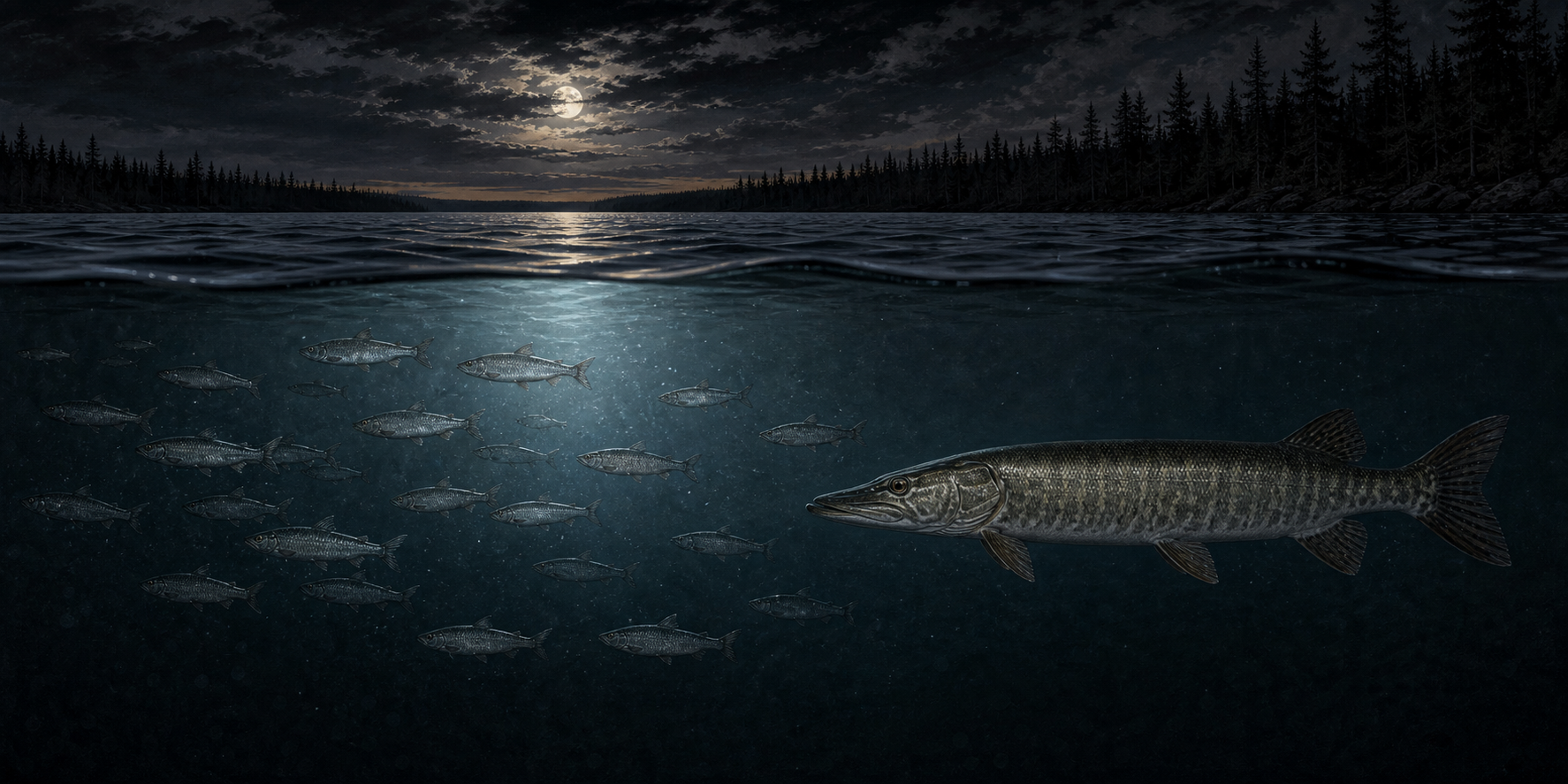
When the shoreline is the distraction
Most musky fishing begins with something you can point at: a weedline, a rock bar, an island, or a fallen tree. Open water feels different because there is no obvious target above the surface. On a clear, deeper lake such as Long Lake, however, the most important structure may be a school of cisco moving over the basin.
When muskies follow pelagic forage, they do not need to remain pinned to the bottom or the nearest weed edge. They can suspend beneath or beside the food. That makes the forage school itself the feature you are fishing. The challenge is to locate a stable band and present a lure where a musky can see and intercept it.
Find the food before choosing a lure
Start along a basin lip, long point, or saddle that gives you a clear route into deeper water. Use electronics if you have them, but look for consistency rather than one impressive mark. A useful forage band appears at a similar depth across more than one pass. Without electronics, pay attention to dimpling bait, diving birds, surface temperature changes, and repeatable arcs of activity at low light.
Do not automatically fish at the depth shown on the screen. A musky commonly attacks upward, especially in clear water. If the forage is suspended, keep the lure above the deepest marks so its silhouette remains visible. Fishing below the bait can put the lure outside the predator’s easiest viewing and striking lane.
Make the invisible spot repeatable
Choose a short transect you can repeat: across the tip of a point, along the basin lip, or through the densest portion of the forage band. Use a compass heading, shoreline reference, or waypoint so the next pass crosses the same water. Open-water fishing becomes much easier when it stops being random trolling or casting over an entire basin.
A weighted rubber bait or deep-running crankbait helps reach the zone while still allowing you to fish above the prey. Count the lure down, use a steady retrieve, and add one purposeful speed change rather than constant jerks. The lure should look like an isolated, vulnerable member of the school—not something fleeing in a different layer of water.
What moonrise changes—and what it does not
Moonrise can be used as a timing cue, especially when it overlaps fading light, calmer boat traffic, or a weather change. It does not create fish where there is no food. Treat the moon as a reason to be on your best forage line at the right moment, not as permission to ignore everything you observed during the previous hour.
In clear water, keep boat noise and unnecessary lighting down. Set up the pass before the window arrives. When a fish follows, note the direction it came from and the depth of the lure. That observation is more useful than the moon phase by itself because it tells you how the fish actually used the forage band.
Know when to return to physical structure
Give the basin pattern a defined test. If two or three careful passes show no stable forage, no follows, and no repeatable signs of life, move back to the nearest point, saddle, or weed edge. Open water is not automatically more sophisticated; it is only better when the prey is truly there.
The useful lesson is that “structure” is whatever organizes the fish. Sometimes that is rock or vegetation. On the right evening, it is a moving school of cisco over forty feet of water. Your job is to identify which kind of structure is active and keep the lure in the water layer a musky can actually use.