
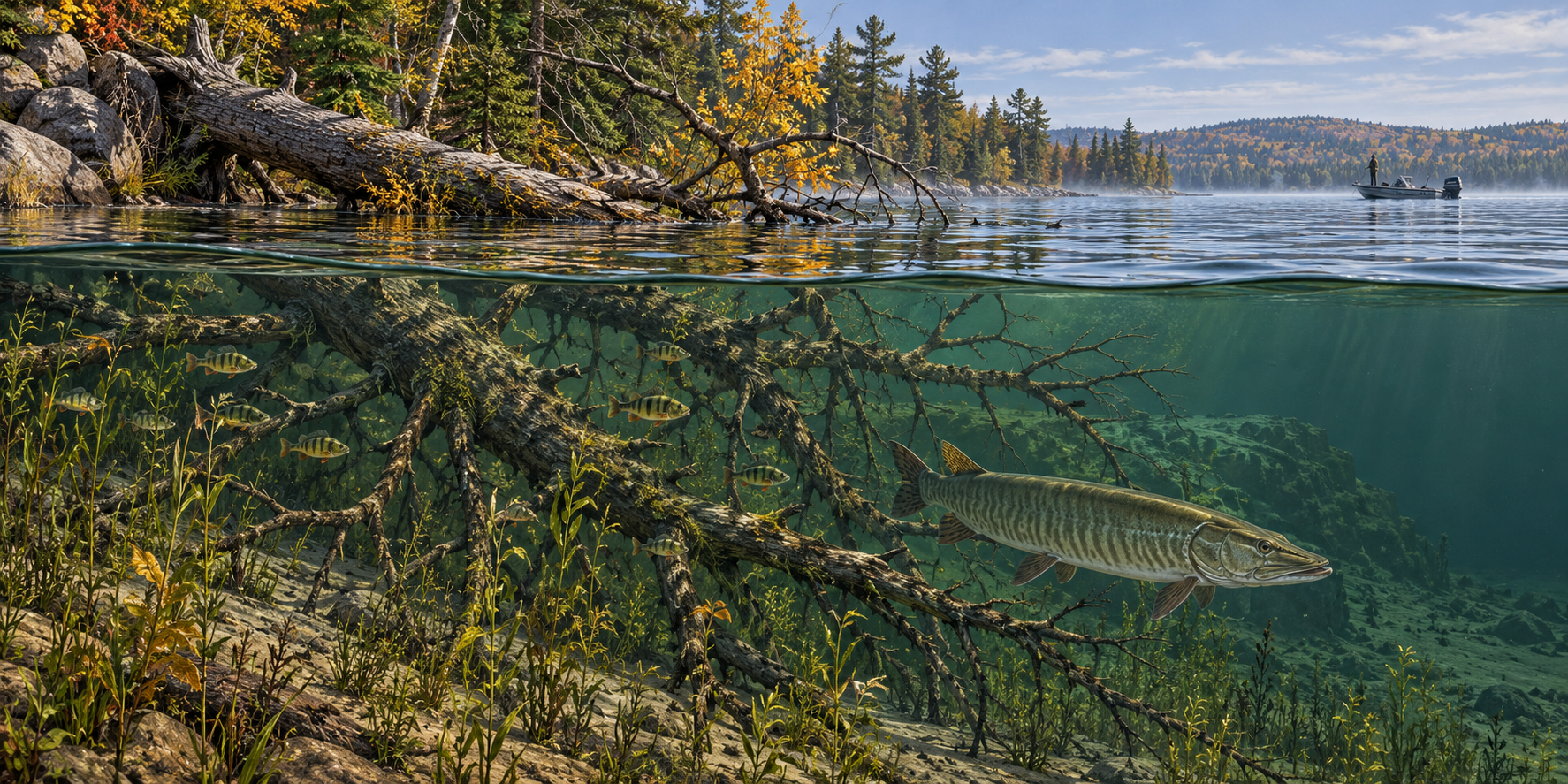
A laydown is a map, not a dot
A fallen tree is easy to reduce to one symbol. Mark the trunk, call it wood, and move on. Underwater, however, two trees of equal length can create completely different places. One may be a smooth pole over bare bottom. Another may divide the shoreline into shaded pockets, narrow travel lanes, prey refuge, and a clean edge where a predator can wait.
Fisheries researchers describe this material as coarse woody habitat. Its value does not come from wood alone. Diameter, branch order, orientation, water depth, decay, nearby vegetation, and the spaces among limbs change how fish can move through it.
For a musky angler, that means the visible trunk is only the address. The useful questions begin at the first fork: Where can prey hide? Where can a predator see or accelerate? Which opening connects the shoreline to deeper water?
The scarce middle won the selection test
Researchers tested wood complexity directly in Forbes Lake, Illinois, using radiotelemetry on stocked juvenile muskellunge. Most available wood, 86 percent, was simple, generally a single trunk with few or no primary branches. Structurally complex wood made up 9 percent. Intermediate wood accounted for only 5 percent.
The juveniles used every complexity class, but they selected intermediate-complexity wood. The other classes were used in proportion to availability or avoided. The authors proposed that the middle level may balance prey availability, predator foraging efficiency, and refuge from predation.
That is a precise finding with a narrow boundary. It describes stocked juvenile muskellunge in one Illinois reservoir. It does not prove that adult fish in a Northwoods lake prefer the same branch count, season, depth, or shoreline setting. Its value is not a universal spot rule. It is evidence that the internal shape of wood can matter to muskellunge.
More branches are not automatically better
Structure creates both opportunity and friction. Branches can hold prey, interrupt current, cast shade, and break a large open edge into smaller decision points. They can also make a space so dense that a larger predator loses a clean approach or that an angler cannot present a lure through it safely.
The juvenile telemetry result did not identify the most complex wood as the preferred class. The selected middle suggests a tradeoff rather than a simple more-is-better relationship. An opening large enough for a fish to enter, turn, and leave may matter as much as the amount of cover surrounding it.
That distinction is useful in the boat. A bare trunk may offer little beyond a shadow line. A complete crown may protect prey but provide no workable lure path. The best fishable wood can be the piece with enough branching to organize the space and enough openness to create an edge.
The shoreline supplies the next generation of wood
A survey of 16 north-temperate lakes connected underwater wood to the forest standing behind it. Coarse woody debris density rose with riparian tree density and fell as shoreline cabin density increased. Undeveloped lakes averaged 555 logs per kilometer of shoreline. Within developed lakes, forested sites averaged 379, while cabin-occupied sites averaged 57.
The study projected that these losses could shape littoral communities for roughly two centuries. Large wood enters slowly, remains for a long time, and cannot be replaced by one quick landscaping decision.
This does not mean every developed shore is poor musky habitat or every wooded shore holds a fish. It establishes a long-term supply relationship. The forest at the water's edge is part of the lake's future structure.
Removing wood can reorganize a food web
In Little Rock Lake, Wisconsin, researchers removed more than 75 percent of the coarse woody habitat from one basin while leaving a reference basin unchanged. Before removal, the two food webs were similar. Afterward, largemouth bass in the treatment basin ate fewer fish, relied more on terrestrial prey, and grew more slowly than bass in the reference basin.
Yellow perch in the treatment basin fell to extremely low density amid predation and little or no recruitment, while consecutive successful cohorts replenished perch in the reference basin. The experiment involved bass and perch rather than muskellunge, so it cannot be converted into a musky location formula.
It does show that wood can function beyond the individual fish holding beside it. When enough structure changes, feeding, refuge, spawning substrate, recruitment, and predator-prey contact can change together. A log is part of habitat architecture, not just a casting target.
Fish the openings, not the bark
Before casting, divide a laydown into working zones. Find the first outside fork, the darkest interior pocket you can reach without burying the lure, the tip of the longest branch, and the route from the wood to the nearest depth break or vegetation edge. Those are separate presentations, even when they belong to the same tree.
Approach from an angle that keeps the lure moving past openings instead of straight into a wall of branches. A parallel or quartering path can expose the lure to several windows while preserving a clean exit. Keep enough distance that the boat does not occupy the only open lane.
Rank the tree only after the pass. Record whether prey was present, how many usable windows existed, the depth at the outside branches, the nearest escape depth, and where any follow began. A dramatic tree with no prey or exit route should be allowed to lose to an ordinary-looking one with better geometry.
Run the three-ring wood test
Choose three short shoreline sections on the same waterbody: one dominated by simple trunks, one by moderately branched wood, and one by dense crowns. Keep the depth range, time allocation, lure family, retrieve-speed class, and weather window as similar as practical. Rotate the order on later trips so the first section does not always receive the earliest light.
For each piece, store branch-complexity class, submerged length, maximum fished depth, nearby vegetation, prey seen, shade, approach angle, lure path, blank minutes, follow, strike, and catch. Count a fish first seen off the tip differently from one that emerged from the interior.
The branch-window theory gains support if intermediate wood produces more contacts per unit effort across repeated matched passes and if those contacts cluster at openings connected to deeper water. It loses support if simple or dense wood performs equally well, if prey presence explains the pattern better, or if contacts track another feature such as rock, weeds, temperature, or current.
Restoration is not instant replacement
A whole-lake addition experiment placed coarse woody habitat into Camp Lake after two years of pre-treatment study and monitored both treatment and reference basins for four more years. Fish behavior and diet changed, and habitat use was positively related to wood abundance and branching complexity. The researchers did not detect a short-term change in fish population dynamics.
That is important disconfirming evidence for any simple claim that adding trees quickly creates more fish. Habitat can redistribute use, change prey availability, and alter feeding before a population-level response becomes measurable. Water level, time, lake productivity, existing structure, and the species present can all limit the response.
Wisconsin's Fish Sticks program treats woody-habitat projects as permitted restoration work, not casual shoreline disposal. Property owners and lake groups should work through the DNR permit process and local fisheries staff rather than dropping trees without authorization.
Let the tree earn the waypoint
Wood deserves attention because it can shape a shoreline at several scales. It does not deserve automatic faith. Juvenile telemetry, whole-lake experiments, and shoreline-development studies all show that structure matters, while also showing that the response depends on complexity, context, species, and time.
The practical upgrade is modest: stop saving every trunk as the same icon. Save the opening, the outside fork, the connected depth, the prey, and the result of the pass. If the same type of branch window produces contacts again, the pattern has begun to earn confidence.
A tree becomes useful fishing knowledge only when its geometry is connected to repeated evidence. Until then, it is wood with a good story.