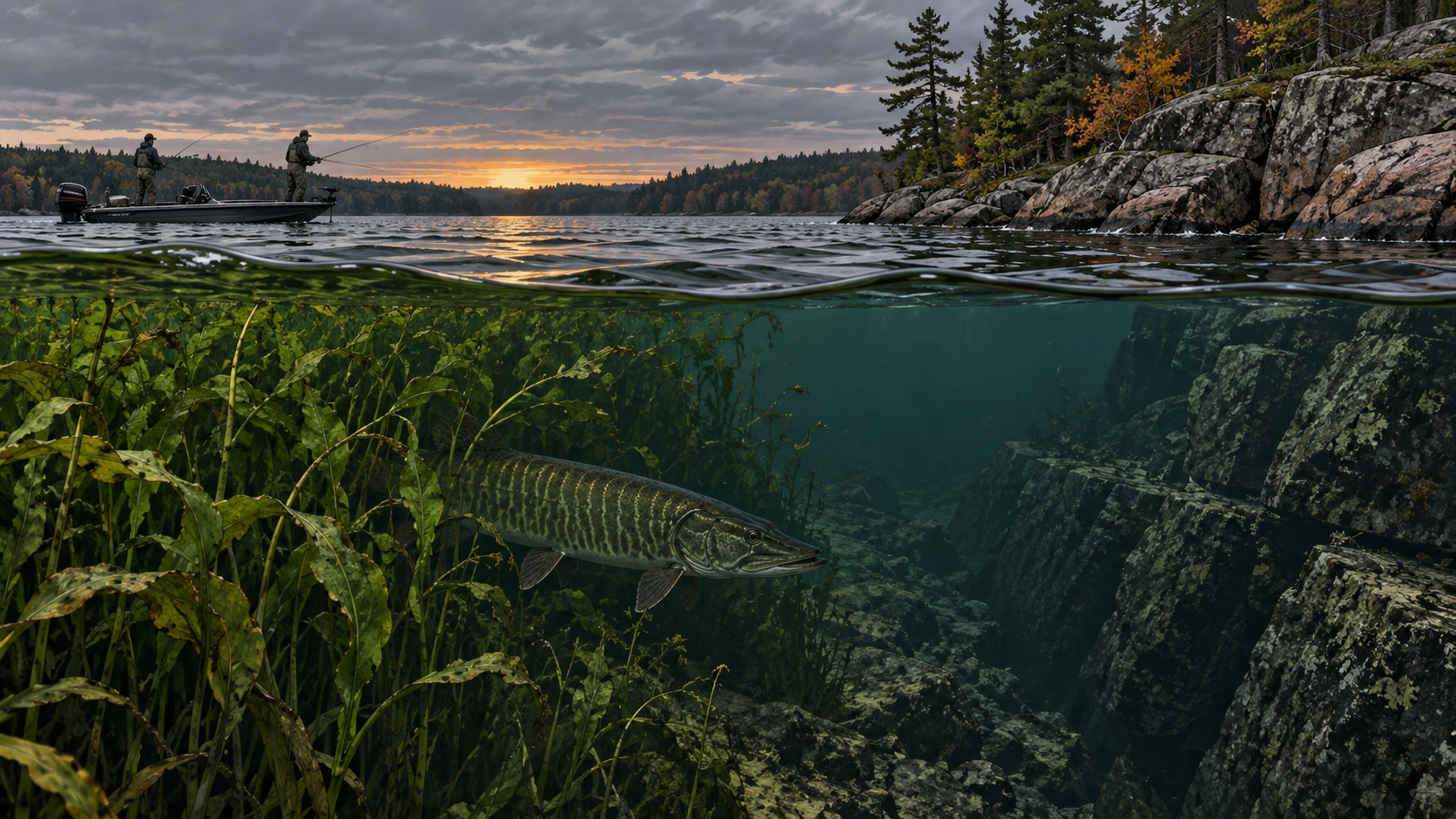
Weeds or rocks is usually the wrong question
Musky anglers love clean categories. Fish the cabbage. Fish the rock. Choose one pattern and commit. The lake rarely separates itself that neatly.
Wisconsin DNR describes muskellunge as ambush predators that use vegetation, rocky bars, ledges, and shoals. The same state guide also notes that some fish leave the shoreline and suspend with open-water prey. That is a wide habitat menu, not a command to spend the day on one kind of cover.
The useful question is not whether weeds beat rocks. It is what each piece of habitat lets a fish do, and where those functions overlap.
Cover is a job, not a material
Vegetation can provide concealment, shade, prey, and a physical edge. Rock can create an abrupt depth change, a firm travel line, current deflection, or a place where forage concentrates. Wood, sand, basin water, and channels can perform parts of the same work.
A federal muskellunge habitat model summarizes the species as commonly associated with aquatic vegetation or submerged structures such as rock reefs and fallen trees. That is habitat-suitability guidance, not a promise that an adult fish occupies every attractive object.
Research also warns against flattening all muskies into one behavior. Studies of stocked yearlings and wild juveniles have found vegetation, depth, and offshore use changing among waters and through time. Those fish are not perfect stand-ins for large adults, but they make one point clearly: habitat use is conditional.
Find the handoff
A long weed edge can hold fish. A rock point can hold fish. The higher-information target is often the handoff between them: cabbage tapering onto broken rock, a boulder point touching the outside weedline, a hard-bottom saddle between two vegetated flats, or a rock spine ending beside the first deep basin water.
These intersections compress choices. A musky can hold inside cover, slide along an edge, drop into depth, or intercept prey crossing from one habitat to another. The angler can test several of those routes without running to a new spot.
This is a practical inference, not a universal biological law. If the vegetation is dying, the rock is featureless, the prey is elsewhere, or fishing pressure has displaced fish, the cleanest-looking intersection can still be empty.
Read the seam in three dimensions
Do not mark the transition with one waypoint and call it finished. Trace where the weed tops rise and fall. Find the first hard return beneath the outside stalks. Note where the rock changes from scattered stone to a defined break and where the break reaches the nearest deep water.
The best cast may run parallel to the edge, cross it at an angle, or begin over rock and finish beside weeds. Each route asks a different question. Parallel casts test fish traveling the seam. Cross-casts test whether fish are holding on one side and willing to intercept across it.
Boat position decides whether those casts are possible. Hold far enough away to keep the transition intact, but close enough to control depth, clear weeds, and finish every cast safely beside the boat.
Let the lure prove where the fish is
Begin with a presentation that can survive both habitats. It should run cleanly over the vegetation, remain controllable across rock, and hold its depth through the seam. The exact lure family matters less than whether it completes that job.
If the first pass produces nothing, change the route before changing the entire tackle box. Move the boat slightly deeper. Reverse the angle. Run one pass that spends more time over the weed crown and another that traces the first hard drop. A contact becomes more useful when you know which side of the handoff produced it.
A lure that constantly fouls in weeds or crashes uncontrollably into rock is not testing the fish. It is testing the limits of the presentation.
The smallest useful transition test
For ten comparable spots, identify the smallest feature where two habitat types and a depth option meet. Give each spot the same number of controlled passes before moving on. Record the exact contact position rather than only the lake or general shoreline.
The theory gains confidence if follows, strikes, or fish seen on electronics repeat near the compact handoff more often than on adjacent uniform cover after effort is included. It loses confidence if contacts distribute evenly, cluster on pure weeds or pure rock, or follow prey that is clearly separated from both.
The goal is not to prove that mixed habitat always wins. The goal is to learn whether a particular lake turns transitions into repeatable musky routes.
What can break the pattern
Season can move the prey and the fish beyond the visible edge. Water clarity can extend vegetation deeper or reduce the value of shallow cover. Wind, current, oxygen, temperature, light, and fishing pressure can make the same structure function differently from one day to the next.
Life stage matters too. Much of the detailed vegetation research involves juvenile or recently stocked muskellunge. Spawning-habitat research answers a different question than late-summer adult angling. None of it supplies a universal cast, depth, or strike probability.
That uncertainty should change the plan, not weaken it. Treat the weed-rock handoff as a high-information starting point. Then let contacts, prey, current conditions, and the empty passes decide whether it deserves another hour.
Two addresses, one decision point
A musky does not have to choose an identity as a weed fish or a rock fish. It needs a useful place to feed, rest, travel, or adjust to changing conditions.
The angler's advantage comes from finding spots that preserve more than one of those options. Healthy cabbage touching broken rock beside depth is not automatically a fish. It is simply a place where several explanations can be tested on the same pass.
Fish the handoff carefully enough that, when something follows, you can say which address it came from.