
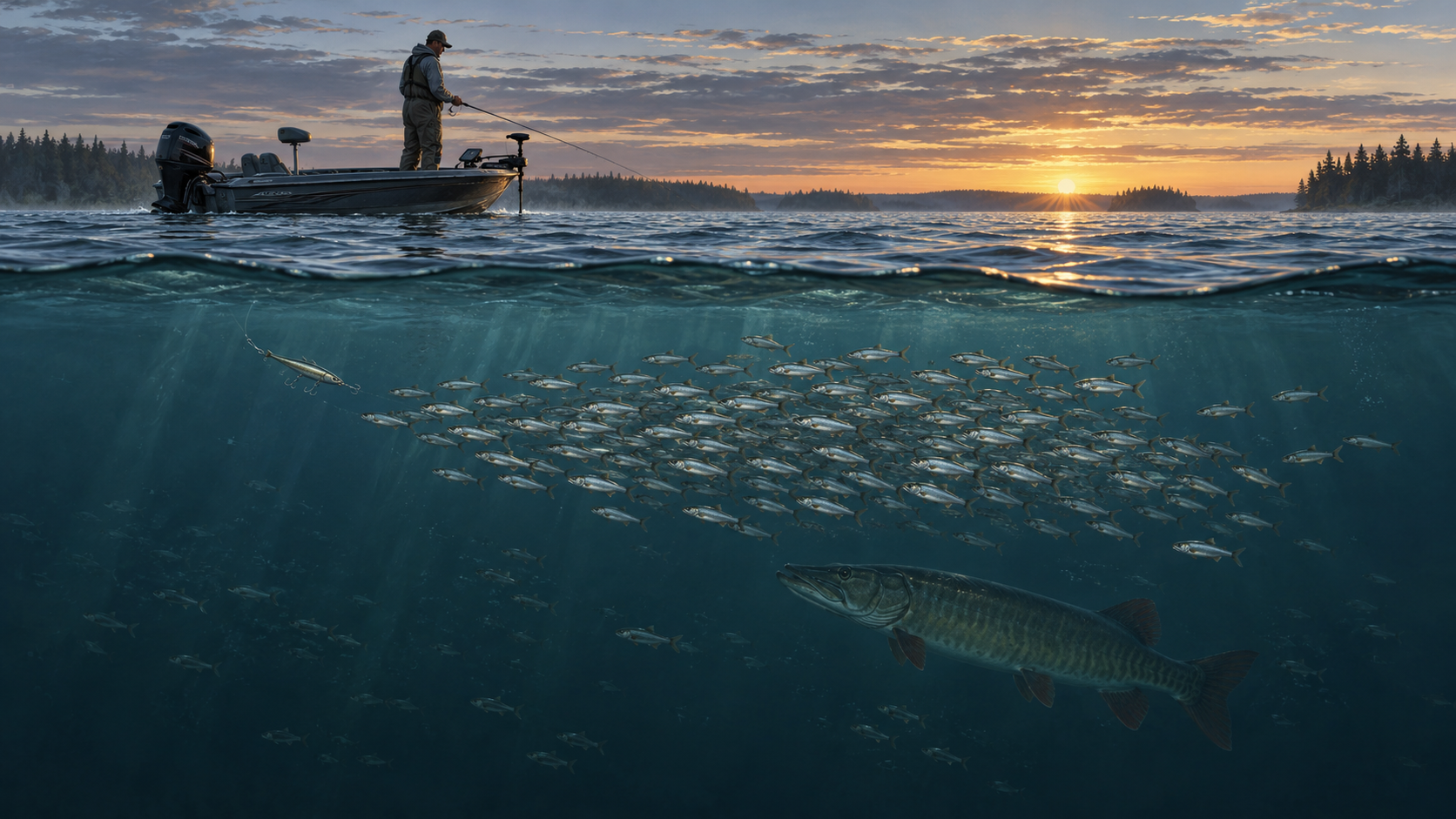
The shoreline is only one map
A good weed edge makes sense immediately. It has a visible boundary, a casting direction, and a place to begin the next pass. Open water removes that comfort. The surface looks identical in every direction, and the nearest shoreline may have nothing to do with the fish beneath the boat.
Wisconsin DNR makes the offshore possibility explicit. Its muskellunge guide says that fish in some waters move away from shore and remain suspended over deep water, commonly with open-water prey populations such as cisco, yellow perch, or crappie.
The important words are in some waters. Offshore suspension is documented musky behavior, not a claim that every lake, season, or individual fish belongs in the basin. The first decision is whether the lake and the day provide a credible open-water reason to search.
Forage can move like structure
Rock does not move. A cabbage edge may bend, thin, or break, but it usually gives the boat a fixed reference. A suspended bait school is different. It can rise, sink, tighten, scatter, or slide across the basin while the angler is making a pass.
That does not make the water random. A school still has edges, depth, direction, and a relationship to the lake beneath it. If bait repeatedly gathers above a basin lip, saddle, channel swing, or steep break, the forage and the fixed feature create two addresses for the same piece of water.
Treat the school as temporary structure only after it repeats. Save the depth of the top and bottom of the bait, the direction it extends from the boat, the nearby bottom depth, and what remains on the return pass. A single bright cloud is an observation. A recurring forage lane begins to become a pattern.
Cisco matter, but they do not settle the question
A 2020 study compared muskellunge populations in northern Wisconsin lakes with and without cisco. The authors concluded that cisco were important to some aspects of musky population ecology, while also warning that other factors may contribute to the differences among lakes.
That is useful evidence for taking cold-water forage seriously. It is not proof that the largest musky in a cisco lake is always suspended beside a school, or that every large screen mark near cisco belongs to a musky.
Diet research from Minnesota reinforces the need for restraint. Muskellunge eat a varied menu alongside other predators. Available prey, fish size, lake community, season, and opportunity all shape what gets eaten. Cisco presence creates a plausible offshore food pathway, not an automatic waypoint.
Build the pass around a vertical lane
Shoreline anglers often describe a cast by distance from cover. In the basin, depth becomes the clearer language. Begin with the band occupied by forage and ask how long the lure can remain in, above, or across that band while staying under control.
A lure running well beneath the prey may be precise but irrelevant. A lure that rises far above the school may leave the useful lane too early. The practical goal is not to touch the bait. It is to present where a predator can separate one target from the group without forcing the retrieve into an unsafe or uncontrollable depth.
Change one vertical variable at a time. Adjust running depth, count-down, boat speed, lure weight, or cast angle, but keep enough of the pass constant to learn from a follow or refusal. Open water becomes impossible to interpret when every cast occupies a different slice.
Use two witnesses before committing
An isolated target can hold an angler's attention longer than it deserves. Before committing to a basin area, look for a second witness. It might be repeated bait at the same depth, a nearby bottom transition, a contour pinch, a temperature boundary, or the same target position on a second clean pass.
The witnesses do not need to prove a fish is a musky. Their job is to make the next presentation testable. A school that returns over the same basin edge gives the boat a route. A single mark over featureless water gives the boat only a memory.
Save the relationship, not just the waypoint. Record where the bait began and ended, which side held the larger target, how the wind moved the boat, and whether the contact appeared above, below, inside, or outside the forage.
Open water still requires an exit plan
A basin cast still ends at the boat. Choose the lure depth and line angle with the last twenty feet in mind. A bait that cannot be controlled beside the hull, or that arrives under the boat with too much slack, gives away the most visible part of the retrieve.
Boat traffic and trolling lanes also change what is safe. Do not drift blindly across another boat's path while watching a screen, and do not let the search for one target replace ordinary navigation. An offshore plan is only useful when the angler can maintain awareness above and below the water.
The cleanest pass follows a defined lane, keeps the lure in a chosen depth band, and ends with room for a controlled turn. If the forage moves, rebuild the lane rather than stretching the old waypoint into a new story.
The moving-edge test
Choose several open-water areas where suspended forage appears. Divide them before fishing into two groups. Group A has forage plus a second stable reference, such as a basin lip, saddle, or recurring depth boundary. Group B has forage or a large mark without that second reference.
Give each area the same reasonable fishing time with the same lure family and depth class. Record bait depth, bottom depth, school shape, target position, wind, pass direction, follows, strikes, catches, and blank passes. Rotate the order so the stronger light or feeding window does not always favor one group.
The theory gains confidence if two-witness areas produce more contacts per hour and more repeatable return passes. It loses confidence if isolated schools perform equally well, if the stable feature stops predicting bait position, or if temperature and season explain the contacts more clearly.
What can make the basin wrong
The open-water pattern can fail because the prey moved, the fish shifted to shoreline cover, the usable temperature or oxygen band changed, the target was misidentified, or the lake never supported a meaningful pelagic prey pattern in the first place.
Even in a lake with cisco, individual muskellunge can use different portions of the system. Research linking cisco to musky population traits does not identify today's fish location, and diet research does not establish that one prey species dominates every water or season.
No source used here supplies a universal bait depth, distance from a school, lure size, trolling speed, or conversion rate. The durable lesson is narrower: open water is habitat when evidence gives it shape. Let forage suggest the first line, demand a second witness, and leave when the pattern stops repeating.