
A clean percentage became a messy rule
Musky anglers love a ratio because a ratio can ride in the boat without taking up storage. If a predator prefers prey around 40 percent of its own length, the arithmetic seems to choose the bait. A 50-inch fish points toward a 20-inch meal, and the tackle decision appears finished before the first cast.
The number is not imaginary. It comes from real feeding experiments. The mistake begins when a result from juvenile hybrids, controlled prey densities, and two prey shapes becomes a universal law for adult wild muskellunge and artificial lures. The useful question is not whether 40 percent ever matters. It is what the number actually measured.
Wild Wisconsin muskies ate across a broad range
From 1991 through 1994, researchers examined 1,092 muskellunge captured in the littoral zones of 34 Wisconsin waterbodies. The fish ranged from 226 to 1,180 millimeters in total length. Food was found in 375 stomachs, or 34.3 percent of the sample, and 74 percent of those stomachs contained a single item.
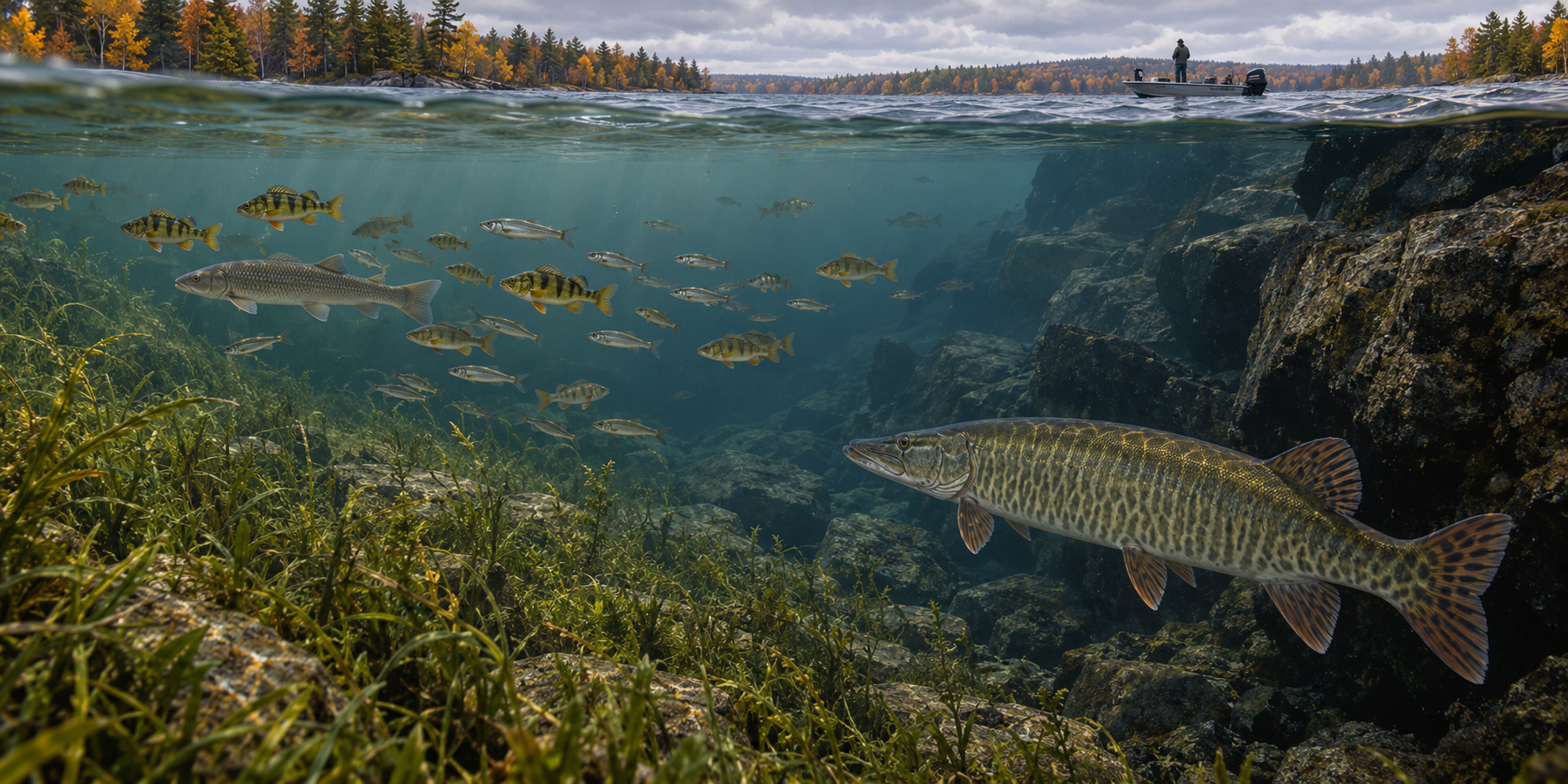
The prey record was diverse: 547 fish from 31 species, plus 35 nonfish items. Fish made up 98 percent of the diet. Yellow perch and white suckers were the leading foods across seasons, but measurable prey fish ranged from 6 to 47 percent of musky length. Larger muskies ate longer prey on average, while the prey-to-predator proportion remained similar across musky sizes. That is a relationship, not a single compulsory ratio.
Where the 40 percent result came from
A 1981 experiment worked with pellet-reared tiger muskellunge, the hybrid offspring of muskellunge and northern pike. In aquaria, fish measuring 86 to 310 millimeters selected cyprinid minnows near 40 percent of their own length and bluegills near 30 percent. Those sizes also fit an optimal-foraging calculation that compared the time needed to capture and swallow prey with the prey's dry weight.
That is a strong result inside the experiment. It is also much narrower than the rule it became. The predators were juvenile hybrids transitioning from pellets to live prey. Prey density was held constant. Minnows and bluegills offered different shapes and defenses. The study did not test mature wild muskellunge, fall lake conditions, artificial lures, or whether the largest available target would trigger the most strikes.
Length is only one dimension of a meal
A long white sucker and a bluegill of the same length do not present the same swallowing problem. One is relatively narrow and cylindrical. The other is deeper-bodied and carries stiff spines. The tiger musky experiment itself reflected that difference: the selected bluegills were shorter relative to predator length, and the hybrids converted to a bluegill diet more slowly than to minnows.
Controlled northern pike research gives the mechanism useful context. Maximum ingestible prey size was limited by prey body depth, while handling time increased as prey became deeper-bodied. Pike are not muskellunge, so that result cannot provide a musky lure formula. It does show why length alone is an incomplete description for a gape-limited esocid handling a whole fish.
Available is not the same as theoretically optimal
The Wisconsin diet study found that prey importance changed by taxon, season, and waterbody. Yellow perch and suckers were prominent when readily available. That phrase matters. A predator cannot choose a profitable prey size that it does not encounter, and a rare large meal may contribute less to the actual diet than a steady supply of smaller prey.
Stomach contents also show what was swallowed, not every prey item inspected, followed, missed, or rejected. The sample leaned on fish captured in littoral zones and the authors specifically called for more work in deep offshore habitat and lakes with different prey communities. The record is broad enough to defeat a rigid ratio and still too bounded to produce a universal replacement.
A lure is not measured like a dead fish
An artificial lure adds variables that a prey-length percentage cannot hold. A ten-inch glider can present a broad side profile, pause, and reverse direction. A longer soft plastic can fold during a strike. A bucktail's blades, flash, vibration, and skirt can create an apparent target larger than its measured body. Running depth and closing angle change the encounter before size gets a vote.
This does not mean lure size is irrelevant. It means size belongs inside a job description. The lure must travel through the right water, remain controllable at the intended speed, clear or contact the available cover, and offer a profile the fish can intercept. A theoretically ideal meal moving outside the encounter window is still unavailable.
Run a paired profile test
Choose two lures from the same functional family with similar action and running depth but meaningfully different length or body depth. Fish matched passes through the same zone. Alternate which size goes first, hold retrieve class and boat path as steady as practical, and record follows, turns, strikes, and catches rather than catches alone.
Before fishing, record the forage you can actually observe. Separate apparent length into small, medium, and large classes, then record body shape as narrow, moderate, or deep. Sonar can estimate target size poorly when angle and range change, so keep uncertain observations uncertain. A seine, agency survey, or identifiable surface school can strengthen the record, but none should be stretched beyond what it measures.
Let the fixed-ratio theory lose
The two-axis forage theory predicts that lure profile will become more repeatable when apparent forage length and body depth are stored together. It gains support if narrow long lures outperform deep profiles around long cylindrical forage while shorter deep profiles improve around perch or sunfish, after location, depth, speed, and pass order are controlled.
It loses support if lure-size results remain inconsistent after enough matched passes, if the same profile succeeds across contrasting forage classes, or if depth and retrieve explain contacts better than profile. A large lure may still be correct because it runs at the needed depth, stays visible, or can be controlled in wind. A small lure may still be correct because it can be placed more often inside a tight encounter window. The percentage should help frame the question, not answer it alone.
The lake does not carry a ruler
The strongest field evidence says two things at once. Muskellunge size and prey size are related, and wild muskies eat across a wide proportional range. Shape, species, availability, habitat, season, and individual opportunity keep that relationship from collapsing into one number.
Use the 40 percent result for what it is: a revealing outcome from a specific experiment. Then look over the side of the boat, study the prey community, and choose the lure that can do today's job. The lake is full of meals, not equations waiting to be obeyed.