
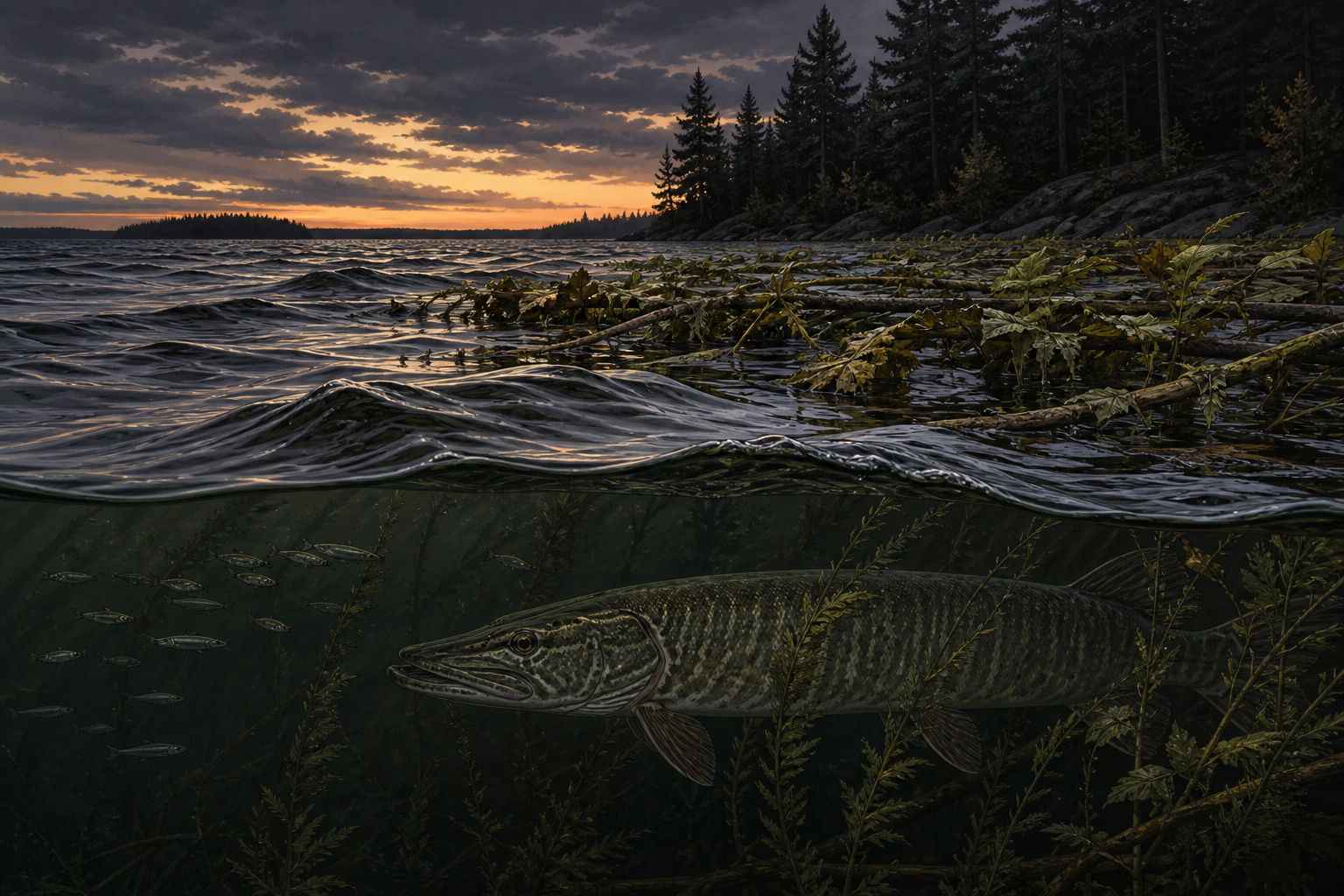
September by calendar. Summer by water.
September arrived in Three Lakes behind a wall of fog. A TLWA-linked real-time sensor read 71.7°F at 8:57 in the morning while the day prepared to climb well into the 80s.
That puts the chain in an interesting place. Summer is losing daylight, but it has not lost control of the water. This is probably not the day to abandon every summer pattern and fish as though October has arrived.
Begin on the edges while the fog holds
Low light favors a deliberate first pass along healthy weed lines, channel mouths, points beside vegetated bays, and the narrow connections between lakes. Wisconsin DNR identifies weed beds and protective cover as characteristic musky habitat.
Use the fog as a reason to test these ambush zones early. It is not proof that every fish has moved shallow. A follow, strike, forage school, or repeatable mark should decide whether the pass deserves more time.
Move outward as the day opens
As the fog burns off and west wind builds, expand the search to outside weed edges, breaks beside shallow feeding areas, channel entrances, and wind-contact structure. Larger basins such as Planting Ground, Big Stone, Big Fork, and Big Lake give fish more room to move between cover and deeper water.
A fish using a shallow edge under fog does not need to disappear when the sun arrives. It may only reposition to the next outside edge, nearby break, point, or channel route associated with prey.
Chase transition routes, not a fall label
The central working theory is simple: do not chase fall muskies yet. Chase the routes connecting a useful morning edge to a more secure afternoon position.
Wind-contact shorelines and points are worth testing because wind can reorganize shallow forage and create short feeding opportunities. This remains a hypothesis because there is no live baitfish telemetry or sonar observation proving where prey moved today.
Be ready when the light falls again
The late-afternoon-to-sunset stretch receives the day's highest Musky Moon rating, roughly 5:30 to 8:00 PM Central. Warm water, building wind, and falling light give ambush structure another chance to become useful.
Start with wind-contact points and weed edges, then slide toward connecting channels if follows disappear. The rating is a model judgment and must be tested against actual contacts.
Keep the moon in its place
The waning gibbous moon is recorded with low weight. Musky Moon should earn any future lunar weighting from local results rather than assume a traditional solunar claim is true.
Handle every fish efficiently
The measured 71.7°F water was below the 77°F threshold where experimental research found increasing catch-and-release mortality. That does not make release risk zero. Keep the fight controlled, reduce net and air time, and return the fish efficiently.
September is here. Fall is not. The gap between the two may be exactly where today's fish are holding.