
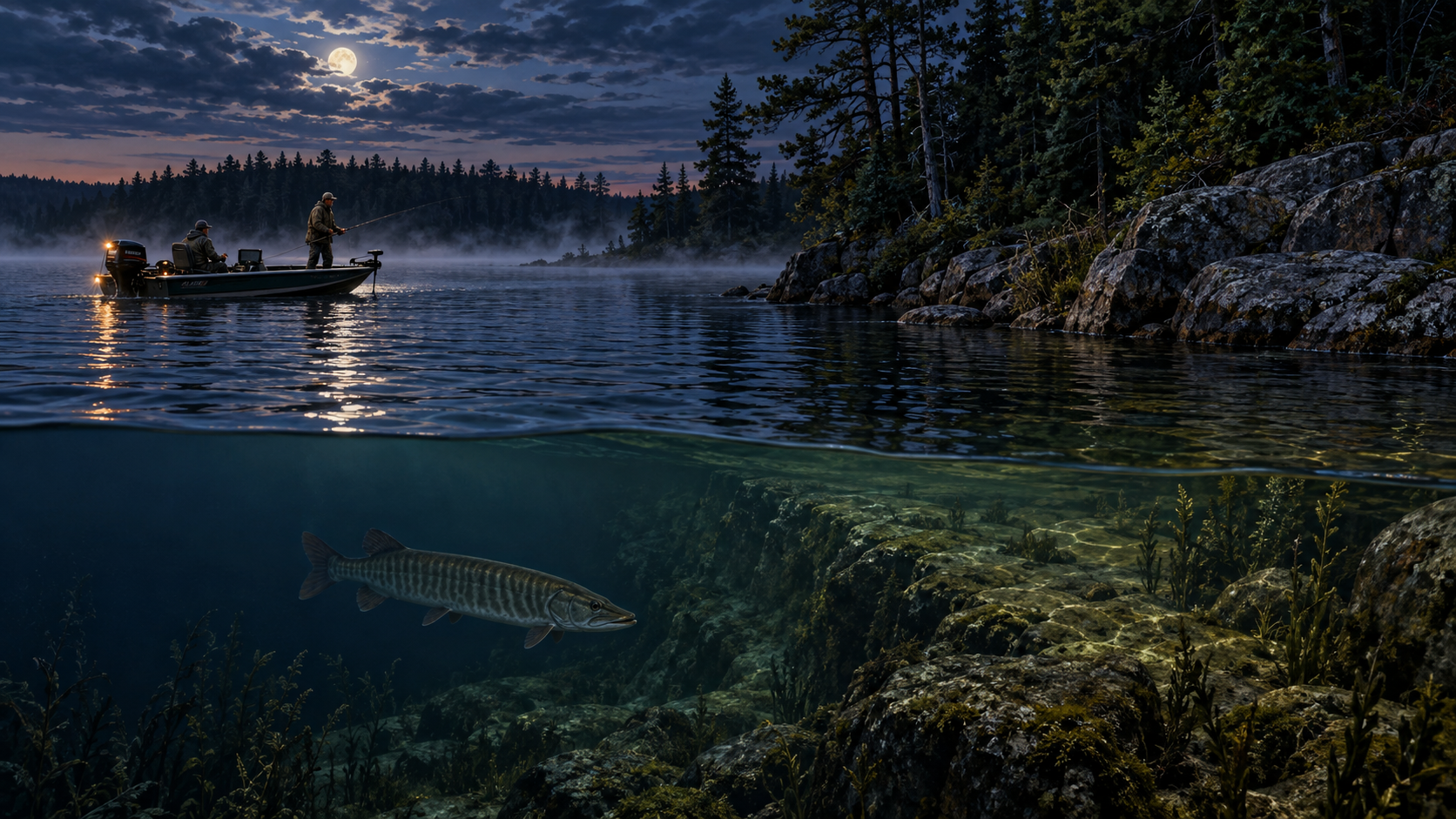
The moon has earned a place in the notebook
Musky anglers did not invent the lunar argument yesterday. Moon phase, moonrise, moonset, overhead, and underfoot periods have been written into fishing calendars and boat conversations for generations. The useful question is no longer whether anyone believes in it. The useful question is how large the signal is and what it can actually do for a day on the water.
A 2014 study analyzed 341,959 muskellunge catch records collected across North America from 1970 through 2013. More fish were recorded around full and new moons than during other parts of the lunar cycle. At night, the full-moon peak was stronger than the new-moon peak.
That is a real pattern in a very large catch archive. It is not proof that a musky must feed when the moon reaches a particular position, and it is not a forecast for one lake on one day.
Five percent is an edge, not a command
The 2014 analysis estimated a maximum relative effect of roughly five percent overall. In plain language, anglers fishing only on the modeled peak lunar day would be expected to catch about five percent more muskellunge than anglers fishing on randomly selected days, on average across the dataset.
That result matters because musky encounters are scarce. A small edge can still be worth using. It also sets a hard limit on the story. Five percent is not a promise that a full moon will rescue poor positioning, inactive fish, unsafe weather, or the wrong lure path.
The effect was not uniform. It was stronger for fish longer than 102 centimeters, stronger in midsummer than in June or October, and stronger above 48 degrees north latitude. Those differences argue against treating one moon rule as equally powerful everywhere and every month.
Catch records contain anglers too
A catch database measures successful encounters, not fish behavior by itself. Anglers may fish longer, return to better spots, choose different hours, or simply go out more often when a calendar marks a major period. The 2014 study had limited effort data and found a lunar pattern in angler effort on Lake Vermilion, so the authors could not assign the catch pattern entirely to muskellunge behavior.
The study also found similar lunar patterns among expert and occasional anglers, which weakens a simple explanation based only on experienced anglers scheduling trips around the moon. Even so, catch and effort cannot be fully separated across the entire archive.
The honest conclusion is narrower and more useful: lunar timing is associated with muskellunge catch, while the biological mechanism and the share caused by angler behavior remain uncertain.
Phase and position ask different questions
Moon phase describes where the moon sits in its roughly 29-day cycle. Moon position describes moments such as overhead, underfoot, rise, and set. Those variables often get compressed into one phrase even though they describe different timing systems.
A 2021 Escanaba Lake analysis used compulsory creel records from 2003 through 2015. It reported that lunar phase and overhead or underfoot position contributed to muskellunge trip success or catch-rate models. The same study also found effects from angler choices, light, air temperature, wind, and the proportion of the population previously caught during the season.
Night fishing was not legal in that research fishery, so lunar illumination could not directly explain the daytime and crepuscular results. The authors discussed other possible lunar cues but did not establish a mechanism. A moon calendar can identify a time. It cannot tell an angler why that time might matter.
Use the window to time a return
The strongest practical use is not driving past good water to reach a famous spot at an exact minute. It is ranking return opportunities. If one fish followed from a weed point, another appeared on a suspended forage edge, and a third high-confidence area has not been sampled, a lunar window can help decide which piece of evidence gets the next pass.
Arrive early enough to settle the boat and make controlled casts before the listed moment. Fish through the window rather than treating one minute as a deadline. Keep the route, lure family, running depth, and retrieve class recognizable so the fish response can be compared with the earlier pass.
If wind, lightning, access, temperature stress, or safe boat control argues against the plan, the moon loses. It is a scheduling input, never a safety exception.
Run a matched-window test
Choose several waters or repeatable routes and define equal fishing windows before the trip. One window should surround a lunar event such as overhead, underfoot, rise, or set. The comparison window should occur on similar habitat with the same duration, lure class, and effort but outside that event.
Rotate which window receives the best-known spot. Record blank effort, follows, strikes, catches, fish identity when recognizable, lure path, moon event, cloud cover, solar light, wind, air and water temperature, boat traffic, and whether the area held recent evidence before the test.
Do not score only catches. A follow during one window and a blank during another is still information, but it is weaker than a repeated pattern across many paired sessions.
What would make the moon less useful
The return-window theory should lose confidence if paired effort produces similar contact rates inside and outside lunar windows, if wind or light explains the contacts more cleanly, or if the apparent effect disappears when known-fish locations are rotated fairly between treatments.
It should also lose confidence when the result depends on one memorable catch. Rare events are powerful stories and weak samples. A moon pattern needs blank trips, ordinary follows, and failed return passes in the same record as the fish that finally ate.
Neither cited study proves that lunar timing will improve an individual angler's results on every water. One used voluntary catch records spread across many fisheries. The other studied one intensively managed Wisconsin lake with unusual permit and fishing-hour rules.
Let the moon break ties, not make decisions
The moon belongs beside wind, light, temperature, forage, pressure, fish contacts, and effort in a musky log. It does not belong above them all. Its best role is breaking a tie between otherwise defensible choices.
A five-percent average edge can matter in a fishery measured in long empty hours. The same number is too small to excuse weak planning or selective memory. Use lunar timing to organize attention, then let the water and the fish decide whether the pattern survives.
Put the moon in the log. Give it a fair test. Do not hand it the wheel.