
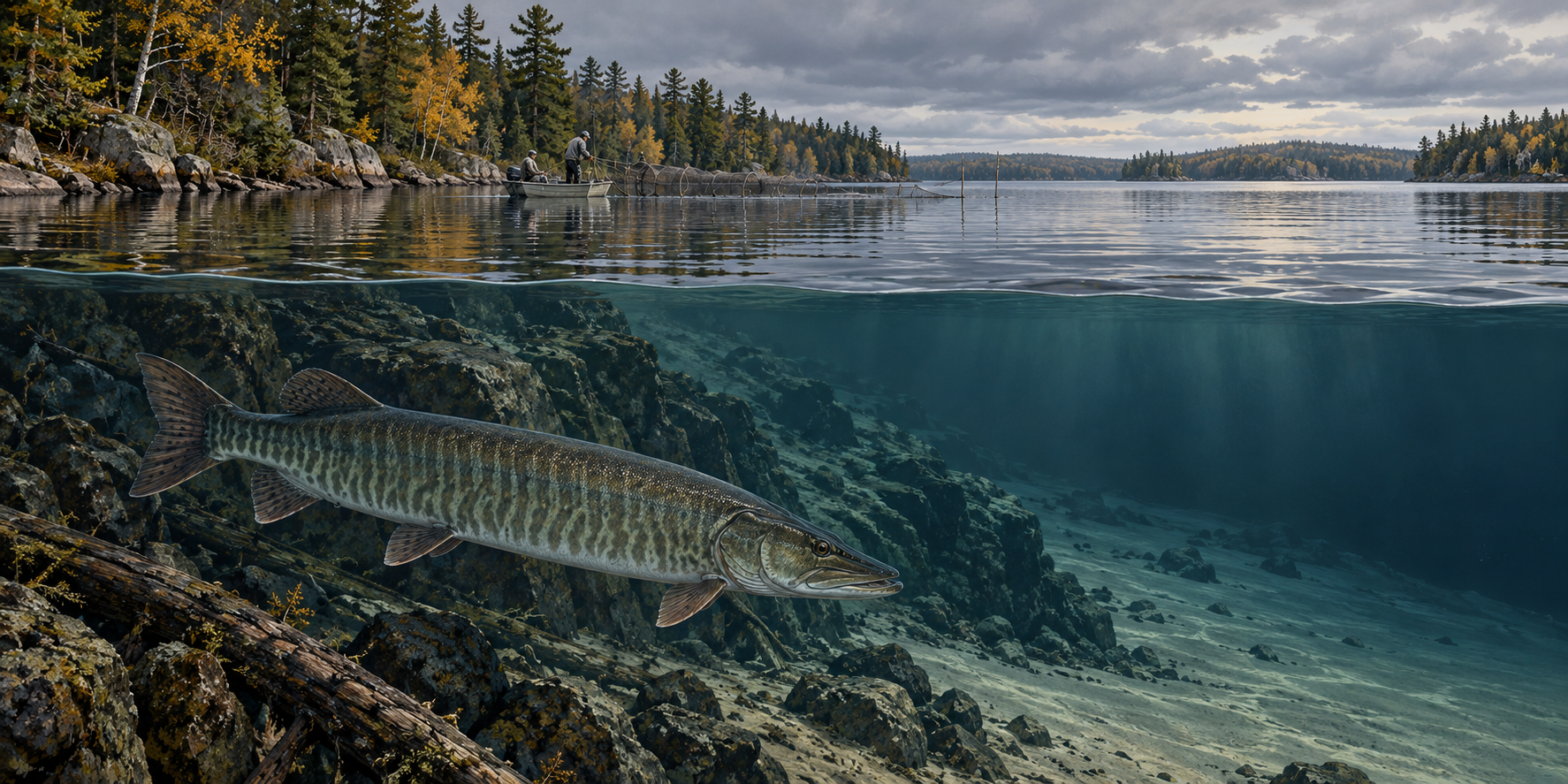
The same netting survey delivered two different headlines
Big Muskellunge Lake gave Wisconsin fisheries crews a result that resists the easy story. During spring 2026 surveys, the Department of Natural Resources captured 23 adult muskellunge, defined as sexually mature fish or fish at least 30 inches long. In targeted netting, adults were captured at 0.22 fish per net-night, a rate below the 25th percentile for the lake's class.
The same work produced a 51.3-inch female. Twenty-two percent of the captured adults were at least 40 inches, and the observed muskellunge length distribution ran from 27 to 51 inches. A low comparative catch rate and an exceptional individual appeared in one survey because they describe different parts of the fishery.
The 51.3-inch fish establishes presence. It does not estimate how many fish of that size live in the lake. The netting rate compares adult encounters per unit of survey effort. It does not erase the large fish or convert directly into an angler's odds on an October afternoon.
The largest fish is evidence of possibility, not the population
A maximum length is irresistibly memorable. It is also a single order statistic, the largest observation in one sample. If the largest fish had missed the gear, the survey would still describe the same lake, but the public story could sound entirely different. If another large fish entered a net, the headline number would rise without proving a sudden change in the population.
Wisconsin's own classification system recognizes the distinction. The DNR describes Class A1 waters as fisheries where overall numbers may be relatively low but caught fish have a larger average size. Class A2 waters are associated with more consistent action and better overall numbers, with large fish making up a smaller share than in A1 waters. Those categories are not labels applied here to Big Muskellunge Lake. They are evidence that abundance and size structure are separate management dimensions.
A useful reading of the 2026 result therefore keeps the big fish in scale. It is a verified sign that the lake can hold a fish over 51 inches. It is not a promise that the next follow, strike, or capture will be similar.
The low catch rate is comparative, not a fish count
The survey sheet reports 0.22 adult muskellunge per net-night and places that rate below the 25th percentile for the lake class. That is strong evidence that the gear encountered adults less often than it did on most comparable waters in the reference group. It is not a mark-recapture population estimate for muskellunge.
That difference is visible elsewhere in the same report. For walleye, crews captured 1,231 adults and used mark-recapture procedures to estimate 3,330 adults, or 3.6 per acre. The muskellunge section reports captures, catch per net-night, length distribution, and percentile, but it does not publish an adult population estimate.
Survey catch can be shaped by fish abundance, gear efficiency, spring location, sex, maturity, timing, temperature, and which fish were available to the nets. The percentile remains useful. It simply answers a narrower question than 'how many muskies are in the lake?'
Big Muskellunge is a deep system with a mixed recruitment story
The DNR describes Big Muskellunge as a 930-acre seepage lake with 10.2 miles of shoreline, a maximum depth of 70 feet, and predominantly sand, gravel, and rock bottom. It is classified as a complex two-story system. Those are important constraints on both survey interpretation and fishing strategy.
The report also says the muskellunge population is supported by limited natural reproduction and supplemental stocking. That wording matters. The adult group encountered in 2026 may reflect several year classes and more than one recruitment pathway. The report does not assign each captured adult to natural reproduction or a stocked cohort.
Research across northern Wisconsin lakes has found recruitment is influenced by more than stocking alone. Adult stock density, stocked-fish density, spring temperature, variation in spring temperature, and age-0 walleye abundance all explained some recruitment variation. One adult survey is a current window into the population, not a complete account of how those fish arrived.
More fish, larger fish, and heavier fish are not the same goal
Long-term Wisconsin work on Bone Lake shows why a fishery needs more than one scoreboard. From 1964 to 1995, estimated adult musky abundance increased 441 percent and mean adult length rose from 31.3 to 36.0 inches. Over the same study period, mean relative weight declined from 110 to 96. More fish and longer fish did not automatically mean fish in better condition.
A New River study made the same management point from another direction. Researchers evaluated size structure, individual condition, growth, mortality, and catch per unit effort, then modeled alternative length limits. They concluded that fishery quality includes catch rate and condition in addition to trophy production, and that a regulation optimized for one goal can create pressure on another.
Neither study predicts Big Muskellunge Lake. The systems, eras, and management histories differ. Together with Wisconsin's classification framework, they establish the durable idea: a musky fishery cannot be responsibly ranked by its longest fish, its raw fish count, or its catch rate alone.
Fish a low-contact possibility without fishing randomly
For an angler, the 2026 survey argues for disciplined expectations. A below-25th-percentile spring netting rate is not a reason to abandon the lake, and a 51.3-inch capture is not a reason to run every shoreline looking for a duplicate. The useful middle path is to cover a small number of routes that connect credible holding water with travel water.
On a deep seepage lake with sand, gravel, and rock, that might mean a rock-to-sand transition, the first major break outside a feeding shelf, or a corridor between the littoral zone and deep water. Those are habitat hypotheses, not current fish locations. Surface temperature, forage position, vegetation, wind, and recent contacts remain unknown until they are measured on the water.
Hold lure family and depth range steady long enough to test location. If every blank pass triggers a new bait, new depth, and new part of the lake, the day produces motion but little evidence. Low expected contact makes experimental discipline more valuable, not less.
Build an encounter-quality ledger
Choose three repeatable route types before the trip: a shallow-to-deep transition, a hard-bottom edge, and a suspended route over adjacent deep water. Give each route a fixed number of casts or minutes. Reverse the order on the next comparable trip so the same route does not always receive the best light or wind.
Record route length, depth band, bottom transition, visible forage, lure depth, retrieve class, wind, light, surface temperature, follows, strikes, catches, and blank effort. For every contacted fish, record an honest size class rather than stretching an estimate toward the survey's largest specimen.
The theory gains support if contacts cluster on one route type after effort and pass order are standardized. It loses support if the proposed routes perform no better than matched alternatives, if forage position explains contacts more cleanly, or if results disappear when light and wind change.
What the 2026 survey does not settle
The survey does not establish the lake's fall musky distribution, current water temperature, current forage location, angler catch rate, total adult abundance, number of fish over 50 inches, or the natural versus stocked origin of each adult. Those values remain unknown here.
The largest fish may be unusually large for the population, or additional comparable fish may have missed the gear. The low catch rate may reflect genuinely low adult density, limited net availability, timing, movement, or a combination. Future surveys and tagged-fish histories would help separate those explanations.
The honest conclusion is still useful. Big Muskellunge Lake produced verified evidence of an exceptional adult within a survey that encountered adults at a low comparative rate. The lake deserves neither a trophy fantasy nor a dismissal. It deserves two truths held at once.