
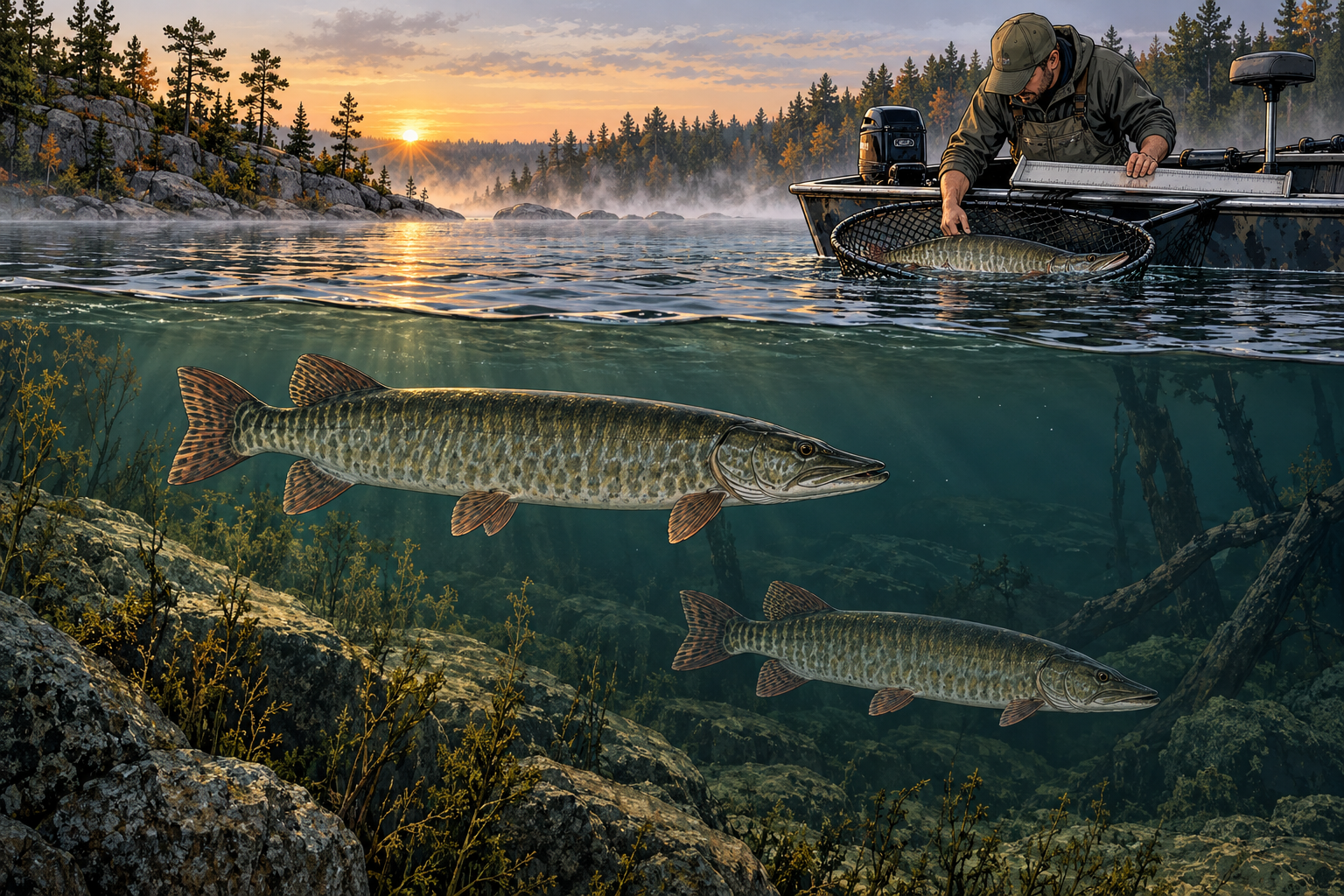
The fish gets a story before it gets released
A long musky comes over the net and the label often arrives before the hooks are out: she. A shorter, leaner fish is just as quickly called he. The habit feels harmless, but repeated guesses can harden into a false population story about which sex was caught, where it lived, and how it behaved.
The useful correction is not that size tells us nothing. Female muskellunge do tend to grow larger than males. The correction is that a group-level difference does not identify every member of the group. Length can shift the odds while the sex of the individual remains unknown.
That distinction matters whenever a fishing log is expected to teach us something later. An unknown field is honest data. A confident guess stored as fact can make a pattern look stronger than it is.
The averages really do separate
Wisconsin researchers had an unusually strong growth record because every extended-growth muskellunge fingerling stocked into ten northwestern Wisconsin lakes from 2009 through 2019 received an identifying tag. Recaptures could therefore be tied to known ages rather than ages guessed from length.
The fish grew rapidly to about 67 centimeters, or 26.4 inches, by age three. After that point, growth became sexually dimorphic. The study's model estimated an asymptotic length of 128.5 centimeters, about 50.6 inches, for females and 102.0 centimeters, about 40.2 inches, for males. The statewide 102-centimeter minimum was reached around age nine by females, while males took much longer or never reached it.
Those results establish a population tendency, not an identification rule. An asymptotic length is a modeled average trajectory. It is not a ceiling, a guarantee, or a boundary that turns every fish on one side into a male and every fish on the other into a female.
Overlap is the part the boat misses
A second northern Wisconsin study reconstructed growth from 305 muskellunge collected between 1995 and 2011. Estimated mean ultimate length was 49.8 inches for females and 43.4 inches for males. Even with that clear average separation, the study's individual estimates covered broad ranges and reflected differences among fish and waters.
Known-sex fish from Fox Lake, Wisconsin, show the same combination of separation and overlap. In capture-recapture work, median female length was 116.3 centimeters, about 45.8 inches, and median male length was 101.2 centimeters, about 39.8 inches. Only females reached the study's trophy threshold of at least 127 centimeters, or 50 inches, in that sample.
The extreme end can therefore carry strong information in a documented population. It still does not create a universal cutoff. A length that was female-only in one sample may not be female-only in a different lake, strain, year class, or growth environment.
A trained anatomical method is not a glance
Sex is not inherently unknowable in a living musky. A Canadian study published in 1989 evaluated external urogenital morphology against dissection in fish collected from two regions. The reported technique correctly classified all adults in that study and 92 to 98 percent of juveniles, depending on the group.
That result describes a specific anatomical examination performed by trained researchers. It does not validate guessing from overall body shape, head size, belly depth, coloration, or a photograph that does not clearly record the relevant anatomy.
For anglers, the welfare rule comes first. Do not extend handling, manipulate a fish unnecessarily, or improvise an examination merely to satisfy curiosity. If a trained determination was not made quickly and responsibly, the log can say unknown.
Put unknown where the evidence stops
Fisheries researchers already use this discipline. A New River muskellunge study applied sex-specific length-weight relationships when sex was known and a non-sex-specific relationship when it was unknown. The analysis did not manufacture a sex label to fill a blank.
A practical fishing log can use three states: verified, probable, and unknown. Verified should record the method and source, such as an agency record tied to a tag number or an examination by a qualified person. Probable should state the evidence and confidence. Unknown should remain the default when neither standard is met.
Do not turn probable into verified during later analysis. The uncertainty is part of the record, just like an unmeasured water temperature or an unconfirmed follow.
Sex changes the fishery before it changes the tactic
Sex-specific growth matters to management because the largest size classes can become increasingly female. Harvest, delayed mortality, escapement, or sampling that removes or misses those fish can change the apparent size structure without affecting males and females equally.
That does not mean an angler should assign a different lure, depth, or retrieve to every fish believed to be female. Length cannot separate sex from age, individual behavior, prey, season, temperature, reproductive condition, and the habitat available in a particular system.
A better working model is modest: use verified sex when it exists to test for differences, and keep the fishing pattern independent until repeated data show that sex adds predictive value beyond length, season, waterbody, and habitat.
Run a blinded calibration, not a dockside vote
Musky Moon's proposed experiment does not require extra fish handling. Use an agency dataset, a tagging project, or a set of records in which sex was already verified and can be temporarily hidden. Show participants only the ordinary information anglers claim to use, such as total length and a standardized side photograph, then record the guessed sex and confidence before revealing the verified label.
Score accuracy by length class, waterbody, participant, and confidence. Compare the guesses with a simple baseline that uses only the known sex ratio for that sampled population. A guesser who is accurate only on the longest fish but highly confident everywhere else has not found a general field method.
The calibration theory gains support if errors consistently label large fish female and medium fish male, or if confidence rises faster than accuracy. It loses support if blinded predictions remain accurate across independent waters and outperform population baselines after length distribution and sampling method are controlled.
The limits belong beside the conclusion
The known-age Wisconsin study involved stocked fish in ten northwestern lakes. The 305-fish growth study relied on cleithra and reconstructed histories. Fox Lake supplied a valuable known-sex sample, but its length distribution and trophy threshold describe that fishery and sampling period, not every musky population.
Gear, season, maturity, genetics, prey, growing season, fishing pressure, and individual vulnerability can all alter which fish enter a sample. An unknown sex is not automatically a 50-50 proposition, and evidence that females are larger on average should not be discarded simply because individual overlap exists.
The disconfirming evidence is important. In the Fox Lake sample, only females reached 50 inches, and the anatomical study achieved high accuracy using an external method. Length can become highly informative at an extreme, and qualified examination can be reliable. Neither finding turns a casual size guess into a verified label.
The honest label travels farther
A single guessed pronoun changes nothing about a good release. Thousands of guessed labels can distort what anglers think they know about growth, habitat, capture timing, and the fish that survive to exceptional size.
Record the measurement you actually made. Preserve the tag number if one is present. Credit a verified sex only when the method and source deserve it. Otherwise, write unknown and let future evidence improve the record.
Length is a useful clue. The clue becomes science only when we stop asking it to prove more than it can.