
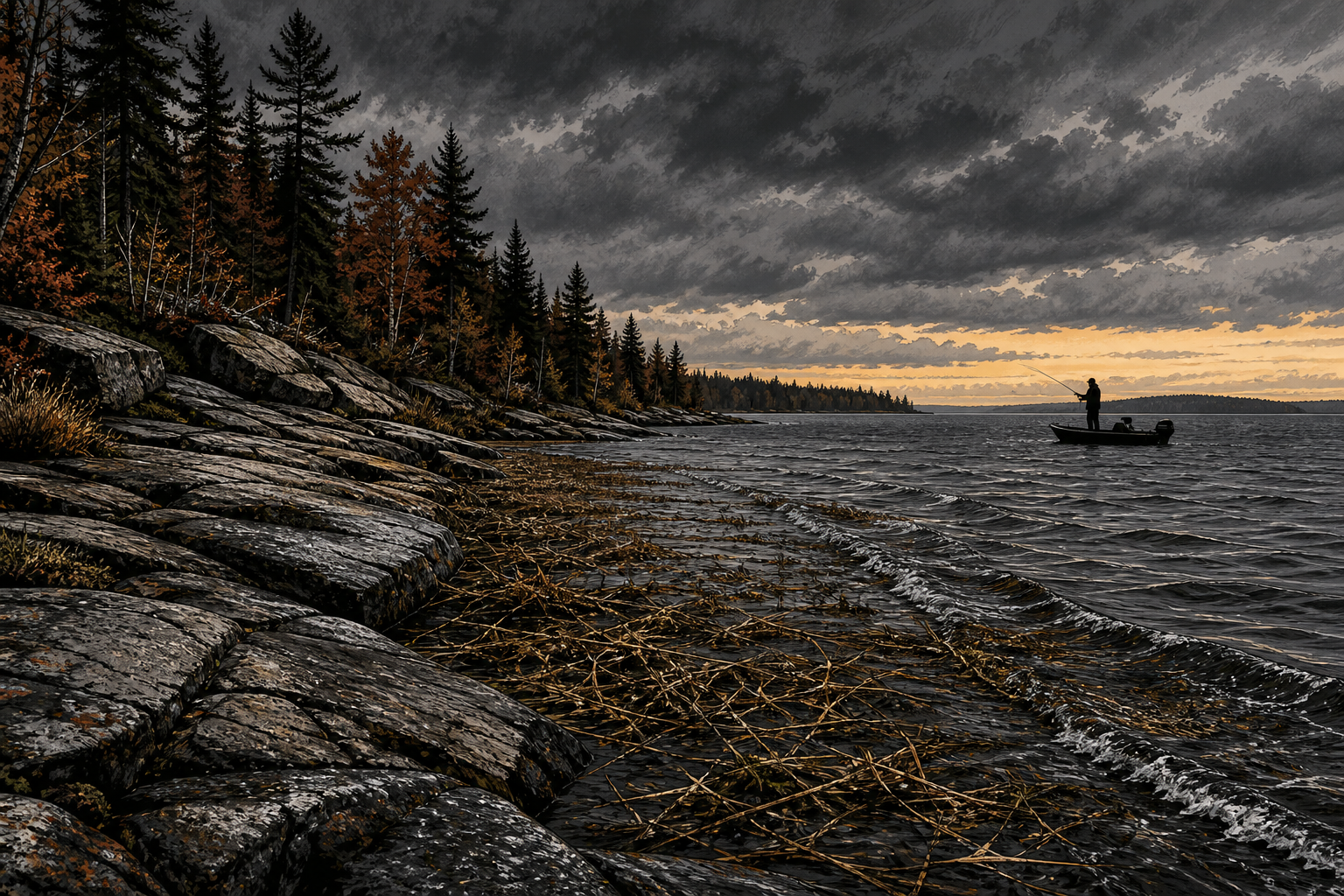
Treat a cool night as a question, not an answer
Late August can feel like a seasonal switch even when the lake has not reorganized. A cool night changes surface conditions first. It does not prove that every musky left summer water, that deep fish moved shallow, or that the fastest presentation is finished for the year.
Begin with what is durable: muskellunge use cover and structural edges, and some follow open-water forage. Temperature belongs beside those facts, not above them. The practical task is to learn whether the cooling trend changed the depth, timing, or precision of an already useful contact zone.
Build one controlled first-light comparison
Choose a compact route on Long Lake where a basin lip, point, or weed edge meets a known forage lane. Record air temperature, surface temperature, wind, cloud cover, and the depth of visible bait before the first cast. If a value is not measured, label it unknown rather than filling the gap with a seasonal assumption.
Make the first pass slightly outside the obvious edge with a lure that stays above the deepest forage marks. Make the second pass tighter to the break. Two comparable routes give the morning a chance to contradict the expected shallow-cooldown story.
Let the first useful signal choose the next depth
A follow from the outer pass, a stable forage band, or repeated marks at one depth is enough to refine the route. Keep the boat outside the fish, repeat the angle, and change only one variable at a time. If the first signal comes from the weed edge instead, shorten the route and work the irregularity that organized it.
The point is not to defend a basin or shoreline pattern. It is to reduce the lake to a comparison that can be repeated. A daily model becomes more useful when it preserves the losing pass as carefully as the winning one.
The working theory for the next cast
For this field plan, begin one structural step outside the previous evening’s contact and fish above the most consistent forage depth. Use a moderate cadence with one deliberate speed change at the break. Tighten to the cover only when forage, a follow, or repeated electronics marks justify it.
Confidence remains moderate because live water temperature, oxygen, and forage observations are still required. The theory should lose confidence immediately if the lake shows no stable forage outside the edge or if the useful depth band is compressed by oxygen conditions.