
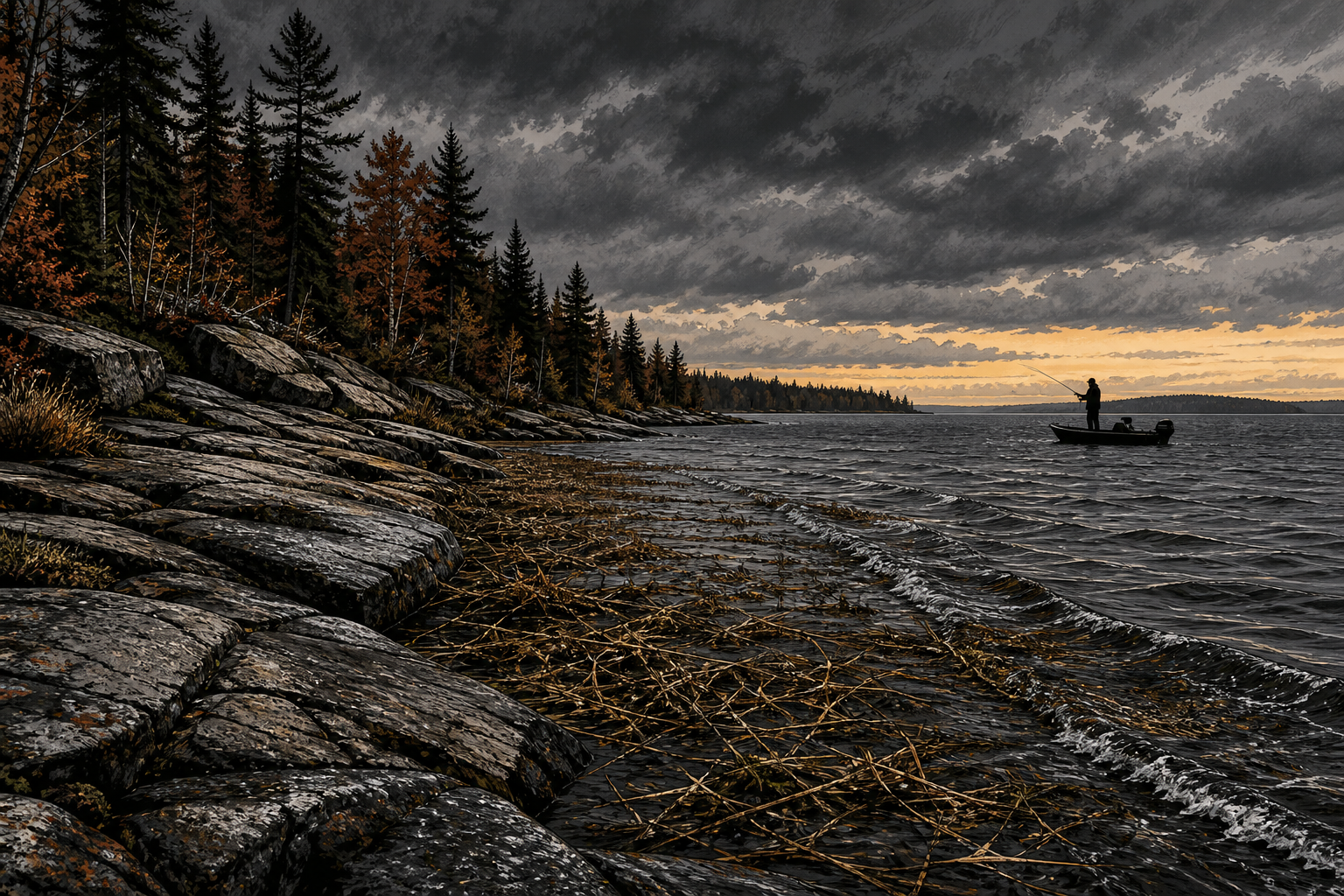
A cold front changes the size of the opportunity
The morning after a front can make a familiar lake feel vacant. The sky clears, the wind falls away, and yesterday’s aggressive follows disappear. That does not necessarily mean every musky left the area. It often means the fish are less willing to travel far or chase a lure that never gives them an easy moment to catch it.
The mistake is to respond by crawling every lure across every acre of water. Slower is only helpful when it happens in the right place. A better adjustment is to shrink the amount of water you ask each fish to cover and spend more time in the highest-quality part of the retrieve.
Choose the smallest high-quality area
On Big Stone Lake, begin where rock, healthy weeds, and a depth change meet. A lone boulder on the outside edge, the end of a cabbage point, or a short patch of mixed cover is more useful than a long, uniform weedline. These compact transitions let you put the lure in front of a fish without demanding a long pursuit.
Position the boat deep enough that your cast crosses the contact instead of landing directly on it. Make several casts from slightly different angles. You are trying to discover whether the fish is tucked into the cover, holding just outside it, or using the deeper escape route.
Use hang time with purpose
A pull-pause minnow bait, dive-and-rise lure, or slow rubber presentation gives a following musky time to close the distance. The pause should happen beside the feature—after the lure clears a weed tip, passes the end of a rock, or reaches the first open pocket. Pausing in featureless water only makes the retrieve longer.
Keep enough tension to feel the lure and start it cleanly after the pause. If the bait rises, know how quickly. If it hangs or sinks, keep it above snags and dying vegetation. The best cadence is the one you can repeat through the same high-percentage window on every cast.
Finish every cast beside the boat
Cold-front fish may follow without showing themselves early. Watch behind and below the lure as it approaches the boat. Begin a broad turn before the bait runs out of room, keep it moving, and give the fish a smooth change of direction. A cramped, last-second circle removes the very hang time you created during the retrieve.
If a fish appears, resist the urge to instantly speed up or stop. Match the cadence that brought it to the boat, then make the turn larger. Even when the fish does not eat, the follow tells you that the location and depth were close. Rest the spot and return later rather than immediately throwing every lure in the box at it.
When to stop fishing slow
If wind and cloud cover return, baitfish rise, or you begin seeing aggressive follows, increase speed before changing locations. The front may have passed far enough for the feeding window to reopen. Conversely, if the best transitions remain empty, move to the next compact piece of cover instead of grinding one unproductive spot for an hour.
The cold-front lesson is not “always slow down.” It is “make the easy opportunity happen in the best six feet of the cast.” Concentrate your time, give the fish one clear chance to close, and let every follow or absence guide the next adjustment.