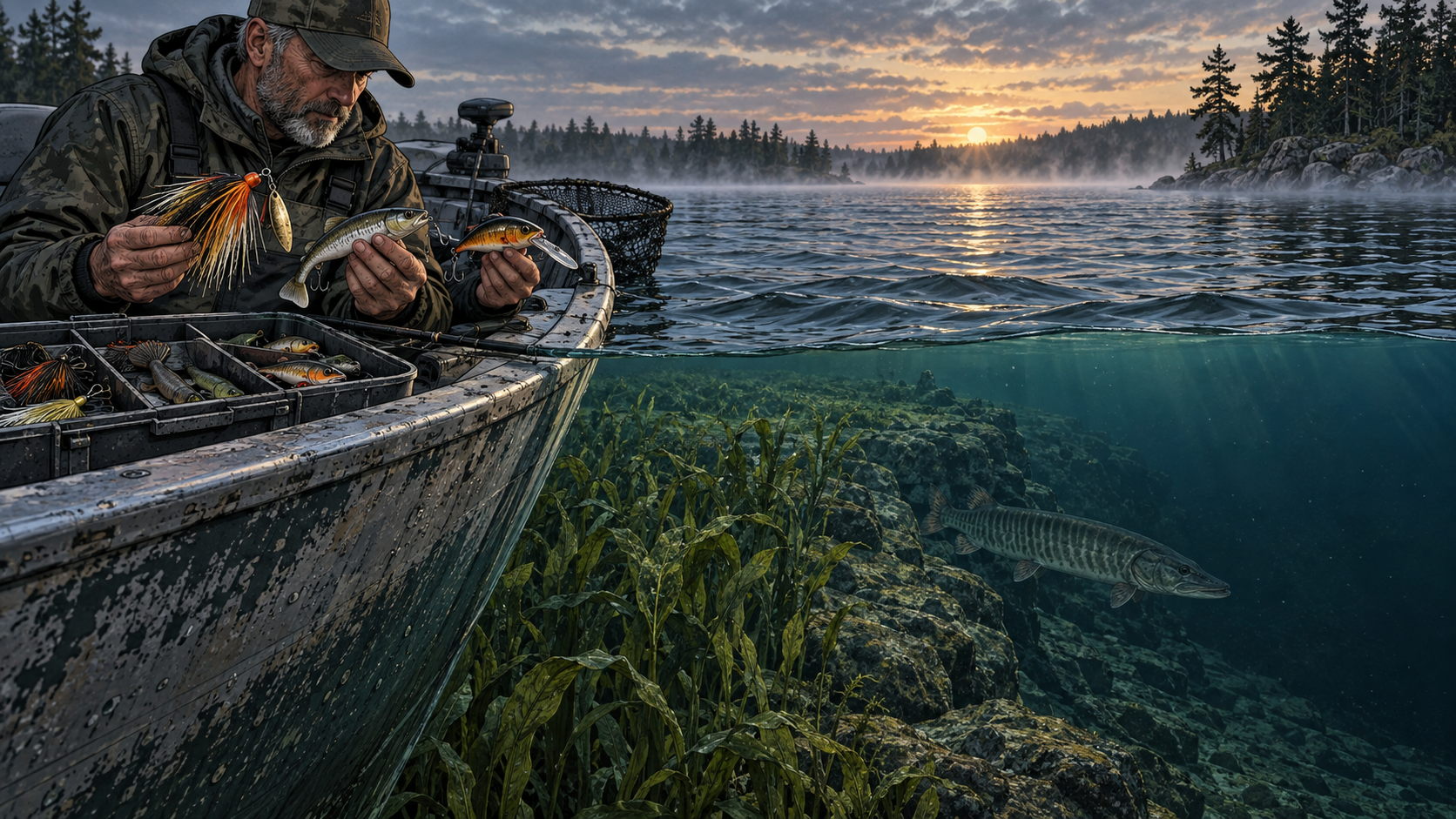
The tackle wall asks the wrong question
A wall of musky lures can make every decision feel like a referendum on the bait. Which one is hot? Which color has history? Which lure looks most like the fish we hope a musky is eating?
The water asks a simpler question. What must the next lure actually do? It may need to clear the tops of cabbage without fouling. It may need to stay above suspended forage. It may need to crawl beside a rock break, move fast enough to search a flat, or remain controllable when a fish follows to the boat.
Minnesota DNR lists several common musky lure families, including bucktails and flashy spinners, large crankbaits, floating injured-prey imitations, and large soft plastics. That range is useful because the families do different work. The agency does not claim that one is best everywhere.
A musky does not read the package
Muskellunge bring more than eyesight to the final decision. In a controlled feeding study, subadult fish used vision to acquire live prey, while vision and the lateral-line system both contributed to the rapid strike. The lateral line appeared especially important near final capture.
That study did not test artificial lures or adult fish in a lake. It cannot tell us that a certain blade, rattle, color, or tail will trigger a strike. It does establish a useful boundary: a presentation is both a visible object and a moving pressure signal. Profile, speed, vibration, direction, and distance change together as the lure moves.
Lure selection should therefore begin with presentation, not decoration. Color matters only after the bait can reach the right layer, survive the cover, and keep working at a speed the angler can control.
Matching the hatch is not a complete plan
A 2023 diet study sampled muskellunge and other predators across ten Minnesota lakes. Muskies consumed a wide range of prey, and their diets differed with fish length. The study did not find one narrow menu that applies to every lake, season, or size of musky.
That argues against treating one exact forage imitation as a universal key. Local prey still matters. A cisco system, a perch-heavy weed lake, and a shallow panfish basin present different opportunities. But a musky may be willing to attack something that behaves like vulnerable prey without matching one species perfectly.
The first goal is to put a credible target where the fish can detect and intercept it. The exact paint pattern comes later.
Write the lure's job in one sentence
Before opening the box, describe the next cast without naming a lure. Run two feet above scattered cabbage, cover water quickly, and stay clean. Hang beside a rock-to-weed edge without rising out of the zone. Track above bait suspended over twenty feet and remain visible from below.
That sentence creates a filter. A bucktail may solve the fast, clean weed pass. A controlled crankbait may hold the break. A weighted soft plastic may reach a deeper lane. A topwater may own a shallow, snag-filled low-light route. The families are examples, not laws. Weight, blade shape, buoyancy, hooks, leader, line, rod angle, and retrieve can move any individual bait outside its usual category.
Test each lure beside the boat before trusting the label. Learn how slowly it can work, how quickly it rises, how sharply it turns, how it behaves after touching weeds, and where it runs on a short line. The lure's real job description is written in water.
Use five constraints, in order
First, choose the layer. Decide whether the useful water is at the surface, over cover, along an edge, beneath the boat, or above suspended forage. A lure that cannot spend most of the retrieve in that layer is already wrong for the job.
Second, choose the collision. Determine whether the bait must pass through weeds, tick rock, avoid timber, cross open water, or follow a clean contour. Third, choose the speed. Search speed and feeding speed are not always the same, so decide whether the cast is locating fish or asking a known fish to finish.
Fourth, choose the signal. Visibility, wind, waves, depth, and cover can change how much flash, vibration, displacement, or silhouette is useful. Fifth, choose the finish. The bait must remain safe and controllable through the final feet of the cast. A lure that works perfectly until it reaches the boat has not completed the job.
Carry three answers, not three versions of one answer
Build a small working set around distinct functions. One bait should search efficiently at the target depth. One should give a following or located fish a slower, longer decision. One should reach a different vertical lane without forcing the boat away from the structure.
Three baits that all run at the same depth, demand the same speed, and send a similar signal are not three tactical choices. They are three opinions about color. That may become useful after fish respond, but it is a poor way to discover what part of the presentation matters.
An experimental study found that fasted muskellunge were caught more than twice as often as fed fish, while the measured laboratory behaviors did not explain the difference. The researchers concluded the food-deprived fish were likely more receptive to lures. That is a reminder that lure quality cannot manufacture appetite. Sometimes the same good presentation meets a fish in a different internal state.
The one-constraint switch
For the next ten follows or credible contacts, write down the lure's job before the cast. If a fish refuses, change one constraint on the return pass. Move the same presentation higher or lower. Keep the layer and change speed. Keep the speed and reduce the signal. Keep everything else steady and change the angle through the cover.
The theory gains confidence if one-constraint changes produce repeatable accelerations, strikes, or renewed follows across comparable fish and water. It loses confidence if responses remain random, if color changes outperform functional changes under controlled comparisons, or if different anglers cannot agree on which job each lure was performing.
The purpose is not to shrink musky fishing into a formula. It is to make each change answer a question. A lure earns its place when the angler can say what it does better than the bait beside it.
What this framework cannot promise
No source used here ranks musky lure families in a controlled head-to-head field trial. The sensory study used subadult muskellunge and live minnows in a test arena. The diet research covered ten Minnesota lakes, not every musky population. The food-availability experiment describes receptivity under its study conditions, not a rule for hungry wild fish.
Boat control, casting accuracy, confidence, fatigue, water clarity, fish history, and the amount of time given to each bait can overwhelm the lure difference an angler thinks is being tested. A familiar lure often receives better casts and cleaner speed control than a new one.
That is why the best lure is not a permanent object. It is the bait that can complete today's specific job, on this piece of water, with this angler controlling it. Choose the job first. Then make the lure prove it belongs.