
The fish can leave without leaving no trace
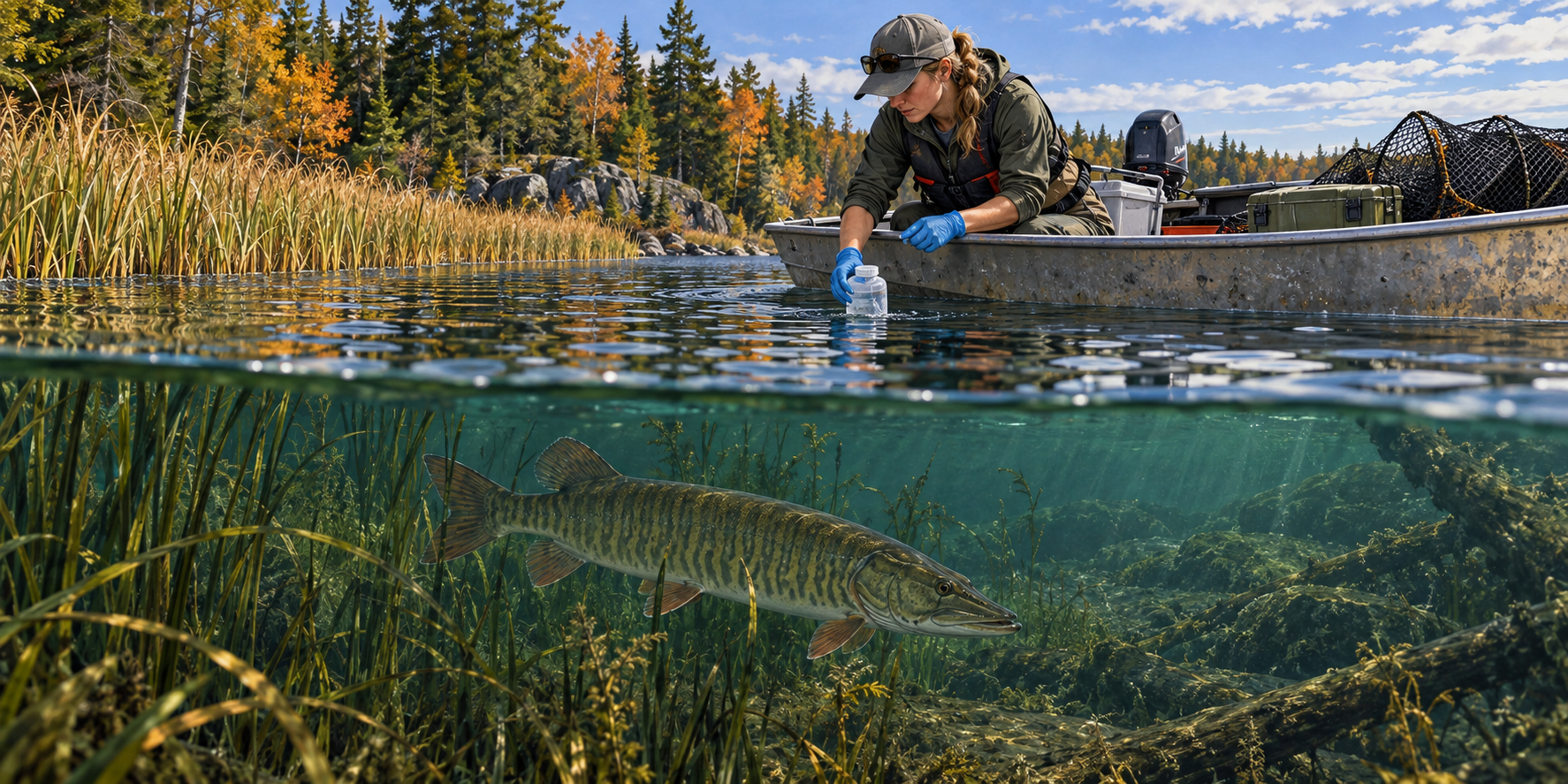
A musky does not need to enter a net, strike a lure, or pass a camera to be detected. As it moves through water, it releases biological material. Cells, mucus, waste, scales, and other traces carry DNA that can be collected from a water sample and tested with a species-specific assay.
That is environmental DNA, usually shortened to eDNA. The method changes the first question a survey can ask. Instead of beginning with, did we physically catch a musky here, researchers can ask whether muskellunge genetic material was detectable in the sampled water under a defined protocol.
The distinction matters. Detection is evidence of a biological signal. It is not a photograph of the fish, a population estimate, a date stamp on its movement, or proof that the animal remained beside the sampling bottle.
In twelve bays, the water found more fish than the nets
A 2026 study in the St. Lawrence River paired eDNA sampling with traditional muskellunge surveys. During the adult spawning-bay comparison, trap nets captured eight adult muskellunge in three of 12 bays. Muskellunge eDNA was detected in 11 of the 12 bays.
Across those spawning sites, 68 of 108 water samples produced a detectable muskellunge signal. The result shows why the method is attractive for a large predator that can be sparse, mobile, and difficult to capture. A blank net can mean no fish entered the gear during that sampling period. It does not necessarily mean no musky used the bay.
The same study compared eDNA with two seine surveys for young-of-year muskellunge in nursery habitat. Detection generally tracked live capture, and detection success was statistically related to catch per unit effort. That agreement is encouraging, but it did not turn the DNA result into a head count.
The strongest result carried its own warning
Every detectable spawning-bay sample in the 2026 comparison remained below the study's limit of quantification. The assay could identify a muskellunge signal, but the concentrations were too low for the researchers to use those samples to estimate abundance.
A separate stocking comparison made the caution even clearer. The researchers sampled before and one week after muskellunge fry were introduced. Detectability was lower after stocking, not higher. Low biomass and environmental variation were possible explanations.
That result resists an easy story. Adding known fish did not guarantee a larger measurable signal. A water sample records the interaction of fish biology, water movement, chemistry, time, sampling location, laboratory performance, and chance.
One fish does not shed one fixed amount
A 2023 muskellunge study measured DNA shedding and decay during embryo, larval, and juvenile stages. Estimated total shedding ranged from 9.92 thousand copies per hour per fish for larvae to 1.32 million for juveniles. After the estimates were adjusted for body mass, larvae and juveniles did not differ significantly.
The experiment also found different decay rates among life stages and aquaria. Hardened embryos produced no detectable eDNA even at high density. In field samples from spawning bays, muskellunge DNA was quantified in more than 27 percent of samples, including bays where traditional capture did not produce a fish.
These findings explain why raw DNA quantity cannot be translated with a universal fish-per-copy equation. A juvenile, adult, embryo, stressed fish, feeding fish, or recently departed fish may contribute a different signal. Temperature, microbes, sunlight, suspended material, flow, and time can change what remains available to collect.
A positive sample has distance and time inside it
DNA moves after it leaves a fish. In a quiet bay, it may settle, degrade, or remain locally concentrated. In a river, channel, or wind-driven system, it can be transported away from its source. Sediment can retain material and later return it to the water column.
USGS-led guidance for aquatic eDNA studies identifies the central interpretation problems: temporal and spatial processes, uncertain positive and negative results, DNA transported from elsewhere, and limited correlation between eDNA concentration and abundance. It also emphasizes contamination controls, assay validation, inhibition testing, and transparent reporting.
A positive therefore means the target DNA passed a validated detection process. How recently the living fish occupied the exact sample point depends on the waterbody and study design. The stronger claim must be earned with replication, hydrology, timing, and another line of evidence.
A negative sample is not an empty lake
Low-density species create a simple problem: the bottle holds only a tiny fraction of the waterbody. A fish can be present while its DNA is absent from that particular liter, below the detection threshold, degraded, transported elsewhere, or blocked by substances that inhibit the laboratory reaction.
The 2026 nursery surveys included two site visits where live muskellunge were captured but eDNA was not detected. Those sites had the lowest reported catch rates, no more than 0.1 muskellunge per seine haul. Even a sensitive method can miss a rare signal.
The responsible conclusion from one negative sample is narrow: muskellunge DNA was not detected in that sample under that method. Repeated samples across suitable habitat and time can raise confidence. They still do not prove absolute absence.
Use eDNA to choose the next expensive question
The best role for eDNA may be screening. Managers can sample many bays or tributaries, identify places with repeated detections, and then concentrate trap nets, seines, cameras, telemetry receivers, habitat assessment, or spawning work where the signal is strongest or most persistent.
That division of labor respects what each tool does well. A water sample can search broadly with little direct disturbance to fish. Live capture can provide length, condition, sex, age structures, tissue, tags, and direct abundance information that the water alone cannot supply.
For anglers, an agency eDNA detection should be read as fishery evidence, not a waypoint. It may confirm that muskellunge use a system or habitat class. It does not reveal whether a fish is there today, whether it is catchable, or which lure should cross the spot.
Build a detection ladder, not a magic test
Musky Moon's working model has four rungs. One positive sample establishes a lead. Repeated positives at the same site establish persistence. Detections that repeat across a seasonal window establish a pattern. Agreement with live capture, telemetry, visual observation, or young-of-year evidence establishes a much stronger biological case.
A useful field experiment would sample the same inlet, spawning bay, nursery edge, and control site on a fixed schedule. Record sample volume, coordinates, depth, water temperature, flow direction, recent rain, wind, turbidity, collection time, filtration delay, assay replicates, detection status, quantification status, and every conventional observation made nearby.
The persistence theory gains confidence if detections repeat at biologically plausible sites while controls remain clean and independent surveys agree. It loses confidence if positives drift with current into unsuitable habitat, disappear under replication, occur in blanks, or fail to align with any conventional evidence after adequate effort.
The value is in the restraint
Environmental DNA gives muskellunge management a sensitive new witness. In the St. Lawrence spawning comparison, it saw a signal in places where trap nets caught nothing. In nursery water, it often agreed with physical capture. In controlled work, it also revealed how life stage and decay complicate the signal.
None of those limitations makes eDNA weak. They define the job it can perform honestly. It can help establish presence, expand survey reach, identify priorities, and test where conventional effort should go next.
The bottle can tell us that a musky left evidence in the water. Counting the lake still requires more than the bottle.