
The number needs a verb
A musky did not simply weigh 40 pounds because a chart put that number beside its length. It was weighed, estimated, or compared with a standard. Those verbs are different evidence.
A calibrated scale can produce a direct field measurement. A formula can produce an estimate from one or more body measurements. A standard-weight equation produces a reference used to compare condition among fish of different lengths. All three can be useful, but none should borrow the authority of another.
The honest record is short: 50.0 inches total length, weight not measured, standard reference about 39.5 pounds by the published nonsex-specific equation. That entry says more than a confident claim with no method attached.
The standard was built from many fisheries
Researchers assembled length and weight records for 4,343 muskellunge from 45 populations in 16 states to develop a species-level standard-weight equation. In English units, the published relationship is log base 10 of standard weight in pounds equals negative 4.052 plus 3.325 times log base 10 of total length in inches.
Put 50 inches into that equation and the standard reference is about 39.5 pounds. That is a mathematical result from the published model. It is not proof that a particular 50-inch fish weighed 39.5 pounds, and it is not a promise that an average 50-inch fish from every lake, sex, or season will match it.
The model is most valuable when used for its intended job. It gives biologists a consistent weight expected at a given length so the measured weight of an individual can be compared with a broad species standard.
Relative weight asks a different question
Relative weight is calculated by dividing a fish's measured weight by the standard weight for its length and multiplying by 100. A value near 100 means the fish matched that standard. A lower or higher value describes its weight relative to the reference, not its age, health diagnosis, reproductive status, or genetic quality by itself.
The distinction matters because length and condition can move in different directions. A New River study found that average muskellunge length and the abundance of memorable-size fish increased after a 42-inch minimum length limit, while the average relative condition of large fish declined. The population contained more long fish, but those fish were not automatically carrying the same weight for length as before.
That case does not prove the regulation caused every change, and it should not be transferred directly to northern lakes. It does show why length and body condition deserve separate columns.
A fifty-inch fish is not one body shape
Two muskies can share a total length while differing in girth, depth, sex, stomach contents, reproductive state, injury history, and seasonal energy stores. A length-only equation cannot see those individual differences. It returns the same number whenever the length input is the same.
A girth measurement may add information when it is taken consistently and used with a named, validated estimation method. It can also add handling time, tape-position error, and false precision. If the formula is unknown or changed between catches, the resulting numbers should not be treated as one comparable series.
The safest editorial rule is simple. Never print estimated as weighed. Never print a species standard as an individual measurement. Never report decimals that imply more certainty than the field method earned.
Build the record before the fish arrives
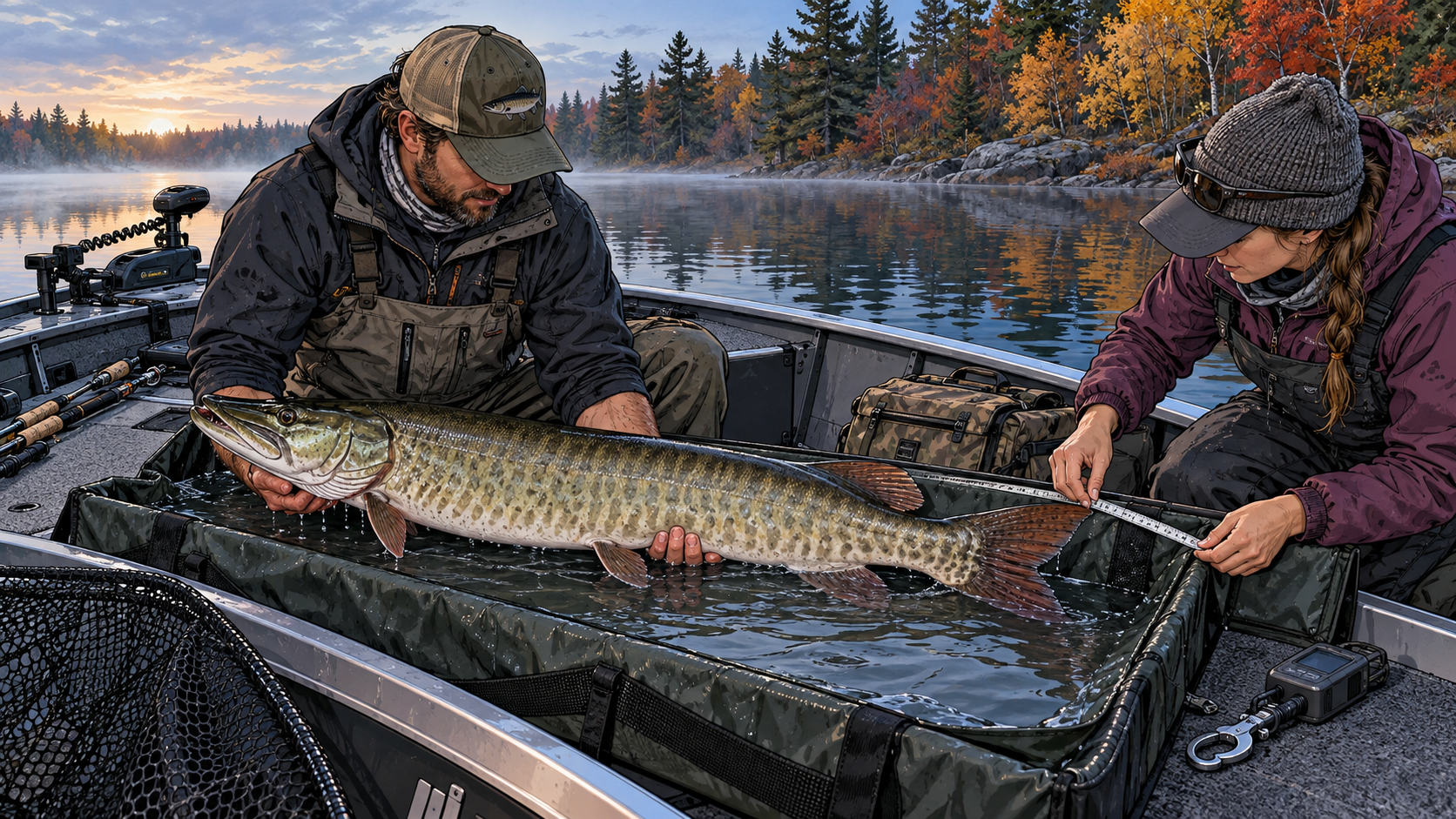
Set the measuring board, wet cradle, pliers, camera, and logging plan before casting. Decide whether weight will be omitted, measured with a calibrated fish-safe system, or estimated later. Preparation keeps the fish from becoming the place where the crew debates its method.
For every catch, store total length and exactly how it was taken: pinched or natural tail, closed mouth against the stop, and the smallest marked unit on the board. If girth is recorded, store the tape location and tension convention. If a scale is used, record the scale model, calibration check, container or sling tare, displayed units, and whether the reading stabilized.
Do the calculation after release. A live musky does not benefit from watching someone search a phone for the right equation.
The three-label field test
For one season, force every weight entry into one of three labels: measured on a scale, estimated by a named formula, or standard reference at length. Keep unknown as an acceptable fourth outcome when no defensible number exists.
Then compare recaptured fish, repeated anglers, and repeated measurement crews. The method-stamp theory gains support if within-method records are more consistent and biologically interpretable than the old mixed column. It loses support if method labels add no explanatory value after length, sex, season, waterbody, and measurement error are considered.
The experiment is not a contest to find the heaviest-looking fish. Its job is to learn which records can actually be compared.
Uncertainty belongs in the catch log
The original standard-weight study pooled many populations to create a broadly usable reference. That breadth is a strength for comparison and a limitation for identifying one fish. A local population can differ from the statewide or species-wide relationship, and an individual can differ from its population.
Scale readings can be affected by calibration, motion, sling tare, water retained in the cradle, and how quickly a value is read. Length can change with board alignment, tail convention, fish posture, and rounding. Formula estimates add model error on top of measurement error.
None of this makes measurement pointless. It makes the method part of the measurement.
A cleaner trophy story
Length remains the easiest large-fish measurement to standardize in the boat. Weight can add valuable condition information when it is collected safely and honestly. An estimate can satisfy curiosity when the scale stays stowed. The problem begins only when the label disappears.
A precise claim should be traceable. If the fish was weighed, name the scale method. If it was estimated, name the formula and inputs. If the number came from a standard-weight table, call it a reference. If none of those happened, leave weight unknown.
The trophy does not shrink when uncertainty is admitted. The record simply becomes strong enough to use again.