
The rule almost moved in the other direction
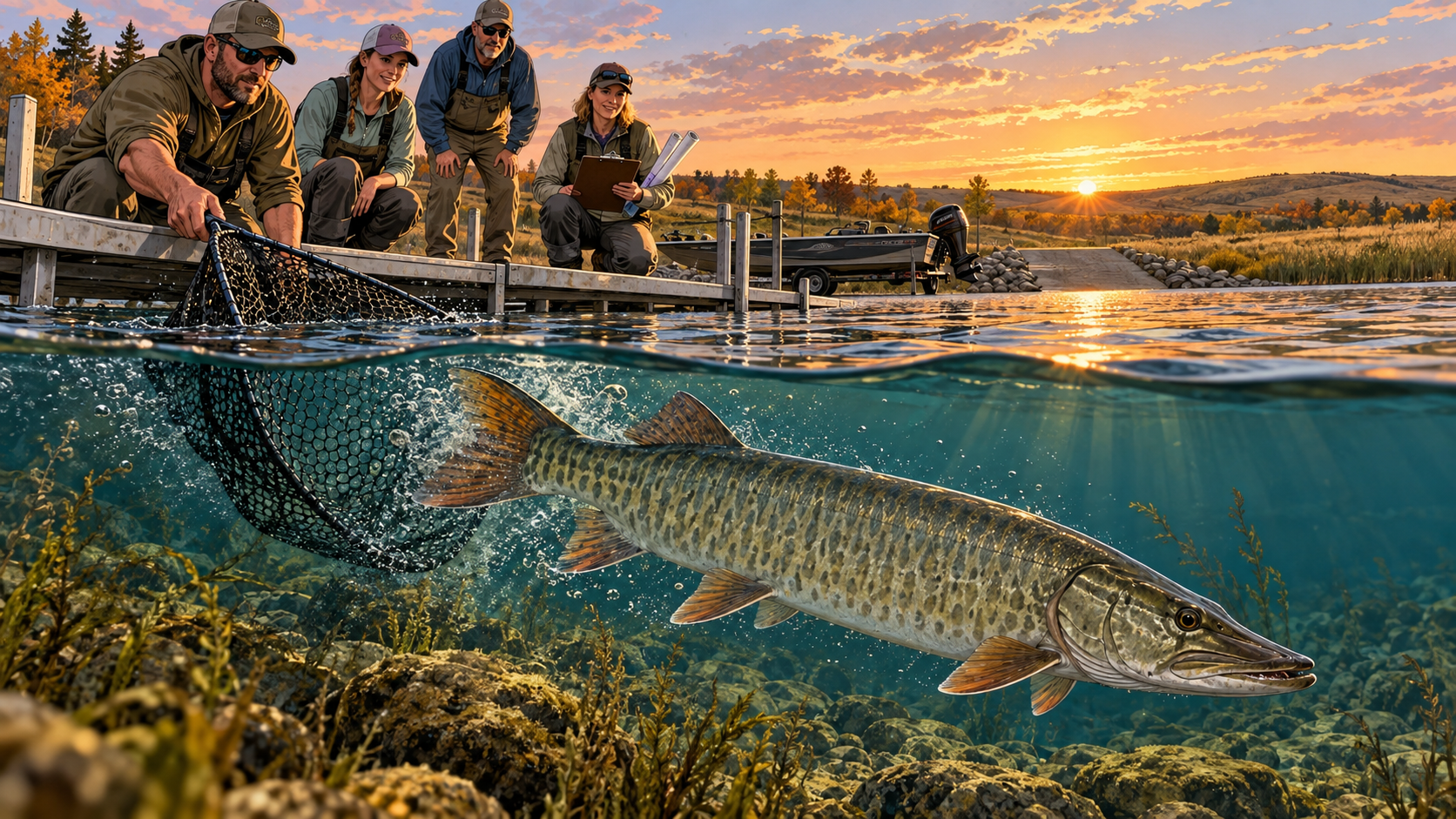
South Dakota entered September with a clear statewide rule for muskellunge and tiger muskie: catch and release only. A proposal before the Game, Fish and Parks Commission would have allowed an angler to keep one fish per day if it measured at least 45 inches.
The proposal did not survive the public meeting. Reporting from the commission proceedings documented a petition with more than 650 signatures and more than 50 written comments that were overwhelmingly opposed to reopening harvest. After testimony and discussion, commissioners removed the musky provision from the broader rule package.
The result is not proof that catch and release is the only reasonable policy for every musky water. It is proof that a fishery can have a public purpose beyond legal harvest, and that anglers can defend that purpose before a rule changes.
South Dakota is managing a scarce, constructed opportunity
South Dakota Game, Fish and Parks identifies five eastern lakes managed for muskies: Lynn, Middle Lynn, West Highway 81, North Island, and Sinai. The agency has also documented muskies in several other waters and the lower Missouri River.
The stocked lake populations did not appear by accident. State reporting says the musky program began in 1975 and has been supported by periodic stocking. The agency previously described stockings of 9 to 12-inch fish every other year in the five managed lakes. At the September meeting, a fisheries biologist described a management target near one musky per five acres and said relatively few fish longer than 45 inches appear in department sampling.
That combination matters. A large fish is not simply one more unit in a dense population. It represents years of survival after hatchery work, stocking, environmental loss, natural mortality, angling encounters, and every previous release.
Caught and killed are not the same column
Fisheries managers use exploitation to describe the share of a population caught by anglers, not only the share carried home. That distinction is easy to miss in a fishery where voluntary release is normal.
Virginia biologists tagged 1,006 muskies in the James River from 2016 through 2019. The agency estimated annual exploitation at 57 percent in the upper study section and 100 percent in the lower section. Yet anglers reported harvesting only four fish, about one percent of those caught during the four-year study.
The study shows how a low-harvest fishery can still expose individual fish to substantial angling pressure. Release keeps the possibility of another encounter alive. It does not erase hooking injury, handling stress, warm-water risk, reporting bias, or natural mortality.
A net and an angler do not sample the same fishery
The South Dakota discussion exposed a useful data gap. The department samples relatively few fish over 45 inches, while its biologist acknowledged that anglers may encounter more large muskies than agency crews see.
That is not automatically a contradiction. Survey gear samples particular habitats, seasons, depths, and fish behaviors. Musky anglers often concentrate effort on known large-fish windows, and their stories can overrepresent exceptional catches. Agency sampling is standardized but incomplete. Angler memory is broad but selective.
The strongest management record joins the two. Standardized sampling can describe population structure through time. Verified angler reports can expand coverage of rare, large fish that may be difficult to collect. Neither should be stretched into a complete census.
Public comment measured value, not abundance
A petition does not estimate musky density. Fifty comments do not calculate recruitment. Public response answers a different question: what kind of fishery do the participating people want the state to maintain?
South Dakota provides a formal comment process for proposed commission rules. Comments must identify the person and city, state a position, and arrive before the hearing deadline to enter the public record. In this case, the response showed strong organized support for leaving large muskies in the water.
That preference belongs beside the biological evidence, not in place of it. Fisheries policy always distributes opportunity, cost, risk, and access. A trophy fishery built around repeat encounters is a legitimate public choice when its tradeoffs are stated honestly.
Build the shared trophy ledger
The next useful step is not another argument about whether anglers or nets see the real fishery. It is a record designed to connect them.
For every voluntarily reported musky at or above the management threshold, store the waterbody, date, rounded location, length method, photo verification status, tag number when present, distinctive natural markings, air exposure class, release condition, and whether the fish appears to match an earlier record. Keep unsuccessful effort in the system so one famous fish does not make the population look larger than it is.
The theory gains support if verified recaptures show that released large fish survive, remain available, and create repeated opportunity across years. It loses support if large-fish records decline despite stable effort, if apparent recaptures fail verification, or if post-release loss is high enough that mandatory release does not preserve the intended experience.
The decision still needs an exit test
Keeping catch and release in place should not end the measurement. Managers should continue tracking size structure, stocking survival, growth, natural mortality, angler effort, verified large-fish encounters, handling outcomes, and the cost of producing each fishery.
Evidence could eventually support a different rule. A system with abundant large fish, low release survival, a clear harvest objective, or a population that cannot support repeated capture may require another answer. A fishery with few large fish and strong demand for repeat encounters may justify greater protection.
The important lesson from South Dakota is not that public pressure defeated science. It is that anglers stated the experience they wanted, managers exposed the uncertainty they still face, and the commission chose not to remove living trophy fish while that uncertainty remained.
A released fish can become shared history
A harvested musky can feed a family or become a traditional mount. A released musky can become several anglers' best story, a tag return, a growth record, a brood fish, or simply one more chance for the fishery to produce what it was built to produce.
Those values cannot be reduced to one length limit. They can be made visible through better records. If anglers want a fishery organized around living trophies, the responsibility is larger than releasing the fish. It includes careful handling, honest reporting, support for stocking and monitoring, and participation when the rule itself comes up for debate.
South Dakota's rule stayed the same. The public record around it became much clearer.