
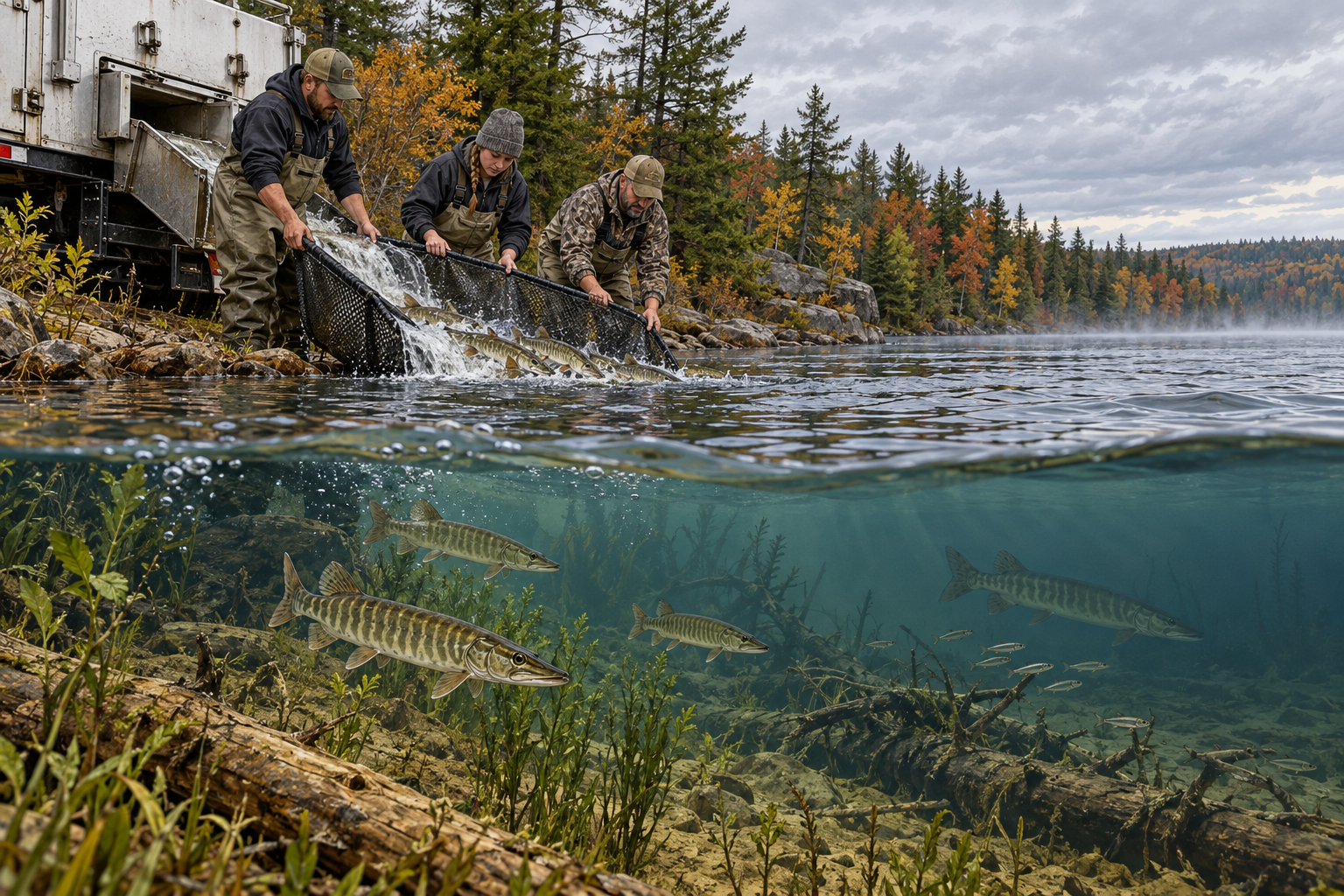
The headline number stops at the boat ramp
A stocking report can make one number feel complete: 500 fish, 1,000 fish, 5,000 fish. That number is accurate for the moment the truck door opens. It is not an adult population estimate, a catch forecast, or proof that every stocked fish has the same chance of reaching six years old.
The missing years matter. A young musky must survive handling, transport, the release itself, its first winter, predators, competition, temperature stress, disease, and every later season before it contributes to the adult fishery. Two lakes can receive the same number of fish and produce very different adult returns.
That does not make the stocking total useless. It makes it the first line of a cohort record. The honest question is what happened to that group next.
A larger fish can be the cheaper fish
A 2025 Iowa study followed that question with individually tagged yearling muskellunge. Researchers stocked 3,315 fish in Big Creek Lake and Brushy Creek Lake, with release lengths ranging from 210 to 406 millimeters, or about 8.3 to 16 inches. Later recaptures were used to estimate survival while accounting for imperfect detection.
Greater length at stocking was positively associated with first-year survival. Under the study's fixed stocking budget of $7,254, the model selected the largest observed fish, 406 millimeters, as the most cost-effective choice in both lakes because the survival gain outweighed the higher production cost.
That result sounds backward only if hatchery price is the final unit. A bigger yearling can cost more to produce, yet cost less for each adult that survives. The useful denominator is not dollars per fish loaded into the truck. It is dollars per fish reaching the management benchmark.
The same release can have two different futures
Lake context changed the Iowa outcome sharply. At the study's mean stocking length of 319 millimeters, the modeled cost to add one age-six fish was $227.38 in Big Creek and $54.75 in Brushy Creek. The estimated cost in Big Creek was more than four times higher even though the study used the same general stocking question and analytical framework.
The minimum fish size predicted to meet the adult density objective within budget also differed. The estimate was 301 millimeters for Big Creek and 221 millimeters for Brushy Creek, with uncertainty around both numbers. The important finding is not a universal length threshold. It is that the receiving water can change the answer.
Predators, forage, habitat, water quality, winter severity, handling, and other local factors can affect survival. The model does not identify every mechanism. It shows why a stocking prescription should be tested at the lake level instead of copied from the nearest successful program.
Wisconsin saw the life-stage effect decades earlier
Wisconsin research published in 1992 compared fall fingerlings with spring yearlings. Average overwinter survival for fall fingerlings was 19 percent across 14 observations and ranged from 2.7 to 43.3 percent. That range alone shows how much the waterbody and year can matter.
In the three lakes where both life stages were stocked, survival to 18 months was 19 percent for spring yearlings and 4 percent for fall fingerlings. Spring yearlings were estimated to be one to four times more cost-effective through that early benchmark.
The study did not find a consistent economic advantage among fall fingerlings within the 8-to-12-inch range when precise predator information was unavailable. Bigger was not a magic word. Life stage, lake conditions, and survival together created the result.
Bigger is a strategy, not a commandment
Raising a fish longer uses hatchery space, feed, labor, and time. A facility that holds fish to a larger size may release fewer of them. If production costs rise enough, the most economical release size can shift, especially in a lake where smaller fish already survive well. The Iowa authors explicitly identified that possibility.
Minnesota's long-range muskie planning illustrates how managers translate evidence into a working policy. The plan describes a phased move toward more yearlings and uses an equivalency of at least five fingerlings for one yearling, with implementation and evaluation extending toward 2030. That ratio is a management assumption to test, not a biological constant for every lake.
Wisconsin continues building the evidence base. The state's 2026 fishing report says up to 20 percent of stocked large fingerling and yearling muskellunge receive PIT tags so biologists can study growth, movement, and survival. Those later detections are what turn a release total into knowledge.
Read a stocking report as a cohort ledger
Start with the release count, then ask four more questions. What life stage and length went into the lake? How much of the cohort was tagged? What survey method and effort will be used to find survivors? At what age will success be judged? Without those fields, a large number can create confidence that the evidence has not earned.
Separate immediate output from delayed outcome. Fish stocked is an output. First-year survival, age-six density, natural reproduction, adult size structure, and angler catch are different outcomes measured on different clocks. One cannot stand in for all the others.
This approach also protects good programs from shallow criticism. A manager may intentionally stock fewer, larger fish because previous cohorts show better adult return. A lower truck count can therefore represent a stronger investment rather than a retreat.
Build an adults-per-dollar test
For one stocked water, build a cohort table that follows every release year. Record the number, source, strain, life stage, mean and range of length, release date, tagging fraction, and program cost. Add lake conditions that could change early survival, including predator and forage indices, habitat complexity, temperature, oxygen, and release-site conditions when they are actually measured.
Then connect the cohort to later survey data. Record gear type, effort, detection probability when estimated, recapture age, adult density, and the share of tagged fish in the catch. Compare cost per detected adult among cohorts only after accounting for changes in sampling effort and lake conditions.
The theory gains support if those joined fields predict adult detections more reliably than release count alone. It loses support if raw stocking totals perform just as well after survey effort and time are controlled, or if natural reproduction overwhelms the stocked signal.
The count matters, but it needs a destination
A thousand stocked muskies are a real management action. They are not yet a thousand members of the adult population. Treating those two statements as identical hides the hardest and most useful part of fisheries work: learning which fish survive, where, and at what cost.
The public should still expect clear release numbers. It should also expect life stage, length, source, tagging, later survey results, and uncertainty. Those details do not weaken the stocking story. They reveal whether the story continued after the truck left.
The better headline is not how many fish crossed the ramp. It is how many entered the fishery that anglers and managers are trying to build.