
The tape answers one question
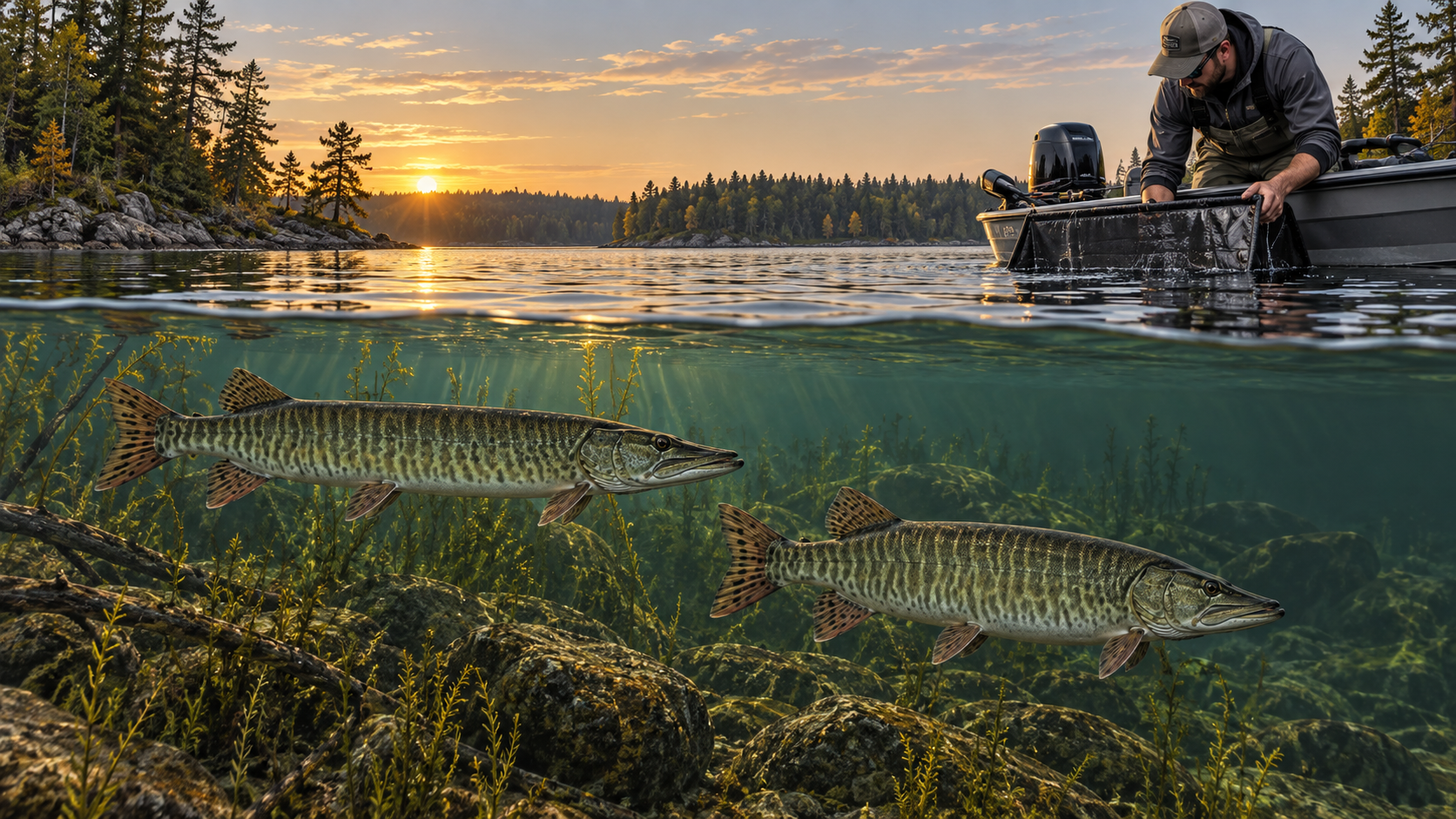
A measuring board can tell you how long a musky is at one moment. It cannot tell you when that fish hatched. Length and age are related because fish generally grow as they live, but the relationship is not a calendar printed on the flank.
Two muskellunge of the same length can have different birthdays. Two fish of the same age can reach different lengths. Growth history, sex, food, temperature, genetics, population density, injury, and the waterbody itself can all contribute to the result an angler sees on the board.
The honest field record is therefore simple: write the measured length and the method used. If age was not determined from a defensible source, leave age unknown.
Biologists read structures, not silhouettes
Fish age is commonly estimated from recurring growth marks in calcified structures. The basic idea resembles reading annual rings, but the choice of structure, its preparation, the reader, and the species all affect the estimate.
The Great Lakes Indian Fish and Wildlife Commission explains that cleithra, paired bones in the pectoral girdle, provide one of the few reliable ways to estimate muskellunge age. The cost is serious: removing a cleithrum is lethal. GLIFWC can collect some from fish already taken in the Wisconsin tribal spear harvest, which allows age information to be gathered without killing an additional fish for the sample.
That tradeoff is why a nonlethal structure matters so much in a fishery built around release.
Fin rays work best inside a tested range
A 2020 study tested anal and pelvic fin rays from known-age muskellunge ranging from age 1 to age 25. Because the true ages were known, the readers' estimates could be checked against reality instead of compared only with one another.
For fish ages 4 through 15, the estimates were relatively precise and accurate. The reported coefficient of variation was 8.5 percent, and the mean absolute difference from known age was 0.85 years. Growth models built from the estimated ages were similar to models built from known ages.
The result supports fin rays as a useful nonlethal option within that range. It does not make every ring count exact.
The oldest fish were made younger on paper
The same validation study found a directional problem at the edges. Readers tended to overestimate the youngest fish and underestimate the oldest fish. That is more important than random noise because it can compress the apparent age range of a population.
An underestimated old fish can make growth appear faster than it was. An overestimated young fish can distort the early part of the curve. When those estimates feed mortality, recruitment, or management models, a small reading error can travel into a larger conclusion.
The study did not say fin rays are useless outside ages 4 through 15. It showed where confidence was strongest and where caution must increase.
Length classes are not age classes
Anglers often describe a water as full of young fish after seeing several short muskies. That may be true, but length alone cannot prove it. A slow-growing older fish and a fast-growing younger fish can overlap on the board. Stocking history, recruitment pulses, and selective survival can further blur the picture.
Use length distributions for what they actually show: the sizes encountered by a particular method, in a particular place, during a particular period. Use official age data, mark histories, or validated aging work when the question is age structure.
This distinction protects both sides of the story. A short fish is not automatically young, and a very long fish is not automatically the oldest fish in the lake.
A recapture can become a tiny growth study
A tagged fish with a documented first capture creates something a guessed age cannot: elapsed time. If the same fish is measured again with a comparable method, the difference describes observed growth between two known dates.
Anglers should report official tags through the agency or program named on the tag and follow its instructions. Never remove a tag unless directed. A natural mark or spot pattern may help identify a fish in photographs, but visual matching should be labeled probable unless the match is independently verified.
One recapture does not describe an entire fishery. It does turn one fish from a size story into a time series.
Run the no-guessed-age test
For one season, remove estimated age from the fishing log. Store measured length, measurement method, fish condition, sex only when confidently determined, tag information, recognizable marks, photo angle, handling time, waterbody, date, and capture location. Mark uncertain values as unknown.
If a fish is recaptured, compare only measurements taken with compatible methods. A pinched-tail measurement should not be treated as equivalent to a natural-tail estimate. Record elapsed days and calculate observed change without converting it into an annual rate unless the interval and seasonal timing make that comparison defensible.
The theory gains support if verified recaptures reveal growth histories that contradict confident age guesses based on length. It loses importance if a local, independently validated length-at-age model predicts known-age fish accurately within a narrow population, sex, and season.
Uncertainty is part of the age
Aging structures are evidence, not magic. Readers can disagree. Growth marks can crowd together as fish age. Different structures can produce different estimates, and the most reliable structure may require sacrificing the fish. Even a strong method has a range where it performs best.
Known-age validation is unusually valuable because it exposes those limits. In the fin-ray study, average performance was strong for middle-aged fish while bias appeared among younger and older fish. That is exactly the kind of boundary a responsible conclusion should keep visible.
A tape measure remains essential. It gives a repeatable observation quickly and can support safe release. It simply should not be asked to certify a birthday.