
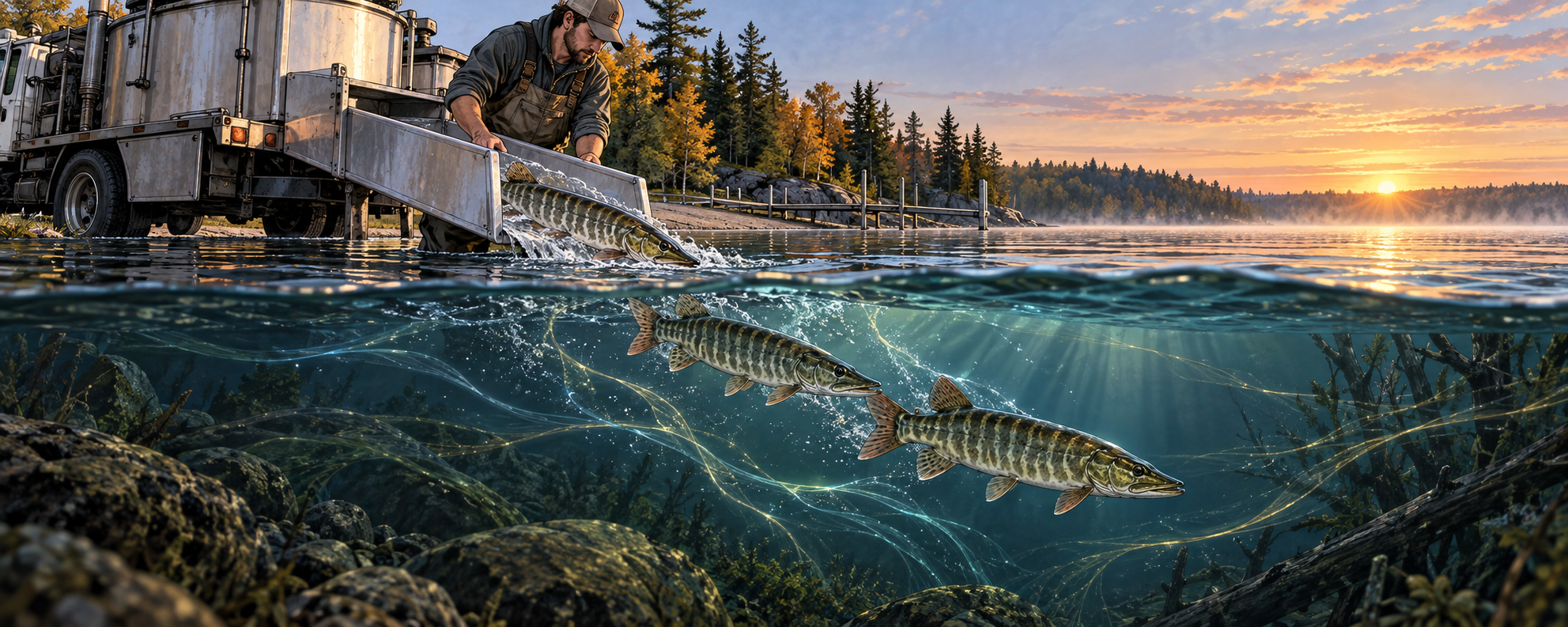
The tank carries more than fish
A stocking truck looks like a simple transfer. Fish leave a hatchery tank and enter a lake. The public record often reduces that event to a date, a waterbody, a size class, and a number released.
Biologically, the truck carries a family history. The brood fish came from somewhere. The hatchery chose a set of parents. Their offspring contain some portion of the variation present in that source population. When those fish enter a new or supplemented water, their ancestry enters with them.
That does not make stocking harmful by definition. Stocking has restored populations, sustained fisheries without adequate natural recruitment, and created angling opportunities far beyond the species' natural range. It does mean the word stocked is only the beginning of the management story.
The Great Lakes do not hold one interchangeable musky population
A 2013 Great Lakes study tested 691 muskellunge from 15 locations at 13 microsatellite loci. The analyses identified nine distinct genetic groups. Two of those groups were separated by only about 50 kilometers.
That result changes the scale of the map. A species can occupy one connected region while still containing populations with measurable genetic differences. Distance matters, but so do spawning-site fidelity, drainage history, barriers, movement, population size, and past stocking.
The practical conservation unit is therefore not automatically the whole lake, the whole state, or the words Great Lakes strain. Managers need evidence for the spatial scale at which fish reproduce and exchange genes. A broad label can be useful shorthand, but it cannot replace a tested population boundary.
Stocking can alter history without erasing it
A later regional analysis found a complicated legacy. Historic muskellunge population structure remained largely intact across the Great Lakes region, yet stocking had altered that structure in some places. Researchers found individuals with primarily non-native ancestry and fish with mixed lineage.
Those two findings belong together. Stocking did not turn every population into one uniform genetic mixture. It also did not leave every native population unchanged. The outcome varied among waters and stocking histories.
That is why restoration and supplementation require different questions. A restoration program may be rebuilding a depleted population. Supplementation adds fish to an existing population. In either case, source choice can influence genetic diversity, local ancestry, future reproduction, and possibly behavior or performance.
The hatchery is part of the population
Wisconsin researchers have treated broodstock collection and hatchery practice as genetic conservation decisions, not merely production logistics. Their recommendations included collecting brood fish from naturally reproducing populations, rotating brood lakes within regional stock boundaries, using large source populations, spreading collection across the spawning period, and randomizing brood-fish selection.
Each step addresses a different way a hatchery batch can become narrower than its source. Too few parents can lose rare alleles by chance. Collecting during a short slice of the run can miss fish that spawn earlier or later. Repeatedly drawing from one brood lake can overrepresent one history while leaving another out.
The 2008 hatchery evaluation described in that work found variable success in representing the genetic variation of source populations. That is not an indictment of propagation. It is evidence that a hatchery batch should be evaluated as a sample of a population, not assumed to be a perfect copy.
A release record is not a performance result
Wisconsin biologists used genetics to follow what happened after different source populations were stocked. They genotyped 1,011 muskellunge at 13 microsatellite markers and used five reference populations to assign fish from four Wisconsin lakes to Wisconsin or Leech Lake ancestry.
Leech Lake fish made up about one quarter of the stocking in both Lake Monona and Lake Wissota, yet their later capture rates differed sharply between those waters: 10 percent in Monona and 2 percent in Wissota. Across the study, the Wisconsin-source fish had higher capture rates than the Leech Lake fish.
Capture rate is not the same as survival, abundance, growth, or catchability. A fish can survive and avoid the sampling gear. It can disperse beyond the sampled area. The environment can affect the two stocks differently. The study authors treated local adaptation as a hypothesis and recommended the nearest native Wisconsin source for the best return on stocking investment.
Ancestry can travel with behavior
Genetic differences can matter after fish reach adulthood. In the St. Louis River estuary and southwestern Lake Superior, researchers genetically identified Wisconsin-strain fish, Minnesota-strain fish, and hybrids, then tracked 60 adults for 15 months.
The groups did not use the system identically. Wisconsin-strain fish and hybrids spent more time in the upper and middle river, while Minnesota-strain fish spent more time in Lake Superior. Minnesota ancestry accounted for 80 percent of the individuals using Lake Superior in the study's random-forest analysis.
One telemetry study cannot establish a universal rule for every lake, and strain was not destiny for every individual. It does establish that source history can be associated with spatial behavior strongly enough to matter in restoration planning.
Do not name a family from its paint job
Anglers often describe muskies as spotted, barred, clear, Wisconsin, Leech Lake, Great Lakes, or hybrid based on appearance. Those descriptions may be useful field notes. They are not a genetic assignment.
A fish's visible pattern is a phenotype. Ancestry studies use genetic markers and reference populations because appearance alone cannot reconstruct stocking history, quantify mixed ancestry, or identify which brood line produced an individual. Lighting, water color, age, stress, and ordinary variation can also change what an angler sees in a photograph.
Record the pattern honestly, but keep the claim narrow. A photo can document visible markings and help match a recapture. It cannot prove a strain, a hatchery source, or a native lineage without the supporting genetic and stocking evidence.
Build the lineage ledger
The next useful record joins the truck, the fish, and the lake. For every stocking batch, store brood source, parent count when available, collection dates, hatchery lot, release date, release size, number released, marks or tags, and exact waterbody. For every later survey or verified catch, store genetic assignment when sampled, tag identity, length, age estimate method, location, habitat, movement, condition, and release outcome.
The theory gains support if ancestry helps explain consistent differences in survival, capture, growth, reproduction, or habitat use after effort and environment are accounted for. It loses support if those differences disappear with better sampling, if lake conditions explain the result more cleanly, or if genetic assignments are too uncertain to separate the groups.
Anglers can contribute without pretending to run a genetics lab. Photograph both sides of a fish, record tags, log exact measurements and effort, report recaptures, and never convert a color pattern into a pedigree. The family tree belongs to the evidence.
The best source is a question, not a slogan
The nearest native source can be a strong default when the objective is conserving regional ancestry and producing fish suited to nearby conditions. It is not a universal answer. A restored population, an introduced fishery, a climate-stressed lake, and a remnant native stock may require different decisions.
Managers still have to define the objective. Are they conserving a native lineage, rebuilding natural reproduction, sustaining adult abundance, maximizing large-fish opportunity, or creating a new fishery? A source that performs well for one objective may carry unacceptable genetic risk for another.
A stocking truck does not deliver a finished population. It delivers young fish, a source history, and a hypothesis about the future. The job after release is to measure which parts of that hypothesis survived.