
The fish may already be carrying its own tag
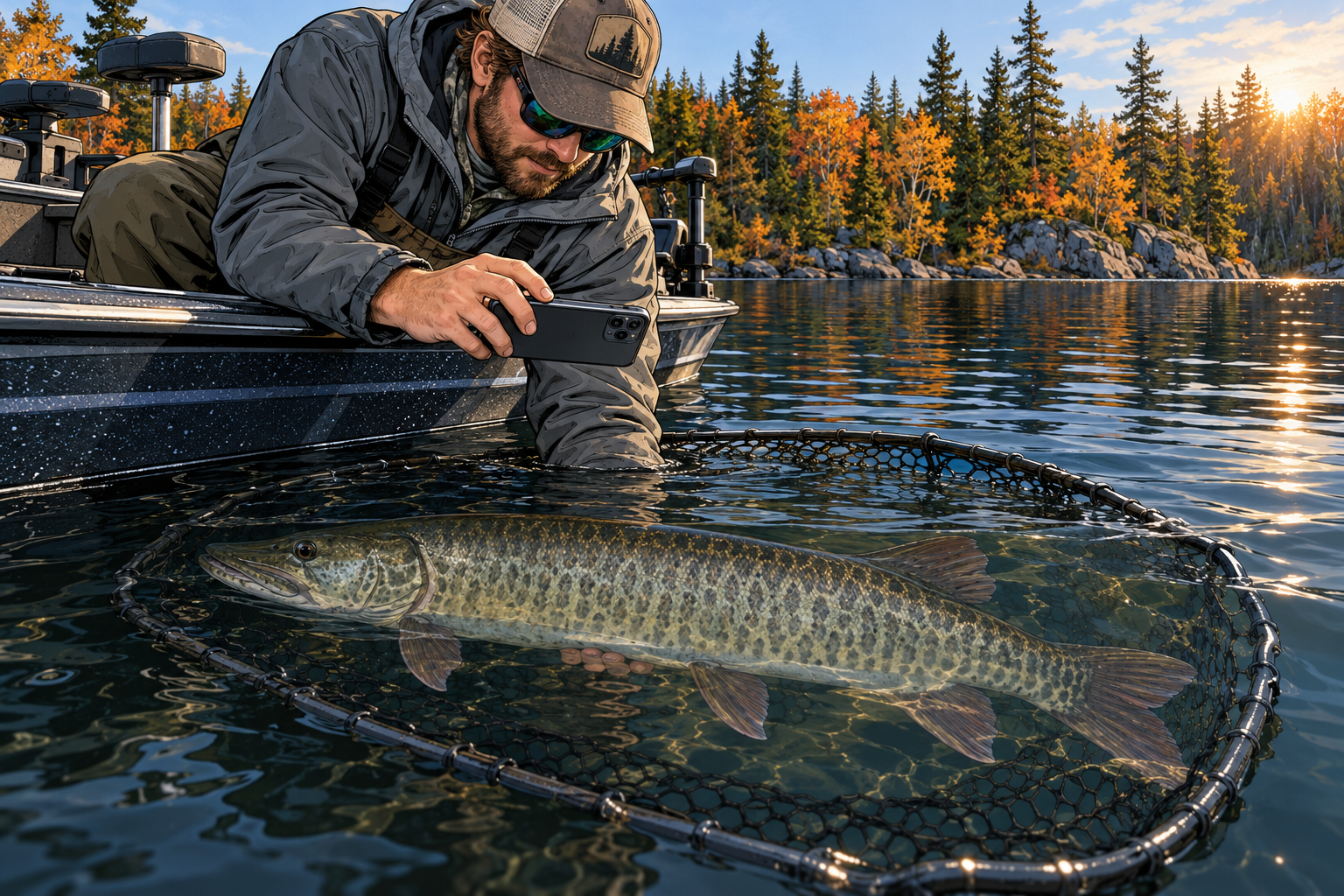
A musky photograph usually records a moment for the angler. It can also record the fish. Bars, spots, blotches, scars, and fin details may create a recognizable combination that allows the same individual to be found again in a later image.
That possibility moved from angler folklore into a direct muskellunge test in 2026. Researchers tagged and photographed stocked muskellunge over two consecutive summers in West Watjask Lake, Manitoba. Using the freely available I3S Spot pattern-recognition program, they correctly matched all known recaptures against a reference database of 170 initial captures.
The study is a preprint posted May 9, 2026, not a completed peer-reviewed publication. Its result is promising, specific, and still provisional. It establishes that the method worked in one stocked population over a limited period. It does not establish that every musky pattern remains readable for life or that every angler photograph is usable.
A close relative passed a harder photographic test
A 2020 peer-reviewed study tested the same broad idea in northern pike. Researchers and anglers photographed 209 individual pike, including 45 recaptures, over about a year and a half. Six images were too poor to isolate the fish from the background, leaving 203 usable photographs.
The software identified every recaptured pike as already present in the database. The correct fish appeared among the first ten suggested matches every time and among the first three matches 87 percent of the time. Even the tail-end pattern carried enough information for identification.
Pike evidence cannot be copied directly onto muskellunge. The species are related, but their markings, waters, handling, and image libraries differ. Its value is narrower: it shows that side-pattern photo identification can survive real photographs of varying quality and can support capture-recapture work in a large freshwater predator.
The photograph needs a method
The best field image is not necessarily the most dramatic one. It is the most repeatable one. Keep the fish supported horizontally in the water or in a submerged rubber-mesh cradle. Hold the camera roughly parallel to one flank, avoid harsh glare, keep the full side and tail in frame, and save the original file rather than only a cropped social-media copy.
Record which side was photographed. Do not assume the left and right patterns are interchangeable. If a safe second frame is already available, photograph the opposite side, but never add air exposure or delay release simply to complete a record. Handling safety outranks data completeness.
Pair the image with the exact waterbody, date, time, and any length that was actually measured. Store location precision privately when public sharing could expose a small fishery. A pattern without context may identify a fish. Context is what lets the recapture teach something.
A match is a candidate before it is a conclusion
Pattern software ranks possible matches. It does not remove judgment. Camera angle, surface glare, water distortion, body bend, resolution, partial obstruction, fresh injuries, and changing scars can all move the correct fish down the list or make two photographs look more alike than they are.
A strong recapture claim should compare the same side, use several independent pattern landmarks, and retain the original images for review. Length and date can support the comparison, but they should not rescue a weak visual match. Two fish of similar length are still two fish unless the pattern evidence agrees.
Some muskellunge carry bold bars or spots. Others are faintly marked or nearly clear. The method therefore has uneven detectability built into it. The easiest fish to identify may be overrepresented in the record.
One fish can become a history
A verified recapture can answer questions that a single catch cannot. How much did the fish grow? Did it remain in the same basin? Was it caught again near the same seasonal doorway? Did it respond to a different lure family, weather state, or depth? How much time passed between encounters?
Those are individual histories, not population conclusions. A fish caught three times may be unusually vulnerable, heavily exposed to angling, easy to identify, or simply lucky enough to be photographed well. Another fish may never appear because it avoids anglers or carries weak markings.
The 2026 muskellunge study combined researcher photographs with angler-submitted images and estimated 826 fish in the study population for 2025, with a 95 percent confidence interval from 472 to 1,445. That wide interval belongs beside the estimate. Photo records become population evidence only through a defensible capture-recapture model and its assumptions.
Build a photo-tag ledger without extending the release
For the next season, use one repeatable release routine. Prepare the camera before the fish is handled. Take one clean side frame while the fish is supported, then release it. Log the side, image quality, waterbody, date, time, measured length if available, capture zone, lure family, and effort before the encounter.
Run new images against the same-side library. Label every result as no candidate, possible match, probable match, or verified match. Verification should require multiple agreeing pattern landmarks or an independent physical tag. Preserve rejected candidates so the matching rule can be audited rather than quietly loosened after an exciting result.
The theory gains support if standardized images produce repeatable matches that agree with known tags, growth, and chronology. It loses support if patterns drift, clear fish cannot be distinguished, reviewers disagree often, or matches collapse when original high-resolution images replace social-media copies.
Citizen science can widen the window and bend it
Angler photographs can add observations beyond a short agency field season. The pike study found that photo identification produced a more complete size structure than standardized gillnetting in the same lake, where the net survey captured only four pike. That contrast demonstrates added reach, not automatic superiority.
Volunteer records inherit angler behavior. Popular access points, familiar spots, active fish, larger fish, favorable weather, and people willing to report are sampled more often. A shared photo archive can expand monitoring while remaining strongly biased in where, when, and which fish it sees.
The honest use is layered. Treat each strong match as evidence about an individual. Treat patterns across many records as hypotheses. Use formal population estimates only when capture probability, effort, database coverage, and model assumptions are explicitly addressed.
The best extra photograph is the one that costs the fish nothing
Photo identification is attractive because it can reuse an image anglers already take. It stops being non-invasive when the fish remains out of water for a better angle, a second camera, or a cleaner background.
Prepare first. Support the fish. Make the frame quickly. Release it. A blurred or missing record is an acceptable outcome. The fish is not a data point until after it is safely swimming away, and no database entry is worth changing that order.
A good release photograph can be more than proof of a catch. With consistency and restraint, it can become the first page in that fish's history.