
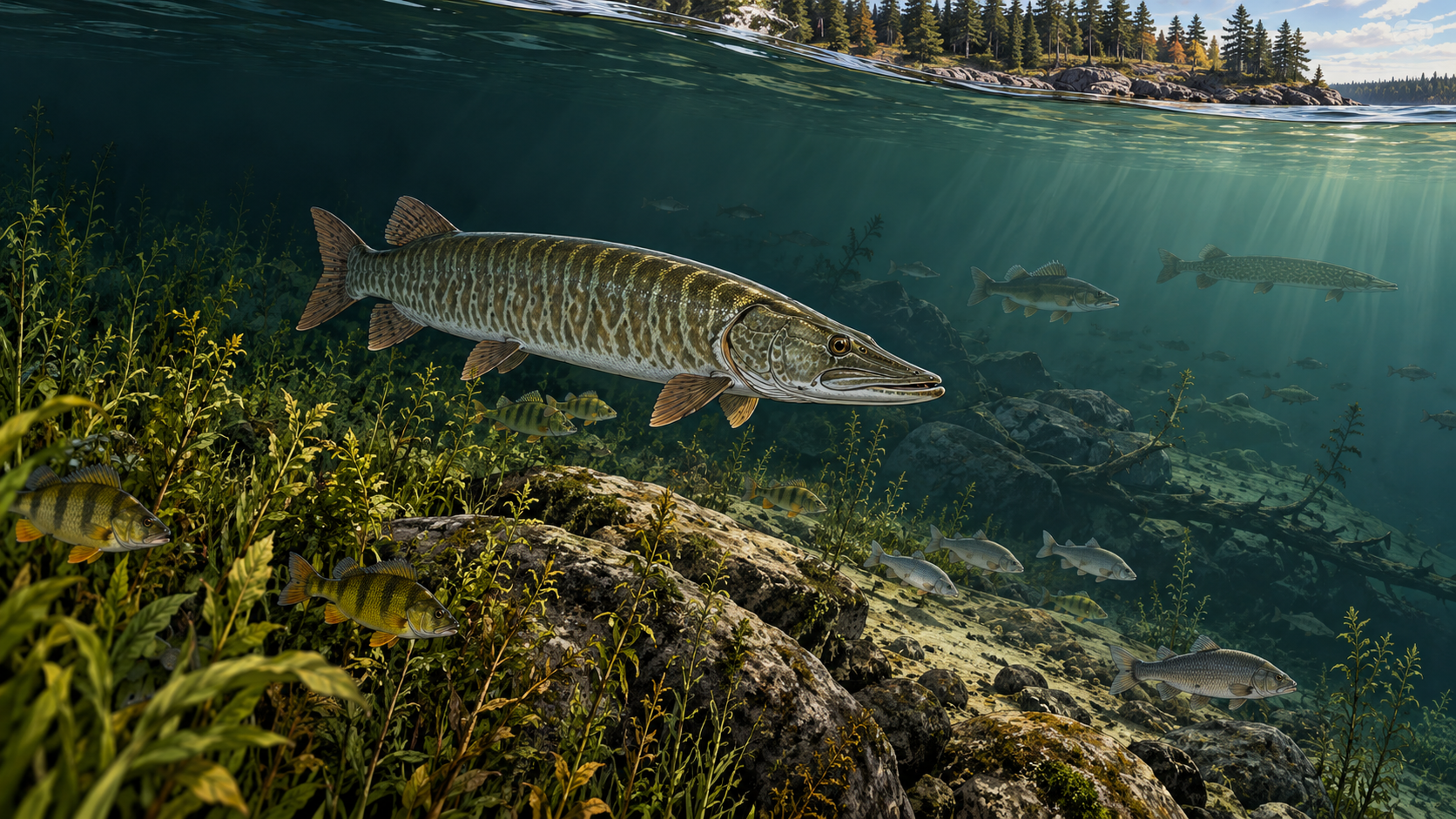
The accusation is bigger than the evidence
A musky is built to make a convincing suspect. It is large, visibly predatory, and capable of swallowing prey that looks substantial beside a boat. When a favorite walleye, perch, or sucker population disappoints, the biggest predator in the lake can become the simplest explanation.
The explanation may feel complete before the evidence has even begun. Seeing a musky eat one fish establishes predation. Finding a gamefish in a stomach identifies a meal. Neither observation measures how much of that prey population is removed, whether recruitment replaced those losses, or whether the population changed at all.
The useful question is not whether muskies eat fish. They do. The question is whether their predation is large enough to cause a measured community change in a particular waterbody under particular conditions. That requires more than a stomach story.
A stomach is a snapshot, not a census
A major northern Wisconsin diet study examined stomachs from 1,092 muskellunge captured in the littoral zones of 34 waters from July 1991 through October 1994. Food occurred in 375 stomachs, or 34.3 percent. Nearly three quarters of those nonempty stomachs held a single food item.
Fish made up 98 percent of the identified diet and represented 31 species from 12 families. Yellow perch and white sucker were the principal foods in each season. Bass, northern pike, walleye, minnows, and other fishes appeared less often. Prey length ranged from 6 to 47 percent of musky length, and prey size increased as predator size increased.
Those observations are valuable because they replace folklore with a broad sample. They still remain stomach contents collected at moments in time. Empty stomachs do not mean a fish had not eaten recently, and an identified prey item does not reveal its abundance in the lake or its population trend. Diet composition and population impact are related questions, not interchangeable answers.
The menu follows the lake
A later study used gastric lavage to compare muskellunge and other large predators in ten Minnesota lakes. Muskellunge consumed a wide variety of prey. Northern pike and walleye diets were concentrated more heavily on yellow perch and sunfishes, while largemouth bass consumed more invertebrates and crayfish.
The researchers found that muskellunge and largemouth bass had the most different diets. Northern pike and walleye diets were similar whether muskellunge were present or absent. Predator length category affected diet composition for most species, but seasonal shifts were not detected during that study.
This does not make every stocking decision harmless. It shows why the decision belongs at the lake scale. Prey abundance, habitat, existing predators, predator size, and the fish community already present shape overlap. A musky population cannot be assigned one universal menu and one universal effect.
Predation is not the same as population decline
Minnesota researchers tested the larger claim by comparing 36 muskellunge-stocked lakes with unstocked reference lakes. They used standardized gill-net and trap-net records from before and after muskellunge establishment to examine catch per unit effort for seven fish species and mean weight for northern pike and walleye.
The results were mixed rather than catastrophic. Yellow perch gill-net catch and mean northern pike weight were higher after muskellunge establishment. Northern pike and white sucker catch rates were lower. In a subset of lakes containing cisco, the only significant change was lower northern pike catch. The authors concluded that muskellunge stocking had not adversely affected gamefish populations across the study waters.
That conclusion is stronger than an anecdote because it uses repeated surveys and reference lakes. It is not a promise that no local effect can occur. It describes the pattern the available data supported across those lakes and years.
One missing year can have many parents
Fish populations move for reasons that can overlap. A weak year class may trace to spawning conditions, water levels, temperature, nursery habitat, winterkill, disease, harvest, sampling variation, or changes in prey. Other predators and anglers may respond to the same abundance shift that gets blamed on muskies.
A single bad catch year cannot separate those causes. Even a real decline measured by a survey needs context: Was the same gear used in the same season? Did effort change? Were several age classes missing, or only one? Did vegetation, clarity, oxygen, or water level change? Did a nearby reference lake without muskellunge show the same pattern?
The disciplined position is not that muskies never matter. It is that causation should be earned. A claim about an entire fish community should survive comparison with the other forces capable of producing the same result.
Run the predator-blame test
Begin with a claim precise enough to fail. Name the lake, the target species, the metric that changed, the time window, and the proposed musky change. Replace statements such as the walleyes disappeared with a measurable prediction about catch per unit effort, recruitment, size structure, or another standardized index.
Then build three lines of comparison. Track the target population before and after muskellunge establishment or a documented abundance change. Compare it with a similar waterbody without that change. Finally, store competing explanations such as habitat loss, harvest, winter severity, water level, survey method, and the abundance of other predators.
The theory gains support if the target population weakens more in the musky lake, the timing follows the musky change, and the relationship persists after major alternatives are considered. It loses support if the reference lake changes similarly, if the decline began first, or if habitat and recruitment explain the pattern more cleanly.
What would change the conclusion
The broad studies do not close the case for every lake. A newly introduced predator can interact with a prey community that differs from the waters already studied. A small, simple system may respond differently from a large, diverse one. Stocking density, natural reproduction, prey productivity, habitat, and the full predator community can alter the outcome.
Diet methods also have limits. Stomach samples can miss rapidly digested prey and may overrepresent fish available to the capture gear, place, and season. The Minnesota community analysis was observational even with before-and-after and reference comparisons. It could detect broad patterns but could not experimentally hold every lake variable constant.
Confidence should fall if well-matched survey records show a repeatable target-species decline unique to waters after muskellunge establishment, especially if recruitment, habitat, harvest, other predators, and survey changes fail to explain it. That would be evidence worth managing, not a story to dismiss.
Manage the food web, not the villain
Muskies are neither harmless ornaments nor underwater vacuum cleaners. They are large predators living inside food webs that already contain competition, predation, variable recruitment, and changing habitat. Their effects deserve measurement at the same scale as the claim.
For anglers, the practical habit is simple: log what was actually observed and keep the explanation provisional. A musky with a perch in its mouth is a feeding observation. A weak walleye year is a population observation. Connecting them requires a bridge of repeated data.
That bridge is what fisheries management is built to provide. Standardized surveys, diet work, stocking records, habitat measurements, and reference waters turn an argument about one dramatic predator into a test of the whole lake.