
A dot on the map is a detection, not a deed
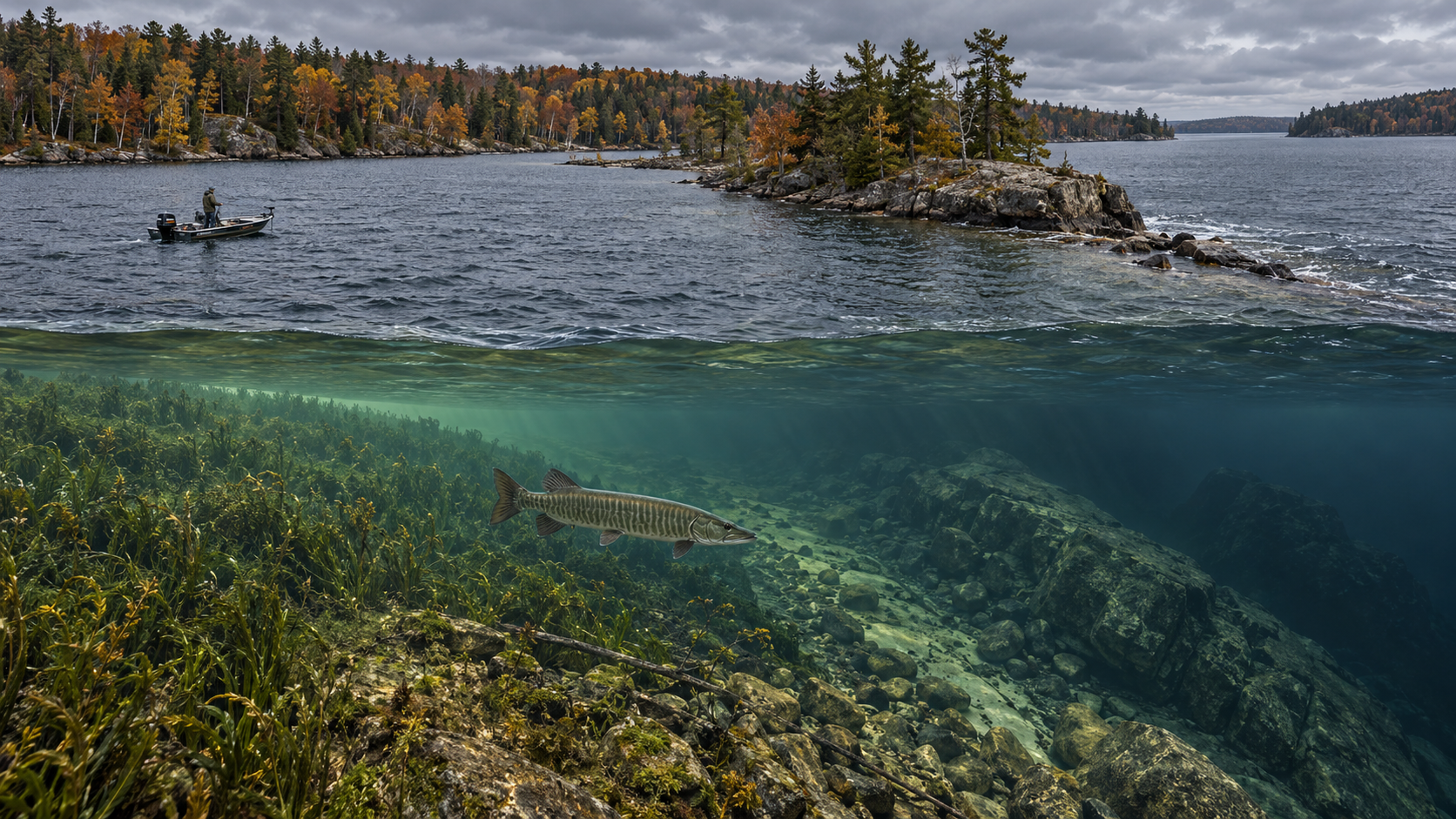
A musky appears beside the same cabbage point twice in one week. The tempting conclusion is that the fish lives on that spot. The observation is narrower: a musky was detected there twice. It may have rested there, fed there, passed through, or simply been catchable there while using a much larger area.
Home range is a way of describing the area used by an animal during a period of observation. It is not proof of property ownership. Territory adds a different claim, usually involving defense or exclusion of other animals. Muskellunge tracking has documented overlapping home ranges, which is exactly why those terms should not be treated as synonyms.
That correction does not make the repeated spot meaningless. It changes the question from where does this fish live to what connected neighborhood makes this place useful now.
The published ranges refuse one universal number
A federal habitat synthesis compiled strikingly different estimates from earlier tracking studies. Wisconsin lake muskellunge were reported using areas from 0.2 to 27.7 hectares. West Okoboji Lake fish averaged 146 hectares, with individual estimates from 39 to 443 hectares. Leech Lake seasonal estimates extended from 50 hectares in winter to 3,390 hectares in summer.
Those values should not be placed on one clean ruler. The studies differed in waterbody size, fish, season, tracking frequency, detection technology, and home-range calculation. A broad range of published numbers is evidence against borrowing a favorite acreage and assigning it to every musky.
The durable finding is conditionality. Space use can change with the system, season, fish size, flow, habitat distribution, and the individual fish being followed.
Overlap changes how a famous spot should be read
On West Okoboji, eight tracked muskellunge used the same home ranges in consecutive summers. That is meaningful site fidelity at the scale measured by the study. The same work also found that home ranges overlapped broadly and concluded that the fish were not territorial.
Several muskies can therefore have legitimate reasons to use the same weed point, saddle, channel edge, or basin lip. A contact there does not prove that one resident fish owns it. It may identify shared habitat, a prey route, a thermal transition, or a constrained path between two useful areas.
This is good news for an angler. A shared piece of habitat can remain valuable even after one identifiable fish leaves. The spot may be part of a network used by more than one fish.
Individual fish can overpower the average
A year-long passive telemetry study in Illinois tracked muskellunge in 128-hectare Shabbona Lake. Smaller females showed up to 10 percent higher residency than comparable groups in the fitted analysis, but individual identity produced the strongest effect on variation in space use.
The researchers did not find a strong preference for one receiver location across the population. Fish continued moving through the reservoir, and the authors cautioned that a stationary receiver array gives a conservative picture of movement between listening stations.
A population tendency is useful for framing a search. It is not permission to erase personality. One fish may repeatedly compress its movements around a sector while another crosses much more water under similar conditions.
Water movement can redraw the neighborhood
River fish make the conditional nature of space use especially clear. Researchers followed 42 muskellunge in a 17-kilometer reach of the New River over multiple seasons. The fish generally selected deeper habitat, but rising discharge shifted selection toward shallower water. Winter fish also used areas closer to the bank.
The study does not tell a lake angler to fish shallow whenever water rises. It shows that a useful area can move when the physical template changes. Current velocity, depth availability, bank position, and the cost of holding in flow can rearrange a fish's workable neighborhood.
In a lake or reservoir, wind-driven current, water-level change, turnover, vegetation loss, and forage movement may play different roles. The general lesson is to test the edges of the known area when conditions change instead of assuming yesterday's coordinate remains the center.
Build three sectors around every repeat contact
Start with the contact sector: the point, weed pocket, break, suspended bait edge, or current seam where a fish followed, struck, or was caught. Then define an entrance sector and an alternate sector. The entrance is the most plausible travel route into the area. The alternate is the nearest habitat that offers a different depth, cover type, exposure, or current condition.
Fish all three with comparable effort and a consistent presentation before changing too many variables. Record which sector was visited first, the minutes spent in each, the contact type, and the apparent direction of travel. A follow that arrives from the basin side is different evidence from a fish buried in cover, even if both finish beside the boat.
The object is not to draw a permanent boundary. It is to learn whether the original spot is a core, a doorway, or one stop in a larger circuit.
Identity turns repetition into stronger evidence
Natural markings, scars, fin shape, and a readable tag can sometimes distinguish one musky from another. A clear side photograph may later show whether two catches were the same fish, but uncertain matches should remain uncertain. Similar size and location are not enough.
Identity matters because two different stories can create the same fishing log. One fish may return to a familiar sector, or several fish may use a shared habitat feature. Both patterns are valuable, but they imply different expectations about timing, recovery, and the number of contacts available.
Store the original photograph, side of the fish, estimated or measured length, tag status, marking confidence, and the reason for any proposed match. Do not convert a hunch into a unique-fish count.
Let the neighborhood theory fail cleanly
The working-neighborhood theory predicts that matched contacts will cluster across a small connected network rather than one precise coordinate. The active piece of that network should shift in repeatable ways with season, wind, current, forage position, vegetation condition, and the identity of the fish.
The theory gains support when contacts move among the original spot, its approach route, and its nearest alternate while comparable water outside the network underperforms. It loses support if adjacent sectors perform no better than randomly selected habitat after effort and pass order are controlled.
It also loses support if the same identifiable fish appears only on the exact original spot through changing conditions and the matched surrounding sectors remain empty. A theory that cannot lose is only a label. The goal is a search model that becomes more specific when the fish disagree with it.