
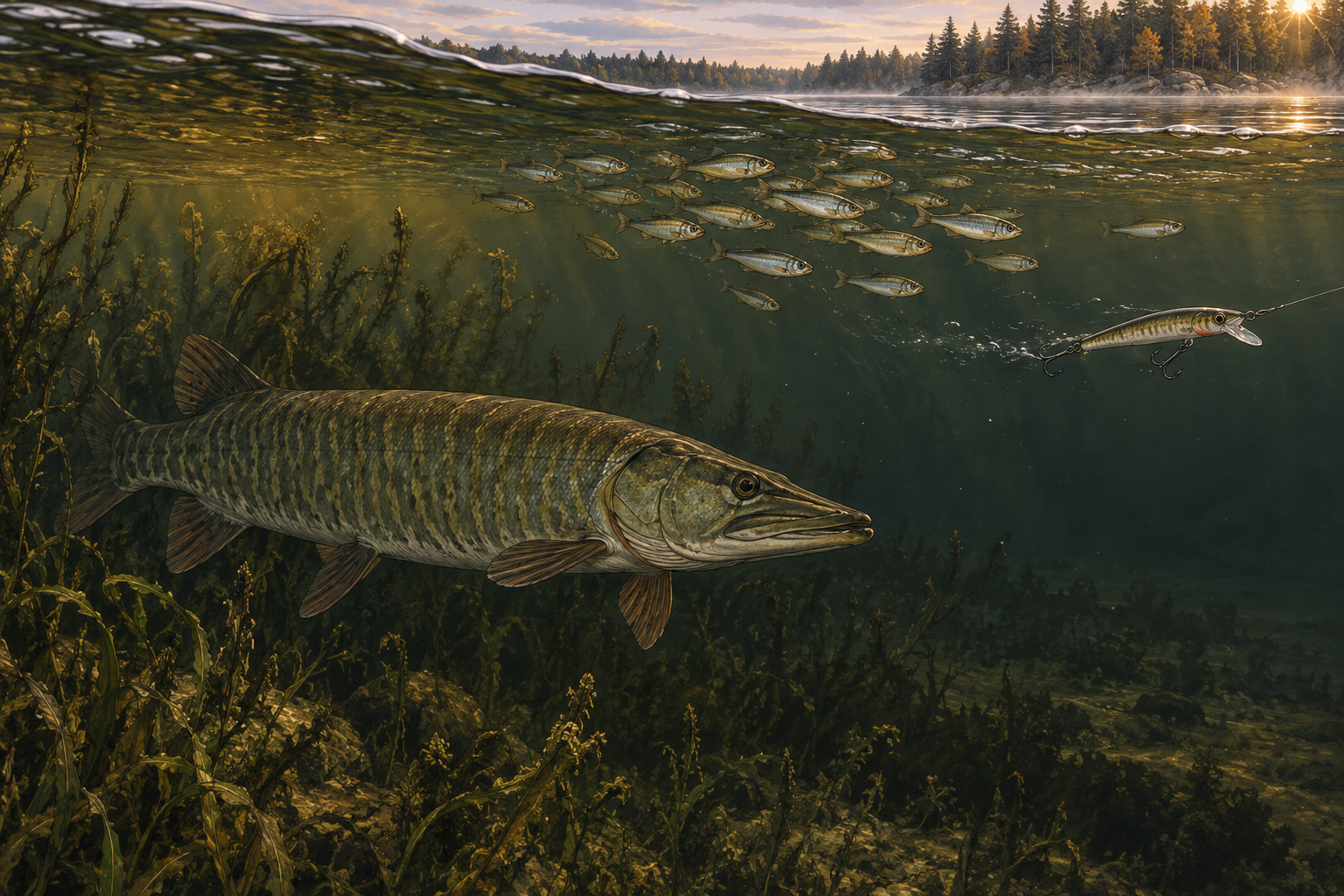
A blank day is not a population survey
Musky anglers are asked to make a large conclusion from a very small sample. Six hours without a strike can feel like proof that the fish are gone, the spot is wrong, or the lake is off. It is none of those things by itself. It is one observed outcome under one set of presentations.
The distinction is catchability. Fish can occupy the water and still be difficult to catch. A lure must intersect a fish, fit its sensory and energetic state, and give it a reason to commit. Failure at any one step produces the same entry in a catch-only log: zero.
That does not make every blank day mysterious. It means a zero must stay smaller than the story we are tempted to build around it.
Forage changed the odds in controlled ponds
A controlled muskellunge study tested three connected questions: whether forage availability changed capture, whether food deprivation changed measured behavior, and whether appetite-related hormones changed behavior. The fish were hatchery-reared, angling-naive age-0 muskellunge, not adult wild fish in a Northwoods lake.
In the pond experiment, fish without added forage were captured more than twice as often as fish in ponds supplied with minnows. The authors reported that the tested lures and presentations were less effective when forage was available. The result supports a direct point that anglers often overlook: food context can change vulnerability while fish presence remains constant.
The mechanism stayed uncertain. Five days of food deprivation did not produce clear differences in the laboratory measures of boldness, aggression, or exploration, and appetite-related hormone treatments did not explain the pond result. The defensible conclusion is not that hungry muskies become reckless. It is that reduced food availability made these experimental fish more receptive to lures for reasons the study could not fully isolate.
Individual fish do not share one vulnerability setting
A separate study followed 68 individually identified muskellunge through 84 half-hour angling sessions in experimental ponds. Captured fish tended to be larger and heavier within that juvenile cohort. They were also less exploratory and less aggressive in the behavior tests used by the researchers.
Metabolic rate, general activity, and boldness did not predict capture in that experiment. That matters because familiar fishing language often turns a visible personality trait into a universal rule. The study instead found a narrower pattern in one hatchery cohort under controlled conditions.
Together, the studies argue against treating every musky as an interchangeable target. Food context, size, individual behavior, and presentation can all shape which fish enters the catchable fraction of a population on a given day.
Do not diagnose fullness from the deck
An empty net cannot tell you that a fish was full. It also cannot tell you that a school of bait seen on sonar was actively feeding a musky. Those are plausible explanations, not observations.
Keep the evidence in layers. Repeated forage marks, visible bait, a musky follow, a strike, and a landed fish are different events. Record each separately. If several muskies follow without committing while forage is consistently present, the pattern becomes worth testing. It still does not become a stomach-content measurement.
This distinction protects useful ideas from becoming superstition. Forage abundance can be part of the working explanation without being blamed for every refusal.
Change the opportunity, not just the paint
When a fish is present but unreceptive, another color on the same track may ask nearly the same question. A more informative change alters the opportunity: running depth, closing speed, lure size, action, cast angle, or the point where the bait crosses the fish's travel line.
That does not mean changing everything at once. Hold the spot and broad lure category steady, then change one constraint that the fish actually experiences. A deeper route tests vertical position. A slower turn tests closing speed. A smaller profile tests the size of the offered target. A return from another angle tests whether the original path asked the fish to chase instead of intercept.
The goal is not to force a strike. It is to make the next refusal more informative than the first.
The forage-context field test
Choose twelve comparable spots or open-water lanes and classify forage only from repeated observations: low, moderate, high, or unknown. Use the same sonar settings and the same observation window. Unknown stays unknown when marks cannot be identified confidently.
Give each location two equal passes. On the first, fish a standard presentation. On the second, change one functional variable such as depth, speed, profile, or interception angle. Alternate which presentation goes first so the test does not automatically reward undisturbed water.
Record effort, forage class, lure path, follows, strikes, catches, pass order, light, wind, and boat traffic. The theory gains support if high-forage settings repeatedly show lower strike conversion on the standard pass and a consistent improvement after one functional change. It loses support if forage class does not track conversion, if the apparent effect disappears when effort is included, or if fish contacts are too scarce to compare.
What can break the theory
Both central studies used juvenile, hatchery-reared muskellunge in experimental ponds. Adult wild fish in large, complex waters may respond differently. The experiments do not justify a universal claim that abundant forage makes every musky harder to catch or that a blank day identifies a recently fed fish.
Fish may simply be absent from the cast lane. Wrong depth, poor boat position, angler execution, recent disturbance, weather, light, temperature, and prior capture experience can also reduce contact or conversion. A small number of follows can make an apparent pattern look stronger than it is.
The durable lesson is modest. Catch rate is produced by fish abundance and fish vulnerability. A day without a musky tells you what happened to your presentation. It does not, by itself, tell you how many fish were there.