
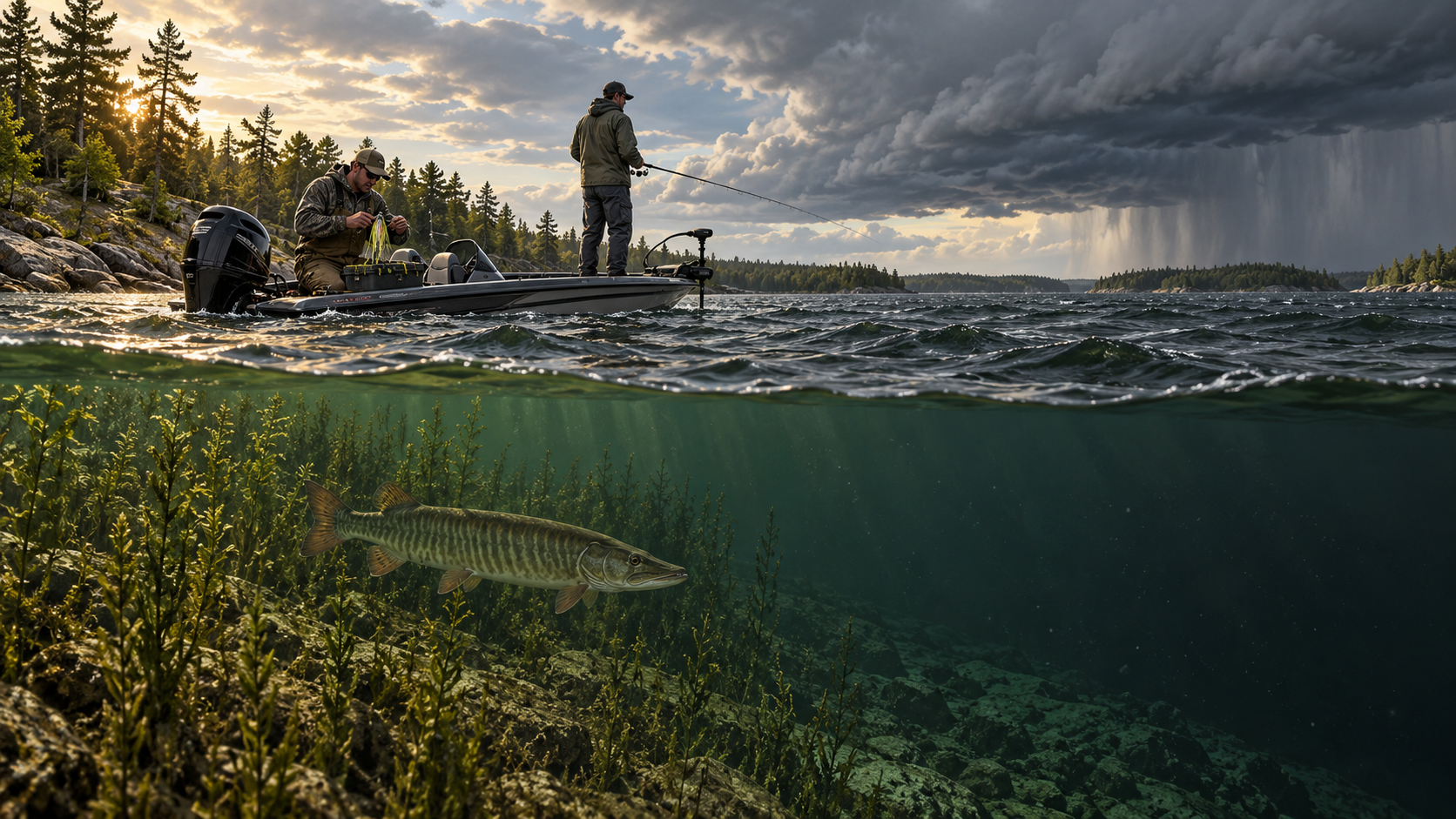
The front arrives as a package
A barometer gives one number, which makes it easy to remember. A front does not arrive as one number. The National Weather Service describes a front as a boundary between air masses with different temperature, wind, and moisture properties. Cloud, precipitation, wave action, light, and safety can change with it.
That matters because a musky angler never fishes atmospheric pressure by itself. The boat fishes a lake whose light, surface motion, temperature trend, prey position, and human traffic may all be changing at once. A pressure drop can mark the event without explaining which part of the event altered a fish's vulnerability.
The useful question is not whether the barometer is good. It is which parts of today's weather bundle are different, where those differences meet fishable habitat, and whether the next pass can isolate any of them.
Escanaba Lake tested the folklore
Wisconsin researchers examined open-water angling records from Escanaba Lake for 2003 through 2015. The analysis included angler choices, fishing effort, fish-population exposure, light, air temperature, wind, precipitation, lunar variables, and daily barometric-pressure trend. It documented 505 successful muskellunge trips during the study period.
Several environmental variables mattered, but the pattern did not support a simple storm switch. Muskellunge vulnerability was associated with light, air temperature, wind speed, and wind direction. Yet large changes in barometric pressure and precipitation were not highly weighted in the analyses, and catch rates on successful trips were higher on calmer days.
That result does not prove pressure is irrelevant everywhere. It shows that one long Northwoods record did not behave like the cleanest version of the fishing proverb. The study's environmental effects were very small, and the authors called for more work on interactions among variables.
Weather changes the angler too
The strongest lesson from the Escanaba analysis may be human. Trip-specific angler variables tended to carry more weight than the environmental variables. Knowledge of the water, lure or bait choice, fishing effort, and the proportion of the population already exposed to angling all helped shape results.
Wind is a good example of the problem. It can change wave action, turbidity, prey movement, boat position, casting accuracy, and the places an angler is willing or able to fish. The study did not record the anglers' exact fishing locations, so it could not separate a change in musky behavior from a change in human behavior.
A weather log that records only pressure and catches misses half the experiment. It should also record where the boat could be held, whether casts reached the intended lane, how much time was actually fished, and whether the angler abandoned or favored certain water because of the conditions.
Build a fingerprint, not a favorite number
Describe each weather window with a small fingerprint. Record pressure trend and rate of change, wind speed and direction, cloud or measured solar condition, precipitation, air temperature, surface-water temperature when verified, and the time relative to the front. Then attach the fishing variables: exact route, depth band, lure family, retrieve class, effort, and contact type.
The fingerprint does not need to predict a bite before it becomes useful. It can explain whether two trips were truly comparable. A falling barometer with calm water and low light is a different test from a falling barometer with a hard crosswind, dirty water, and a boat that cannot hold the edge.
Use unknown when a value was not measured. A blank field is more honest than a remembered estimate and more valuable than a number borrowed from a distant station without a timestamp.
Let the lake translate the weather
Weather should change the first question, not erase the map. Increasing wind may raise the value of a protected casting angle or a wind-facing feature where the boat remains controllable. Lower light may justify testing a fish farther from cover. A sharp cooling trend may make a shorter, slower pass through the best contact zone more informative than another mile of searching.
None of those adjustments is automatic. If the windward water is empty, the weeds are deteriorating, forage remains offshore, or the lure cannot be controlled, leave the story and follow the evidence. The same front can create different useful water on two lakes because clarity, depth, basin shape, vegetation, and prey differ.
The goal is not to match a lure color to a weather icon. It is to preserve lure control and put a distinct presentation through a place where the changing conditions have a plausible way to alter encounter or strike opportunity.
The matched-window test
Choose three to five compact routes that can be fished safely in more than one weather state. When a front is approaching, give each route a fixed number of casts or minutes before the main change, during the safe portion of the change, and after it passes. Keep the lure family, depth class, and route as consistent as conditions allow.
Record follows, strikes, catches, blank passes, boat-control failures, prey observations, and the exact segment where each contact occurred. Rotate route order across future fronts so the same spot does not always receive the strongest light window or the freshest angler.
The theory gains confidence if a repeatable combination of pressure trend, wind, light, temperature, and route state produces more contacts per unit effort across multiple events. It loses confidence if pressure alone performs just as well, if location explains the contacts better, or if the apparent signal disappears when blank effort and angler behavior are included.
What can break the weather pattern
One lake's long-term creel record cannot establish a universal musky response. Escanaba Lake has controlled fishing hours, its own fish population and habitat, and a specific angling culture. Its models did not test every interaction among wind, light, temperature, precipitation, pressure, season, and angler behavior.
A weather signal can also be overwhelmed by prey position, water temperature, dissolved oxygen, vegetation condition, current, boat traffic, fish density, previous angling exposure, or individual fish behavior. A contact during a pressure drop may still have happened because the lure finally crossed the correct depth at the correct angle.
No source used here supplies a universal pressure threshold, ideal rate of change, wind direction, cloud percentage, or post-front waiting period. Any such number should remain a local hypothesis until repeated effort supports it.
The safest pattern is the only one worth keeping
A matched weather experiment ends when lightning, dangerous wind, poor visibility, cold exposure, or unsafe boat control begins. The National Weather Service advises boaters to get to land as quickly as possible when thunderstorms threaten.
Do not fish through the dangerous part of a front to protect a data point. Mark the interrupted pass, leave the water, and treat safety as part of the record. A useful pattern can be tested again. A bad decision cannot always be taken back.
The durable weather rule is simple: read the whole bundle, keep the lake and the angler in the model, compare equal effort, and let repeated contacts decide which signals deserve weight.